
Digital Tools vs. Paper Planning: How Travellers Build Itineraries Today
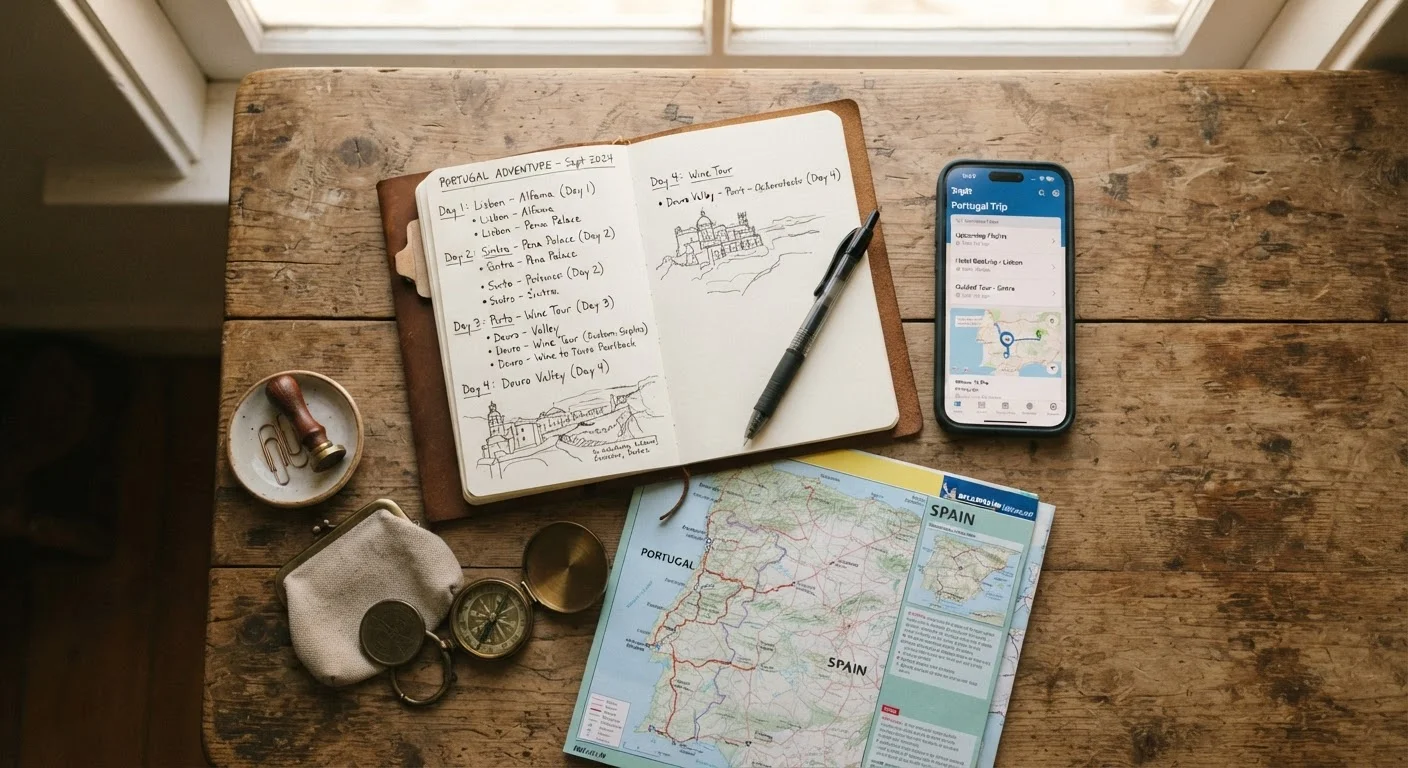
Photo credit: ExploreRoute.net | Travel Made Simple
In this article
Apps, spreadsheets, notebooks, and printed guides all serve different planners. Compare the practical strengths and limits of each approach.
Key Takeaways
- Digital tools excel at real-time updates, collaboration, and storing confirmations in one place.
- Paper planning supports deeper thinking, acts as a reliable offline backup, and suits low-connectivity destinations.
- Hybrid approaches — digital for logistics, paper for daily flow — work well for most trip types.
- Your planning style should match your travel personality, not just popular convention.
- Neither approach guarantees a better trip; execution and flexibility matter more than format.
Why Your Planning Format Affects More Than Just Organization
How you build an itinerary shapes how you experience a trip — not just in practical terms, but in how you engage with decisions before and during travel. A digital spreadsheet loaded with hyperlinks behaves very differently from a handwritten notebook, even if both contain the same flight times and museum hours. The format influences how much you retain, how quickly you can adapt, and how much cognitive load you carry through each travel day.
For experienced travelers hunting destinations beyond the obvious, the planning stage is also a research stage. Trip research quality often determines whether you surface genuinely interesting local experiences or default to the same tourist circuit everyone else follows. The tool you use affects how deeply you explore. See the core components of a well-built itinerary to understand what any planning format should ultimately produce.
Digital Planning Tools: Strengths and Real Limitations
Apps, cloud documents, and dedicated trip-planning platforms share several structural advantages. They centralize booking confirmations, allow real-time edits accessible across devices, and make sharing itineraries with travel companions or family at home straightforward. Collaborative tools let multiple people contribute to a shared schedule without version confusion — an important factor when planning a group trip versus a solo journey.
Digital mapping layers add research depth that paper cannot replicate. Digital maps contain destination insight most travelers never tap into — satellite imagery, local business hours, and user-submitted photos can all inform itinerary decisions before you leave home.
The limitations are equally real. App ecosystems fragment: your flight confirmations sit in email, accommodation in one app, saved restaurants in another. Stitching these together requires deliberate effort. Connectivity failures at critical moments — border crossings, rural transfers, international roaming gaps — can render a fully digital itinerary temporarily inaccessible. Battery dependency is an underrated risk on long travel days.
| Digital Tools | Paper Planning | |
|---|---|---|
| Connectivity requirement | Requires power and often signal | None — works anywhere |
| Real-time updates | Instant edits, synced across devices | Manual rewrite required |
| Collaboration | Easy sharing with groups | Requires copying or photographing |
| Information storage | PDFs, confirmations, photos in one place | Limited to what you write or print |
| Cognitive engagement | Fast input, easy to over-schedule | Deliberate; makes density visible |
| Reliability on the road | Battery and signal dependent | Always available, no failure mode |
| Flexibility for changes | High — quick edits and alternatives | Low — changes require rewriting |
| Best for trip type | Multi-destination, group, complex logistics | Remote, off-grid, or reflective travel |
Paper Planning: Where Analog Still Holds Ground
Handwritten itineraries and printed guides offer something digital formats structurally cannot: zero dependency on power, signal, or platform availability. A printed day-plan works identically in an airport lounge and on a mountain trail with no cell service. For destinations where connectivity is genuinely unreliable, paper isn't nostalgic — it's functional infrastructure.
Research also suggests that writing by hand reinforces memory encoding differently than typing. Travelers who draft their itineraries on paper often report stronger recall of their plans and a more deliberate approach to scheduling — they're less likely to over-pack a day because writing it all out makes the density visible. This aligns with advice in choosing between fixed plans and loose frameworks: the format you use to plan shapes the rigidity or flexibility of the result.
Print Local Addresses in the Local Script
When traveling to destinations where the local language uses a non-Latin script, print your key addresses — hotel, airport, key attractions — in that script alongside a transliteration. Showing a driver or local a correctly formatted address eliminates communication friction that no translation app can fully replace in a hurried moment.
Paper's weaknesses are equally clear. A handwritten schedule cannot update itself when a train is delayed or a site closes unexpectedly. It can't store a PDF of your hotel booking or share your location with a waiting transfer driver. Changes require crossing out and rewriting, which becomes unwieldy on longer trips with many moving parts.
Building a Hybrid Approach That Actually Works
Most seasoned travelers land on a hybrid model through experience rather than conscious design. The practical version: use digital tools for the infrastructure layer (confirmations, reservations, transportation details, shared access) and paper or printed summaries for the daily-use layer (what you're doing today, which neighborhood you're in, key addresses in local script).
Experienced travelers build adaptability into their itineraries rather than treating the plan as fixed. A hybrid format supports this well: digital tools allow quick replanning when circumstances change, while a printed daily outline keeps you oriented without requiring constant screen time. For cruise itineraries, where port schedules and onboard programming generate significant paperwork, a printed summary of key port times alongside a digital folder of excursion confirmations is a common practical solution.
Building any itinerary end-to-end benefits from applying each format to the stage it suits best: digital during the research and booking phase, a clean printed version for on-the-ground use, and digital again for post-trip notes and future reference.
~70%
Travelers using smartphones as primary planning tool
Multiple travel industry surveys consistently find the large majority of leisure travelers rely on smartphones for trip planning and navigation, though exact figures vary by survey and region.
1 in 3
Travelers who print at least part of their itinerary
Despite digital dominance, a significant share of travelers still print key documents or day-plans as a backup, according to general travel behavior research.

Author
Travel Planning Editorial Team
Travel Planning Editorial Team is the collective byline for our editorial team and contributor network. Articles published under this byline or an editorial pen name are researched, written, and reviewed according to our editorial standards for clarity, consistency, and independence before publication.
View all articles →