
Capsule Hotels, Pods, and Micro-Rooms: Compact Stays Explained
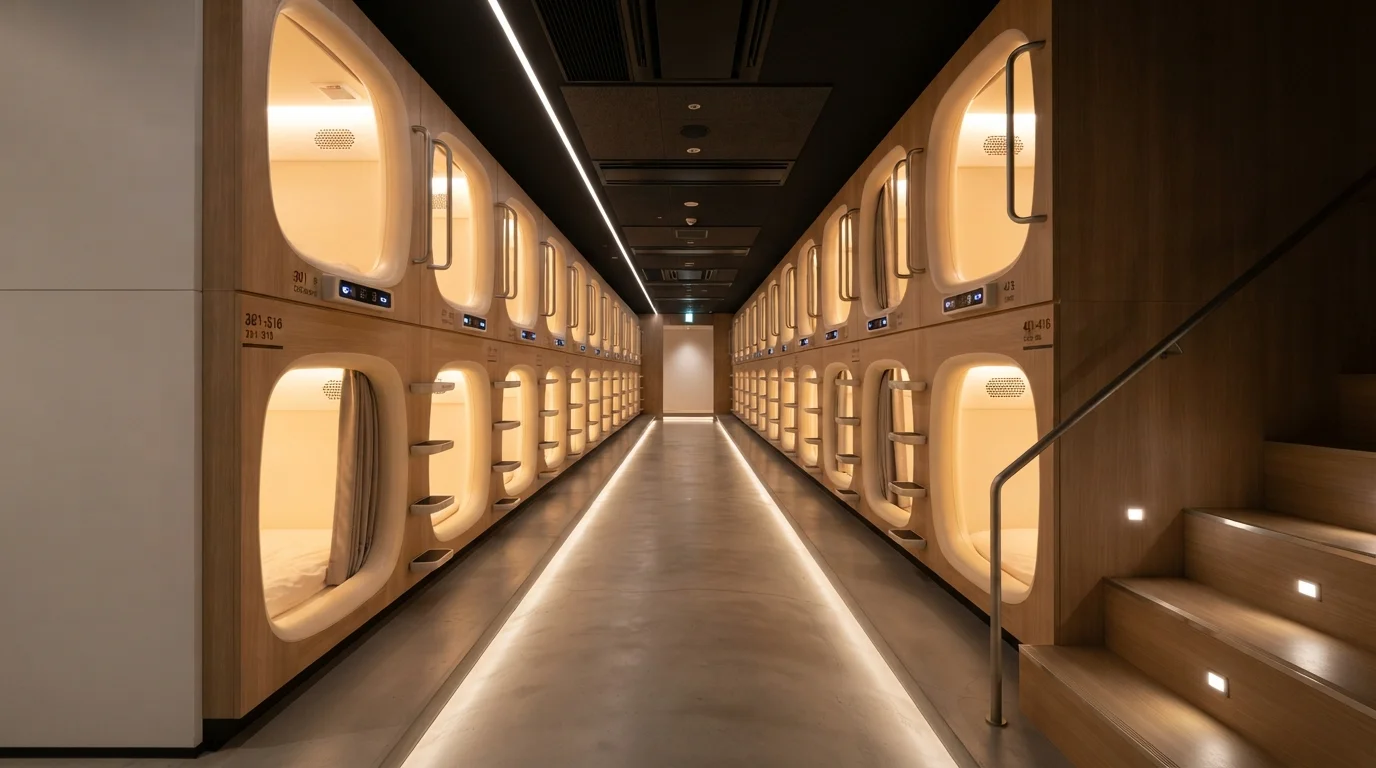
Photo credit: ExploreRoute.net | Travel Made Simple
In this article
Space-efficient hotel formats are spreading beyond Japan. Learn how they work, who they suit, and what to realistically expect.
Key Takeaways
- Capsule and pod hotels trade private square footage for affordability and central locations.
- Most formats share bathrooms, lounges, and storage — personal hygiene expectations are high.
- Modern pod hotels vary enormously in quality, from utilitarian to design-award-winning.
- These stays suit solo travelers best; they are rarely suitable for couples or families.
- Micro-rooms differ from pods by offering a fully private, self-contained space.
- Claustrophobia, light sensitivity, and noise tolerance are worth honestly assessing before booking.
How the Format Actually Works
The core premise of all compact hotel formats is the same: reduce the private footprint, invest in shared or common infrastructure, and pass some of the space-efficiency savings to the guest. In a classic Japanese capsule hotel, guests check in, receive a locker for luggage and valuables, and are assigned a numbered berth — essentially a molded fiberglass or wood-paneled sleeping chamber fitted with a mattress, reading light, power outlet, and sometimes a small screen. Curtains or roll-down shutters provide the only separation from the corridor.
Western pod hotels adapted this concept with more design ambition. Pods are often fully enclosed, with locking doors, USB charging, climate controls, and better acoustic insulation. Communal bathrooms, lounges, and coworking areas replace what a conventional hotel room would contain. The social architecture is intentional: guests are expected to spend time outside their sleeping unit.
Micro-rooms take a different approach. These are fully private rooms — typically in purpose-built urban hotels — that pack a bed, bathroom, and minimal furniture into 100–150 square feet through clever spatial design: wall-mounted desks, under-bed storage, and ceiling-height mirrors that create the illusion of space. They function exactly like a conventional room; the only difference is scale.
Gender-Separated Facilities Are Common
Many capsule hotels — particularly traditional Japanese properties — operate gender-separated floors or sections, with bathrooms and common areas assigned accordingly. Western pod hotels are more likely to be mixed-gender. If this is relevant to your comfort or safety, confirm the property's policy before booking, as listings don't always make this explicit.
Who These Stays Actually Suit
Solo travelers are the natural audience for capsule and pod hotels. The format was designed around single occupancy, and the economics only work at individual scale. Business travelers on tight itineraries who need a clean, quiet berth near a transport hub — and nothing more — find capsule properties genuinely practical. Backpackers who have graduated from dormitory bunks but aren't ready to pay full hotel rates appreciate the middle ground.
Light sleepers, people who require a bathroom at night without navigating a shared corridor, and anyone who relies on morning routines with gear spread across a full room will find the format frustrating rather than freeing. Couples rarely find pod hotels workable beyond novelty. For anything longer than a two-night stay, the absence of personal space compounds quickly.
Micro-rooms, by contrast, work for a broader range — including couples — as long as the trip is active and the room is a place to sleep rather than spend the day. City breaks where museums, restaurants, and neighborhoods fill waking hours are the ideal context. Matching your trip type to the right hotel style explores this logic across a wider range of formats.
Test Your Tolerance Before a Long Trip
If you've never stayed in a capsule or pod hotel, avoid booking one as the foundation of a multi-week itinerary. Book one night in this format at the start or end of a trip, when you have alternatives nearby. This gives you an honest read on whether the format works for you without compromising an entire journey.
The Spectrum of Quality and Experience
Lumping all capsule and pod hotels together is a mistake. At one end sits the utilitarian airport capsule — functional, brightly lit, acoustically challenging, and priced as infrastructure rather than experience. At the other end, a growing number of design-focused pod hotels have received architectural awards and press attention for their spatial ingenuity: bespoke joinery, curated art, specialty coffee bars, and soundproofed pods with premium mattresses.
The differentiators worth scrutinizing before booking: pod enclosure type (curtain versus hard-sided door), bathroom-to-guest ratio, locker security, and whether the property separates genders or is mixed. Noise is the most common complaint across reviews, so floor-level placement of a pod — lower units are often quieter than those near communal areas — and the building's overall construction quality matter considerably.
~14 sq ft
Typical floor area of a traditional capsule unit
The standard capsule berth — as established in Japanese hotel design — measures roughly 6.5 feet long by 3.3 feet wide, providing just enough room for a single sleeper.
100–150 sq ft
Typical size range for urban micro-rooms
Micro-rooms in purpose-built urban hotels occupy roughly one-third to one-half the space of a standard U.S. hotel room, which averages around 325 square feet.
Late 1970s
Era when capsule hotels originated
The capsule hotel format is generally traced to Osaka, Japan, where the concept was developed as a practical solution for commuters and business travelers needing an overnight option near city centers.
For travelers drawn to the experiential end of the lodging spectrum, compact hotels occupy an interesting position between the ultra-practical and the genuinely distinctive. They share philosophical territory with other unconventional formats explored in our field guide to unconventional stays, though the design intent is urban efficiency rather than immersion in nature.
What to Realistically Expect on Arrival
First-timers are frequently surprised by how small the sleeping unit feels in person compared to photos. Reputable properties photograph pods at their most generous angle — in reality, sitting up fully may not be possible in traditional capsule formats. Arrive knowing your pod number, locate your assigned locker immediately, and consolidate what you need for the night into a small bag before stowing luggage.
Shared bathrooms in well-run properties are cleaned frequently and managed systematically — peak times are early morning, so adjust your schedule if you value a calm shower experience. Noise from corridors, neighboring pods, and building HVAC systems is a near-universal feature; foam earplugs and a sleep mask are practical additions to pack.
For those weighing compact hotel formats against extended stays or apartment-style lodging, our comparison of extended-stay hotels and aparthotels clarifies where each format serves travelers best. And for travelers exploring the full range of what non-conventional lodging offers, the complete guide to unique stays is the broader starting point.
“The best small rooms don't feel small — they feel edited. Every element has been considered, and nothing superfluous remains. That discipline is what separates a genuinely good micro-hotel from one that's simply cramped.”
— Liz Murison, Hospitality design commentator and travel writer
Frequently Asked Questions

Author
Where to Stay Editorial Team
Where to Stay Editorial Team is the collective byline for our editorial team and contributor network. Articles published under this byline or an editorial pen name are researched, written, and reviewed according to our editorial standards for clarity, consistency, and independence before publication.
View all articles →