
A First-Timer's Orientation to Reading a Cruise Itinerary
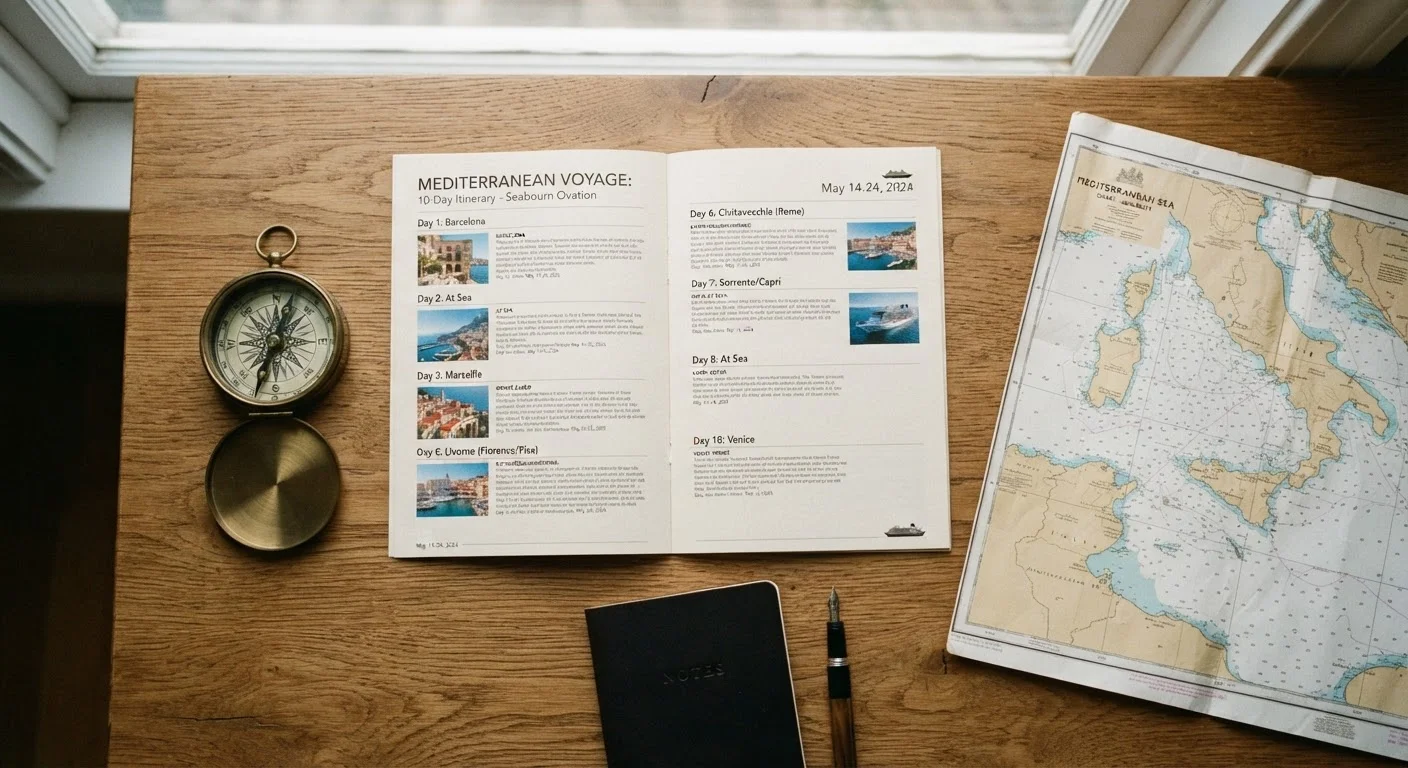
Photo credit: ExploreRoute.net | Travel Made Simple
In this article
Port days, sea days, tendering, embarkation — learn what every term on a cruise itinerary actually means before you sail.
Key Takeaways
- A cruise itinerary lists ports, dates, arrival times, departure times, and sea days in sequence.
- Sea days are full days at sea with no port stop; port days include scheduled time ashore.
- Embarkation and debarkation refer to boarding and leaving the ship, usually at the homeport.
- Tender ports require a small boat transfer between ship and shore - not all ports use a dock.
- Arrival and departure times on an itinerary are in local port time, which may differ from ship time.
- The itinerary sets the skeleton of your trip; shore excursion planning builds on top of it.
What a Cruise Itinerary Actually Shows You
A cruise itinerary is more than a list of destinations - it is the operating blueprint for your entire voyage. At its most basic, it shows you the sequence of ports the ship will visit, the calendar date for each stop, and the scheduled arrival and departure times at each location. Between those stops, you'll see sea days: days when the ship is underway and no port call is planned.
Most itineraries are presented as a day-by-day table. Each row represents one calendar day and typically includes the day number, the destination name (or "At Sea"), and the times the ship arrives and departs. Some itineraries also flag whether a port is a tender port - meaning passengers transfer ashore by small boat rather than walking directly off the ship onto a dock.
For a deeper look at how this skeleton of information becomes a full trip plan, see our step-by-step itinerary walkthrough for first-timers. And for a handy reference of every term you might encounter on a booking document, the cruise itinerary terms glossary is a useful companion to this guide.
Port Days vs. Sea Days: The Core Rhythm of Any Voyage
The balance between port days and sea days shapes the entire character of a cruise. A seven-night Caribbean itinerary might include five port days and two sea days; a transatlantic crossing might flip that ratio entirely. Neither pattern is better - they suit different travelers.
On a port day, the ship docks or anchors at a destination for a defined window of time. You can join an organized shore excursion, explore independently, or stay aboard. Shore time typically runs anywhere from four to ten hours, depending on the port and the itinerary.
On a sea day, the ship is in transit. There are no stops, but the ship itself becomes the destination - with programming, dining, pools, and activities running throughout the day. Many experienced cruisers actively seek itineraries with several sea days built in for exactly this reason.
Balance Port and Sea Days Before You Book
The ratio of port days to sea days is one of the most important itinerary factors to consider when booking. If you want maximum exploration time ashore, look for itineraries where port days outnumber sea days. If rest and onboard experience matter equally, a more balanced schedule may suit you better.
The ratio of port days to sea days is one of the most important itinerary factors to consider when booking. If you want maximum exploration time ashore, look for itineraries where port days outnumber sea days. If rest and onboard experience matter equally, a more balanced schedule may suit you better.
Key Terms Every First-Timer Needs to Know
Embarkation
The process of boarding the cruise ship at the start of your voyage, typically at the homeport on Day 1.
Debarkation
The process of leaving the ship at the end of the voyage, also known as disembarkation. Usually occurs at the homeport on the final day.
Homeport
The port city where a cruise originates and (on round-trip voyages) ends. This is where passengers board and depart the ship.
Tender Port
A port where the ship anchors offshore and passengers travel to the dock by a small vessel called a tender, rather than walking directly off the ship.
Sea Day
A day during the voyage when the ship is traveling between ports and makes no scheduled stop. Passengers remain aboard and enjoy onboard amenities.
All-Aboard Time
The deadline by which all passengers must return to the ship before it departs a port. Missing this time means the ship may leave without you.
Port Day
A day when the ship is docked or anchored at a destination, giving passengers a defined window of time to go ashore.
One-Way Itinerary
A cruise route that starts and ends at different ports, requiring passengers to arrange their own travel from the debarkation city back home or onward.
Beyond the basic structure, a few specific terms appear consistently across itineraries and booking documents. Understanding them before you sail prevents confusion on embarkation day and helps you plan shore time more accurately.
The homeport (sometimes called the turnaround port) is where the cruise begins and ends - where you board at the start and disembark at the finish. Embarkation is the act of boarding; debarkation (or disembarkation) is leaving the ship at the end of the voyage. Both events happen at the homeport on most itineraries, though some voyages are one-way, with different start and end ports.
A tender port requires a short boat transfer from ship to shore because the water depth or harbor configuration prevents the ship from docking directly. This adds a step to going ashore and can affect timing. For a full explanation of what this process looks like in practice, our guide on what a tender port means and how to prepare covers it in detail.
How to Read Arrival and Departure Times
The arrival and departure times printed on your itinerary tell you the window during which the ship will be in port. Your usable shore time falls within that window - not equal to it. In practice, passengers typically begin going ashore thirty to sixty minutes after the ship officially arrives, and you need to be back aboard before the all-aboard time, which is usually thirty minutes before the listed departure.
Ship Time vs. Local Port Time
One detail that trips up many first-timers: itinerary times for ports are almost always expressed in local port time, while the daily schedule posted inside the ship uses ship time. These can differ - sometimes by an hour - when a ship crosses a time zone during the voyage. Always check the ship's daily program each morning to confirm the all-aboard time in ship time, since that is what the crew enforces.
One detail that trips up many first-timers: itinerary times for ports are almost always expressed in local port time, while the daily schedule posted inside the ship uses ship time. These can differ - sometimes by an hour - when a ship crosses a time zone during the voyage. Always check the ship's daily program each morning to confirm the all-aboard time in ship time, since that is what the crew enforces.
Matching the Itinerary to Your Travel Style
Once you can read a cruise itinerary fluently, the next step is evaluating whether a specific route fits how you like to travel. A traveler who wants deep cultural immersion in every port will read the same itinerary very differently than someone who prioritizes nature, beach days, or simply unwinding at sea.
Look at the sequence of ports, not just the names. Back-to-back port days with short windows at each stop can feel rushed; a single longer port day at a complex destination like Dubrovnik or Cartagena may be more satisfying than three quick stops. Also consider the geographic spread - itineraries that loop tightly around a region typically allow earlier arrivals and later departures than those covering vast distances.
For a structured framework to match itineraries to your personal travel preferences, see choosing a cruise itinerary that matches your travel style. And if you've never ventured beyond a cruise terminal before, port towns as destinations in their own right offers a grounded orientation to what awaits ashore.
Frequently Asked Questions

Author
Cruise Journeys Editorial Team
Cruise Journeys Editorial Team is the collective byline for our editorial team and contributor network. Articles published under this byline or an editorial pen name are researched, written, and reviewed according to our editorial standards for clarity, consistency, and independence before publication.
View all articles →