
Inside the Difference Between Ocean and River Cruise Itineraries
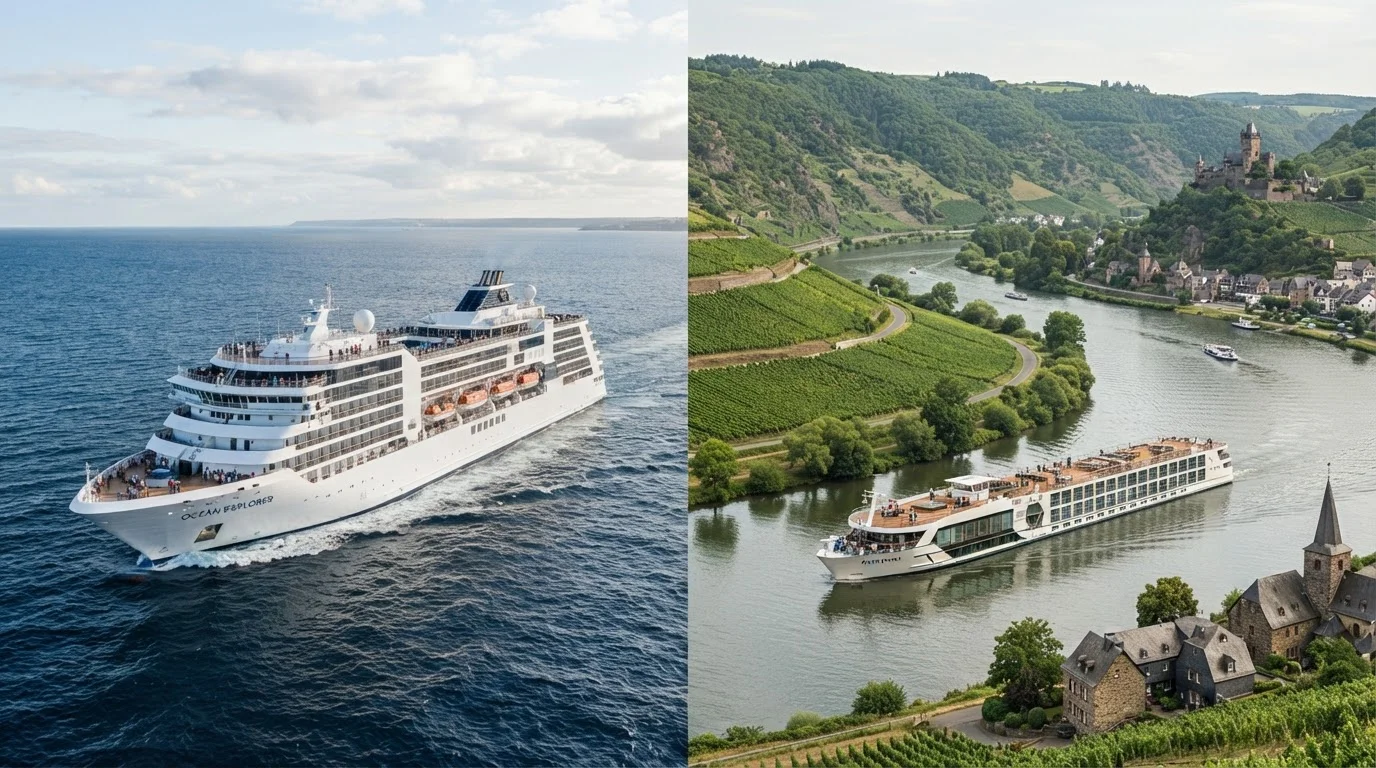
Photo credit: ExploreRoute.net | Travel Made Simple
In this article
Ocean and river cruises offer fundamentally different experiences. Explore how their routes, port styles, ship sizes, and pacing compare.
Key Takeaways
- Ocean cruises cover multiple countries and longer distances; river cruises move through a single region at a slower pace.
- River ships dock in town centers, while ocean ships anchor at purpose-built cruise terminals often outside the city.
- Ship size is the starkest difference: ocean vessels carry thousands of passengers; river ships rarely exceed 200.
- Ocean itineraries typically include more sea days; river itineraries offer a port or landmark almost every day.
- Both formats suit different travel personalities - the right choice depends heavily on how you prefer to spend shore time.
How the Routes Are Built
The fundamental design logic of ocean and river itineraries diverges from the very first planning decision: where can the ship physically go?
Ocean cruise routes are shaped by open-water geography and homeport logistics. A typical Mediterranean sailing might depart Barcelona, call in Marseille, Civitavecchia (Rome's port), Naples, and Dubrovnik before returning - covering roughly 1,500 nautical miles in seven nights. Sea days are built in not as filler but as structural necessity. For a more specialized take on extreme open-water itineraries, our piece on transatlantic crossings illustrates how distance alone becomes the journey's character.
River routes, by contrast, are constrained by waterway depth, bridge clearance, and the physical layout of European rivers, Southeast Asian deltas, or American waterways. The Danube between Passau and Budapest, for example, is roughly 370 kilometers - traversable in eight to ten nights with a stop nearly every day. There are no sea days because there is no open water; every morning brings a new dock.
| Criterion | Ocean Cruise | River Cruise |
|---|---|---|
| Ship capacity | 500-6,500+ passengers | Typically 100-200 passengers |
| Geographic range | Multiple countries, open seas | Single river corridor or region |
| Port access | Commercial terminals, often remote | Town-center docking, walkable |
| Sea days | Common; built into itinerary | None; waterway only |
| Onboard amenities | Extensive: pools, theaters, spas | Minimal: lounge, single dining room |
| Typical voyage length | 7-14+ nights | 7-14 nights |
| Itinerary flexibility | Wide; many route options globally | Limited to navigable waterways |
Port Access and Shore Experience
Where a ship docks reshapes the entire shore experience. This difference is consequential enough to drive itinerary selection on its own.
Ocean ships are large and require deep-water ports or tender service. That means passengers often arrive at commercial terminals - sometimes several miles from a city's historic core. In Civitavecchia, the dock is roughly 80 kilometers from central Rome. In Livorno, it's an hour's drive to Florence. Shore time is real but compressed, and getting somewhere meaningful requires planning. Our Ports & Shore Life hub covers strategies for maximizing limited time in busy port cities.
River ships are dimensionally modest - typically 135 meters long and 11 meters wide on European waterways - which allows them to moor directly in town. In Regensburg, Cologne, or Arles, the gangway lands you steps from the old town. The psychological effect is significant: you feel embedded in a place rather than bused to it. Excursions still exist, but independent exploration is genuinely walkable.
~135m
Maximum length of most European river ships
European river lock and bridge infrastructure constrains ship dimensions, effectively standardizing the vessel category across the continent.
1 in 3
US cruise passengers who have taken a river cruise
Industry surveys from CLIA (Cruise Lines International Association) have consistently shown growing river cruise uptake among experienced ocean cruisers.
For travelers weighing how regional differences play out at a port level, our comparison of Baltic vs. Norwegian fjord shore experiences demonstrates how port style shapes an entire voyage's rhythm - a dynamic that applies equally here.
Pacing, Onboard Life, and Who Each Style Suits
Pacing is where traveler personality enters the equation most directly.
Ocean cruises balance port days with sea days, and the ship itself functions as a destination. Sprawling vessels - some exceeding 5,000 passengers - offer entertainment venues, multiple pools, specialty restaurants, and enrichment lectures. For travelers who value downtime between ports, or who travel with companions who want onboard activity options, an ocean ship provides genuine flexibility. Cabin choice matters more on ocean ships precisely because you spend meaningful time in it.
River cruises are port-forward - most itineraries schedule a dock or a scenic sailing almost every day. Onboard amenities are deliberately scaled: a single dining room, a lounge, perhaps a small sundeck. The social dynamic is closer to a country house party than a resort. This suits travelers who find large ships overwhelming, or who consider onboard time secondary to shore experience.
Neither format is inherently superior. The right question is whether you want the ship to be part of the experience or primarily a moving hotel. If you're still working out your broader itinerary philosophy, our guide to matching a cruise itinerary to your travel style offers a practical framework for that decision - and it applies equally to ocean and river contexts.
Seasonality Matters More on Rivers
River water levels are subject to seasonal variation - drought conditions in late summer can strand ships in shallow stretches, while spring snowmelt can cause high-water closures. Ocean itineraries face weather disruptions too, but their routing flexibility is considerably greater. Travelers considering river cruises should research typical water-level patterns for their chosen waterway and season before committing to an itinerary.

Author
Cruise Journeys Editorial Team
Cruise Journeys Editorial Team is the collective byline for our editorial team and contributor network. Articles published under this byline or an editorial pen name are researched, written, and reviewed according to our editorial standards for clarity, consistency, and independence before publication.
View all articles →