
Baltics vs. Norwegian Fjords: Two Iconic Cruise Regions, Two Very Different Shore Experiences
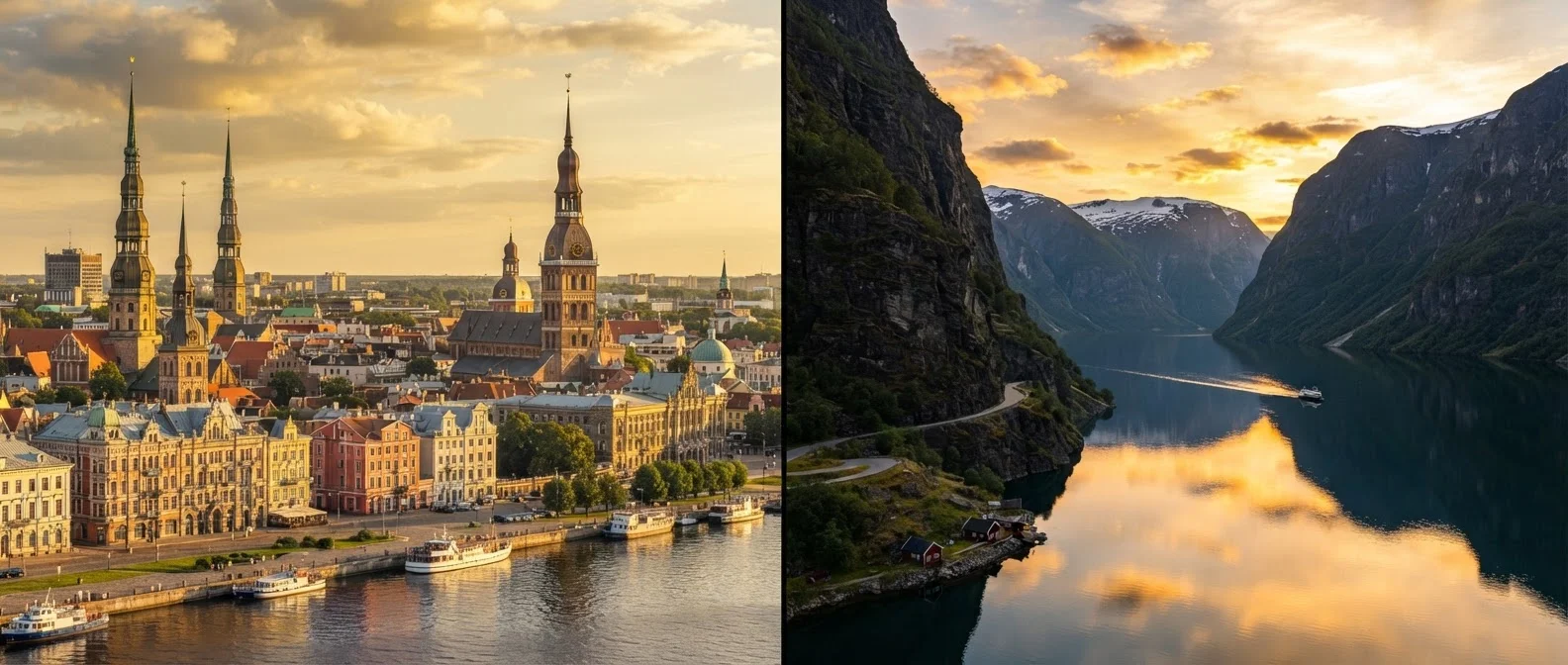
Photo credit: ExploreRoute.net | Travel Made Simple
In this article
Historic city ports or dramatic natural landscapes? Understand what sets Baltic and Norwegian fjord cruising apart when you're ashore.
Key Takeaways
- Baltic ports are predominantly major cities with rich imperial and medieval histories requiring strategic time management ashore.
- Norwegian fjord ports are smaller and nature-oriented, offering easier independent exploration and direct access to landscapes.
- Shore time in the Baltics often means choosing between one or two anchor sights; fjord ports allow unhurried immersion.
- Both regions are seasonal — peak sailings run from May through September — but crowd patterns differ significantly.
- Your ideal region depends on whether you prioritize cultural depth or natural grandeur when you step off the ship.
What Defines Each Region as a Shore Experience
When cruisers weigh a Baltic sailing against a Norwegian fjords itinerary, the instinct is often to compare destinations. The more revealing comparison is the type of time each region demands ashore. These two European cruise circuits are structured around fundamentally different relationships between ship, pier, and landscape — and understanding that distinction is what separates a well-spent port day from a frustrating one.
Baltic itineraries are organized around major metropolitan ports. Stockholm, Helsinki, Tallinn, Copenhagen, Gdańsk, and Riga are full cities with sprawling historic cores, often more than a mile from the cruise terminal. Shore time frequently runs eight to ten hours, and that sounds generous until you factor in transit each way and the sheer density of what each city contains. Prioritization is not optional — it is the skill the Baltic demands.
Norwegian fjord itineraries work on a different logic entirely. Ports like Flåm, Geiranger, Ålesund, and Eidfjord are modest in scale. The scenery is the destination, and it begins the moment the ship enters the fjord. Many fjord stops are tendering ports — passengers are ferried ashore by small boat — and the villages themselves can be walked end-to-end in under an hour. Shore time is often shorter, but the experience is more immediately immersive.
| Criterion | Baltic Cruise Region | Norwegian Fjords |
|---|---|---|
| Port character | Major metropolitan cities | Small villages and natural sites |
| Primary draw ashore | History, culture, architecture | Scenic landscapes, outdoor activity |
| Typical shore time | 8–10 hours | 4–8 hours |
| Independent navigation | Requires planning and transit | Walkable from pier in most ports |
| Crowd intensity | High at peak historic sites | Concentrated at top fjord stops |
| Cultural variety per voyage | Spans multiple countries and traditions | Single national identity, varied terrain |
| Weather dependence | Moderate — cities function in any weather | Higher — visibility affects the experience |
| Best sailing season | May–September | May–September |
For context on how itinerary structure shapes the whole voyage — not just individual ports — see our guide to choosing a cruise itinerary that matches your travel style.
Maximizing Shore Time in Baltic Ports
The Baltic's greatest challenge is also its reward: each city is a self-contained cultural capital with competing claims on your attention. In Tallinn, the UNESCO-listed Old Town is extraordinarily well-preserved medieval architecture, but it fills with tour groups by mid-morning. An early departure from the ship — ideally in the first tender or gangway wave — puts you in the upper town before the crowds arrive. In Stockholm, the Vasa Museum and Gamla Stan (Old Town) are logical anchors, but they are on opposite sides of the water, making sequencing critical.
St. Petersburg has historically been the most logistically complex Baltic port, requiring visa documentation for independent travelers and demanding careful advance planning. Conditions and entry requirements change, so travelers should verify current rules with official government sources before sailing.
5+
Countries typically visited on a Baltic circuit
A standard 10–12 night Baltic itinerary commonly touches ports in Sweden, Finland, Estonia, Germany or Poland, and Denmark.
~1,190 km
Total length of Norway's mapped fjord coastline
Norway's fjords form one of the longest and most geologically complex coastlines in the world, according to Norwegian geographic surveys.
418
Steps to Ålesund's Aksla viewpoint
The staircase from the town center to the Aksla hilltop panorama is a defining independent shore excursion in this Art Nouveau fjord city.
The practical takeaway for Baltic planning: choose one to two anchor experiences per port and walk away from the rest. Trying to cover a full city in eight hours produces surface-level impressions of everything and meaningful engagement with nothing. The Baltic rewards disciplined focus over ambitious lists.
Travelers drawn to lesser-known urban stops alongside the headline cities may find our piece on where fewer tourists actually go a useful frame for thinking about the quieter ports in a Baltic circuit.
Making the Most of Fjord Ports
Norwegian fjord ports invert the Baltic's challenge. The landscape is so visually commanding that the temptation is simply to stand and look — and while that is never wasted time, the most memorable fjord shore experiences involve moving through the terrain rather than observing it from a distance.
Flåm, one of the most visited fjord stops, offers the historic Flåm Railway (Flåmsbana), a narrow-gauge mountain railway considered one of the steepest standard-gauge lines in the world. The round trip takes roughly two hours, passing waterfalls and mountain farms, and is a genuinely efficient use of limited shore time. Geiranger, a UNESCO-listed fjord village, is smaller still, with hiking trails above the village providing panoramic views that no excursion bus can replicate.
Ålesund offers a different fjord port character — an Art Nouveau town rebuilt after a 1904 fire, with a coherent architectural identity and a hilltop panorama accessible by 418 steps from the town center. It rewards independent walkers more than organized tours.
Fjord Port Weather: Plan for Variability
Norwegian fjord ports sit within a maritime climate where conditions can shift quickly, even in summer. Rainfall is distributed fairly evenly across months, and morning mist in the fjords — while atmospheric — can limit visibility on hikes and scenic viewpoints. Checking local forecasts and having a flexible shore plan is advisable. Layered, waterproof clothing is generally more useful than a single heavy jacket.
Weather is the variable that fjord itineraries depend on in ways that Baltic city visits do not. Overcast fjords are still spectacular; fog can occasionally obscure peaks. Layered clothing and flexibility in shore plans are more important here than in Baltic city ports. Shoulder-season sailings in May and early September tend to offer clearer skies and noticeably fewer crowds at the most visited stops.
If the appeal of dramatic coastal geography extends beyond Europe, our comparison of Alaska cruise ports and what each stop offers covers a similarly nature-led shore experience in a very different hemisphere.

Author
Cruise Journeys Editorial Team
Cruise Journeys Editorial Team is the collective byline for our editorial team and contributor network. Articles published under this byline or an editorial pen name are researched, written, and reviewed according to our editorial standards for clarity, consistency, and independence before publication.
View all articles →