
Making the Most of Sea Days When You're Not a Pool Person
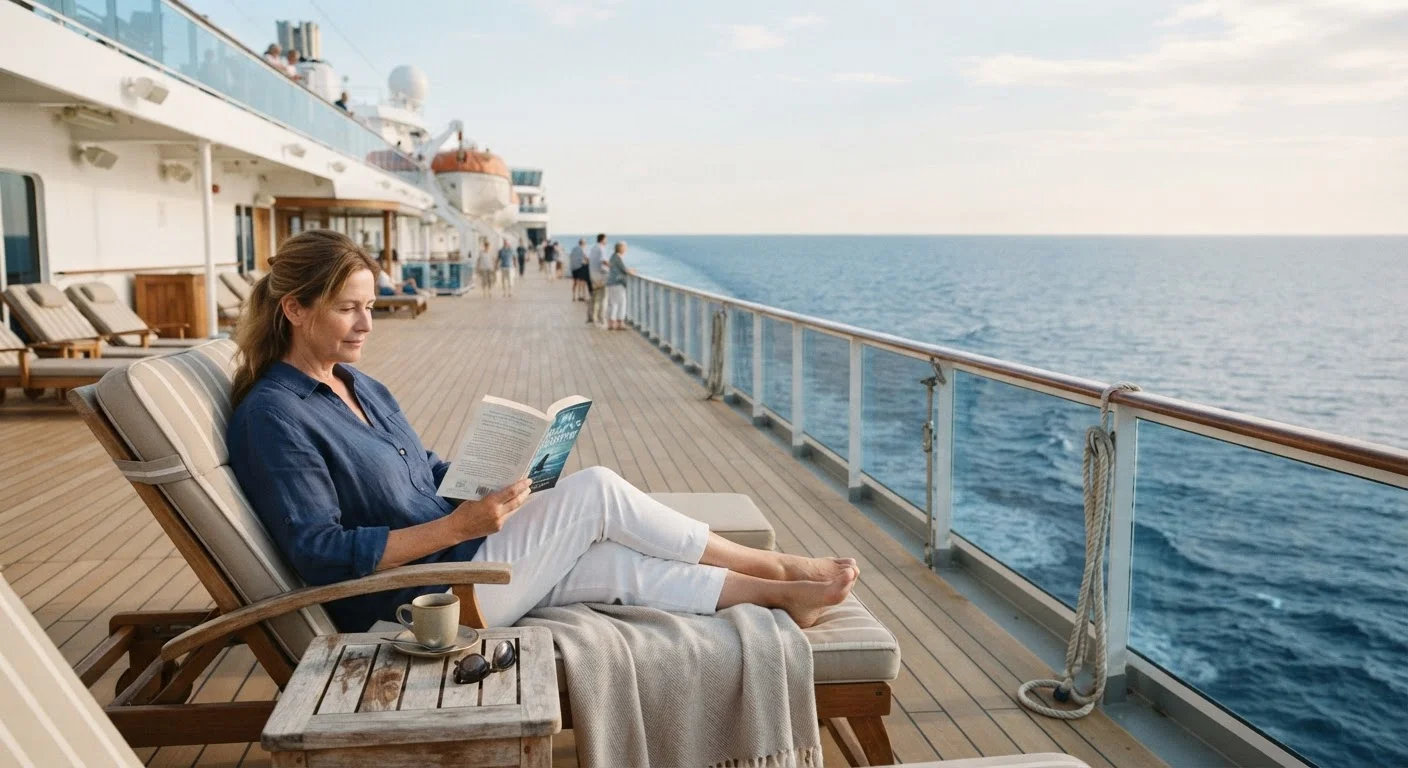
Photo credit: ExploreRoute.net | Travel Made Simple
In this article
From enrichment lectures to quiet deck corners, discover how cruisers with varied interests fill sea days meaningfully.
Key Takeaways
- Sea days are not wasted time — they offer some of the richest onboard experiences available.
- Most ships run enrichment programs, cooking demos, and lectures that appeal far beyond the pool crowd.
- Identifying quiet deck zones early in the voyage pays dividends across every subsequent sea day.
- A loose personal schedule prevents the aimless drift that makes sea days feel long.
- Connectivity choices on sea days deserve advance planning to avoid unexpected costs.
Why Sea Days Deserve a Different Mindset
A persistent cruise myth holds that sea days are filler — time burned in transit between the 'real' destinations. The reality, as any veteran cruiser will tell you, is almost the opposite. Sea days allow the ship itself to become the destination, and the quality of those hours depends almost entirely on how intentionally you approach them. As we explore in common cruise itinerary misconceptions, the assumption that more ports equals a better trip ignores the restorative and enriching value of time at sea.
For cruisers who aren't drawn to poolside lounging — and there are many — the challenge is knowing where to direct your energy. Ships are floating small cities with galleries, theaters, libraries, lecture halls, fitness centers, and a dozen distinct social atmospheres operating simultaneously. The gap between a sea day that feels purposeful and one that feels aimless is almost always planning, not the ship itself.
Scout Quiet Spots on Day One
The forward observation lounge, the library, and the aft open decks are consistently the least crowded spaces during sea days. Visit these areas on embarkation day before the ship fills up, so you know exactly where to head when you want solitude without competing for a chair.
For a grounded picture of how time flows on a typical ocean voyage, a day-by-day look at life at sea provides useful context before you build your own routine.
What You'll Need Before You Start
Preparing for productive sea days doesn't require much — but a few things make a meaningful difference.
What you will need
Ship's Daily Program
Lists every scheduled activity, lecture, workshop, and event happening that day — your primary planning tool for sea days.
Ship's App or Interactive TV
Most contemporary cruise lines offer a mobile app or cabin TV portal for browsing the daily schedule, reserving activities, and checking dining times.
Noise-Canceling Headphones
Useful for reading or focused work in shared spaces like lounges or libraries where ambient noise is unavoidable.
Offline Reading or Learning Material
E-readers, downloaded podcasts, or offline language apps extend your options when ship Wi-Fi is slow or costly.
If you're still deciding how many sea days suit your travel style, aligning your cruise route with how you actually like to travel is a practical starting point before you book.
Step-by-Step: Building a Sea Day That Works for You
The steps below are designed to be adapted, not followed rigidly. Every ship's schedule differs, and your ideal sea day will depend on your interests — intellectual, creative, physical, or social. Use this framework as a starting scaffold and adjust as you learn the ship's rhythms.
Plan Your Sea Day the Night Before
Daily programs — sometimes called the 'Fun Times' or 'Herald' depending on the line — are typically delivered to your cabin the evening before. Reading it before bed lets you claim limited-seat enrichment sessions, cooking classes, or port talks before they fill up. Arriving at popular activities even ten minutes late can mean standing room only.
Read the Daily Program the Evening Before
Pick up your ship's printed daily program — or open the line's app — the night before each sea day. Scan every time slot and mark anything that genuinely interests you: enrichment lectures, culinary demonstrations, art classes, port-destination talks, or fitness workshops. Highlight a morning anchor activity and one afternoon option to give your day a loose skeleton without over-scheduling.
Claim Your Quiet Space Early
Head to your preferred low-traffic area before 9 a.m. — the forward observation lounge, the library, a sheltered aft deck, or an adults-only terrace if your ship has one. Drop a book or a light layer to hold a chair, then go for breakfast. Staking a spot early avoids the midmorning scramble when pool decks become crowded and noise levels rise across the ship.
Anchor the Morning with a Structured Activity
Attend the enrichment lecture, cooking demonstration, or workshop you flagged the night before. These sessions — typically 45 to 90 minutes — provide a satisfying sense of accomplishment and often open conversations with fellow passengers who share your interests. Many lines bring aboard guest speakers covering history, astronomy, marine biology, or culinary arts, depending on the itinerary.
Use the Midday Lull Strategically
Between roughly 11 a.m. and 2 p.m., pool decks peak in activity and public spaces are busiest. This is an ideal window for the ship's spa (if that's your preference), an unhurried sit-down lunch in the main dining room, a long walk around the promenade deck, or simply reading in your quiet corner. If you want to use the gym, midday is also when it's least crowded on most ships.
Schedule an Afternoon Project or Exploration
Treat the post-lunch hours as exploration time. Walk every deck from bow to stern — most passengers never visit the forward areas below the pool deck or the crew-adjacent working spaces that are publicly accessible. Check whether the ship's art collection, photography exhibition, or botanical installations (features on some premium lines) are worth a slow wander. If you brought a creative project — journaling, sketching, or even planning future itineraries — a quieter afternoon lounge is the right backdrop.
End the Day with Something Social
Sea days can become isolating if you spend them entirely in solo pursuits. The pre-dinner period — typically 5 to 7 p.m. — is the most sociable window on the ship. Join a trivia session, attend a wine or cocktail tasting, or simply linger at the bar with the daily program to spark conversation. Many enriching cruise friendships begin not at the pool, but in these quieter connective moments before dinner.
Don't Let Sea Days Slip By Unplanned
Without any structure, sea days can feel adrift — and the temptation to fill the void with expensive spa treatments or casino time adds up quickly. A few intentional choices in the morning set a productive, satisfying tone for the rest of the day.
Troubleshooting Common Sea Day Frustrations
Even with good intentions, sea days can stall. Here are the most common issues and how to address them:
- Everything feels full or overbooked: Specialty workshops and cooking classes fill fastest. If you miss your first choice, pivot to the next session down — the ship's schedule almost always repeats popular formats on subsequent sea days.
- The ship feels loud and crowded: Move vertically. Lower decks near the bow and stern are structurally quieter. The library and card room are often nearly empty even on busy sea days.
- You're traveling with someone who loves the pool: Agree on two shared activities and build independent time around them. Sea days are actually easier to navigate as a mixed-preference pair than port days, where logistics force more coordination.
- You run out of things to do by afternoon: This usually signals under-planning rather than a shortage of options. Revisit the daily program — most ships run 20 to 40 distinct activities per sea day across the full range of interests.
For a contrast with how port days demand a completely different kind of energy and planning, see how seasoned cruisers plan their limited time ashore.

Author
Cruise Journeys Editorial Team
Cruise Journeys Editorial Team is the collective byline for our editorial team and contributor network. Articles published under this byline or an editorial pen name are researched, written, and reviewed according to our editorial standards for clarity, consistency, and independence before publication.
View all articles →