
Life at Sea: A Day-by-Day Look at What Happens on a Cruise
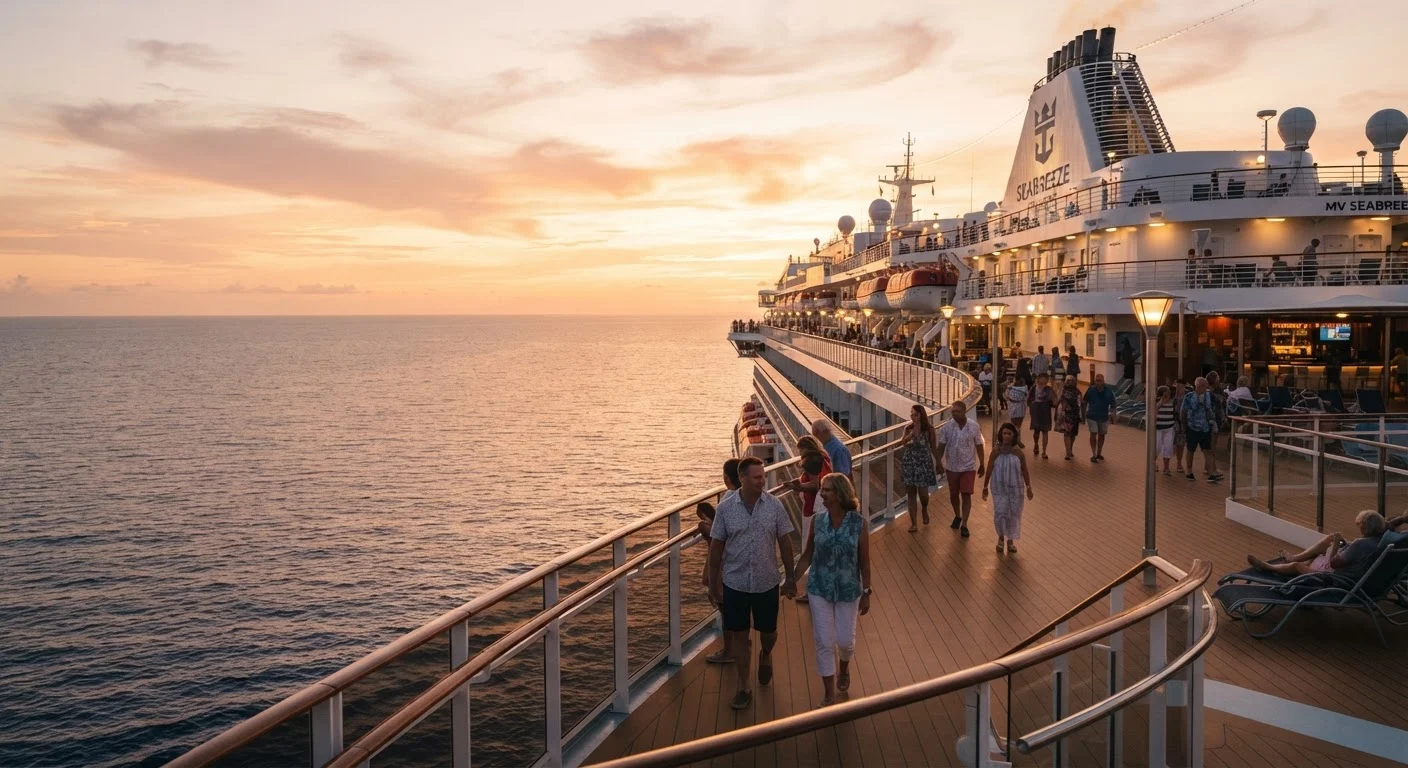
Photo credit: ExploreRoute.net | Travel Made Simple
In this article
An honest, hour-by-hour portrait of sea days, port days, and evening routines aboard a typical ocean cruise ship.
Key Takeaways
- Embarkation day sets the tone — arrive early, explore the ship, and confirm reservations before crowds build.
- Sea days follow a loose but predictable rhythm; planning a few anchor activities prevents wasted hours.
- Port days require time discipline — ships depart on schedule, with or without late returners.
- Evenings are the social heartbeat of the ship, from multi-course dinners to late-night deck walks.
- Disembarkation runs smoother when you settle accounts, tag luggage, and choose an exit strategy the night before.
Embarkation Day: More Than Just Boarding
Most cruisers think of embarkation as pure logistics — check in, find the cabin, head to the pool. In practice, it's the highest-leverage day of the entire voyage. The ship is yours before the crowds settle in.
Terminals typically open for boarding between 11 a.m. and noon. Arriving in that first wave means shorter security lines, an uncrowded buffet, and, crucially, time to walk every public deck while the ship is quiet. Use this window to locate the specialty restaurants you want to book, identify the quieter pool areas, and confirm any dining reservations. Many guests only discover the best deck chairs or the library on day three — you can know by day one.
Cabins are generally accessible by 1–2 p.m. Once inside, run through the pre-departure packing checklist to make sure formal-night attire and shore-excursion gear are accounted for. The mandatory muster drill (now often conducted via in-cabin video or app on modern ships) must be completed before departure — treat it seriously, not as a formality.
Make the Most of Embarkation Day
The ship's specialty restaurants, spa, and excursion desk are all significantly less busy on embarkation day than at any other point in the voyage. Use the first afternoon to book dinner reservations, secure preferred spa times, and confirm shore excursion details — all before the majority of passengers have finished unpacking.
By early evening the ship will have sailed. Step outside for departure — watching a port slip away from the rail is one of the genuinely unrepeatable moments in cruise travel.
Sea Days: The Rhythm of Life Underway
A sea day — a full day at sea between ports — is where cruise culture lives. For first-timers it can feel unstructured; for experienced cruisers it's often the most anticipated part of the itinerary.
The ship's daily program (delivered to your cabin or accessible via the cruise line's app) maps out everything from morning trivia and enrichment lectures to afternoon cooking demonstrations and evening shows. The key is choosing two or three anchor activities rather than attempting everything — or nothing.
~8 hrs
Average usable time in port per stop
Typical port windows run from docking (7–9 a.m.) to all-aboard calls (5–6 p.m.), with tender and transit time reducing available hours.
60%+
Cruisers who say sea days are a highlight
Passenger satisfaction surveys across major cruise lines consistently show sea days among the most positively rated parts of the voyage.
1–2 p.m.
Typical cabin-ready time on embarkation day
Most cruise lines make cabins accessible in the early afternoon, though public areas are open from the moment boarding begins.
Mornings on deck before 9 a.m. offer the ship at its most peaceful: a near-empty pool, unobstructed ocean views, and the particular calm of open water. After 10 a.m. the pool area fills quickly. Those less drawn to sun loungers will find quieter value in the full range of sea day options beyond the pool — from onboard lectures to card rooms and well-stocked libraries.
If motion is a concern, sea days are also when conditions are most variable. Understanding what causes seasickness and how cruisers manage it before you sail helps you prepare rather than react.
On sea days, book enrichment lectures or cooking demonstrations the evening before — popular sessions fill quickly and walk-ins are often turned away.
Onboard programming has finite capacity, and high-demand activities routinely reach capacity before the day begins.
Position yourself on the ship's lower, midship decks during rough weather — this is the vessel's most stable zone and significantly reduces motion sensation.
Midship and lower decks experience less pitch and roll than bow, stern, or high-deck cabins, a well-established principle of ship stability.
Port Days: Maximizing Shore Time
Port days introduce the tightest time constraint of the voyage. Ships typically dock between 7 and 9 a.m. and depart by 5 or 6 p.m. — and they will leave without you if you're late. That creates a usable window of roughly seven to eight hours, less if your port requires a tender (a small boat to ferry guests from ship to shore when docking isn't possible).
The Ports & Shore Life hub provides deep context on individual destinations, but the universal rule is this: know your return deadline and build in a buffer of at least 45 minutes. Traffic, tender queues, and unexpected closures erode time faster than most travelers anticipate.
Ship-organized excursions guarantee a return to the pier; independently arranged tours do not. If you're going independent, research the distance from port to your destination in advance, and have the ship's agent contact number saved in case you need assistance.
For those exploring cruise itineraries across varied regions, note that port characters differ significantly — a tender port in a remote fjord demands different logistics than a deep-water berth in a major city terminal.
Evenings Aboard: Dining, Entertainment, and Winding Down
The evening structure on a cruise ship is arguably the most underestimated part of the experience. After port days, many guests return tired and underestimate how much the ship comes alive after 6 p.m.
Dinner is the social anchor. Main dining rooms operate on either a fixed-seating or flexible (open) schedule — both have merits, but flexible dining requires earlier reservations to avoid long waits at peak hours (7–8 p.m.). Specialty restaurants require advance booking and typically carry a cover charge; they're worth reserving for at least one evening, particularly on formal nights when the main dining room is at its most festive.
Understanding the unspoken social norms of cruise dining and shared spaces makes a measurable difference in how smoothly the evening flows — for you and the guests around you.
“The sea, once it casts its spell, holds one in its net of wonder forever.”
— Jacques-Yves Cousteau, Marine explorer and ocean conservationist
After dinner, the ship offers a spread of entertainment: Broadway-style productions, comedy acts, live music in multiple venues, and casino play. The late-night upper deck — near-empty, open ocean, stars overhead — is among the most memorable things a cruise offers and costs nothing.
The Final Day: Disembarkation Without the Stress
The last full day and disembarkation morning are where preparation pays off. The night before arrival, place tagged luggage outside your cabin door by the posted deadline (usually 10–11 p.m.) if you're using the ship's luggage service. Settle your onboard account — review every charge carefully, as billing errors are common and easier to dispute before you leave the ship.
Disembarkation is called in waves, typically beginning around 7 a.m. Self-assist disembarkation (where you carry your own bags off) generally departs earliest; luggage-service guests follow in assigned groups. Either way, the main dining room serves breakfast until the ship clears, so there's no need to rush to the gangway at first call.
Before leaving, check every drawer, safe, and power outlet — items left in cabins are frequently the source of post-voyage distress. If you've been managing connectivity, review the guidance on staying connected at sea to ensure roaming is correctly managed before your phone hits port signal.
Review Your Onboard Account Before Disembarking
Billing errors — duplicate charges, incorrectly posted gratuities, or unrecognized bar tabs — are far easier to resolve while you are still on the ship. Guest services lines on disembarkation morning can be long; check your account the evening before and address any discrepancies then. Once you've left the vessel, disputes take considerably longer to resolve.
The days between embarkation and disembarkation follow a rhythm that becomes intuitive quickly. Understanding its shape in advance — sea days, port days, evenings, the quiet early mornings — is what separates a reactive passenger from one who makes every hour count.

Author
Cruise Journeys Editorial Team
Cruise Journeys Editorial Team is the collective byline for our editorial team and contributor network. Articles published under this byline or an editorial pen name are researched, written, and reviewed according to our editorial standards for clarity, consistency, and independence before publication.
View all articles →