
The Lost Cities That History Almost Erased
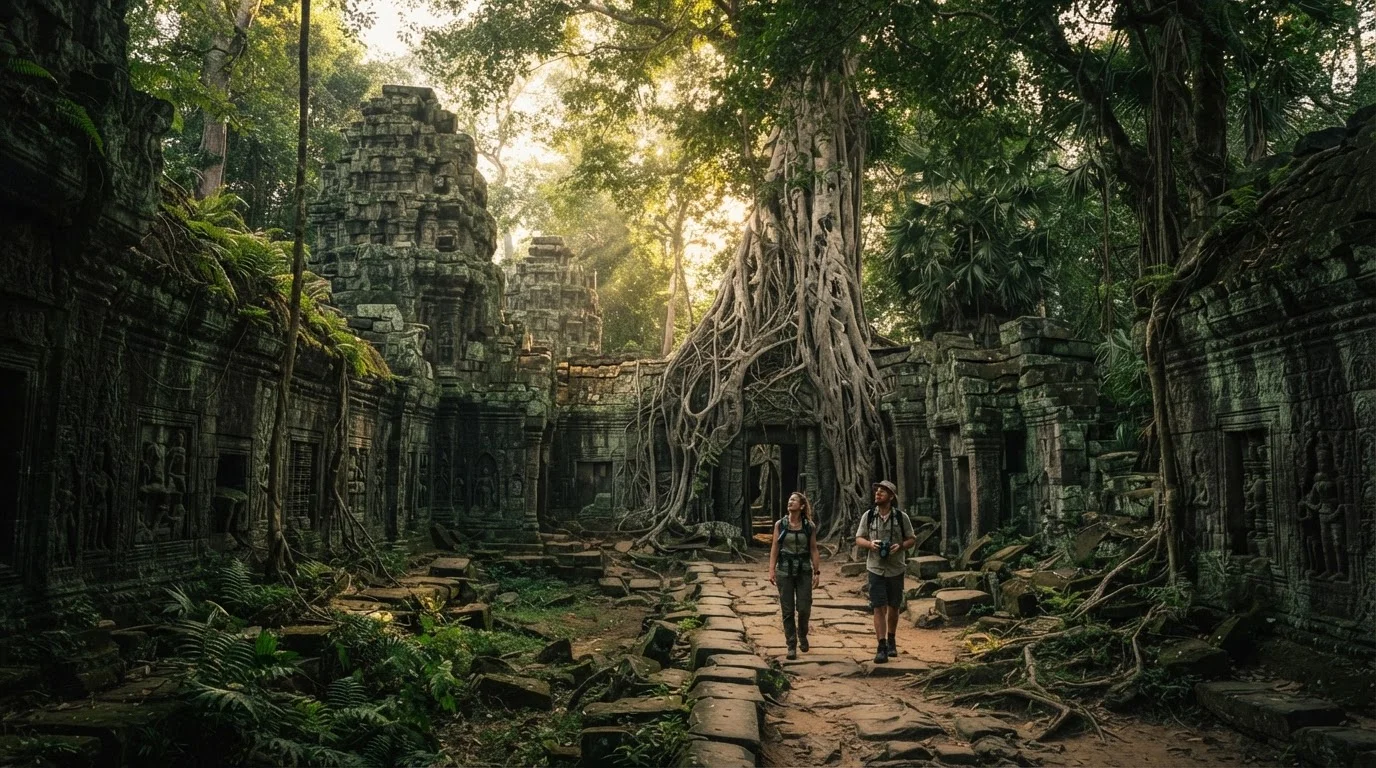
Photo credit: ExploreRoute.net | Travel Made Simple
From jungle-swallowed capitals to buried port towns, explore the forgotten urban centres that shaped civilisations and now draw almost no visitors.
Key Takeaways
- Several once-thriving cities rivalling ancient Rome or medieval Baghdad remain almost entirely off tourist radars today.
- Archaeological access, seasonal conditions, and local regulations vary widely — always verify before planning a visit.
- Visiting lesser-known historic sites often means richer encounters with local custodians and living cultural traditions.
- Many lost cities face ongoing threats from climate change, looting, and underfunding that affect their long-term preservation.
- Independent research and preparation are essential — infrastructure at these sites is often minimal or absent.
Cities the World Forgot to Remember
Every seasoned traveller knows the feeling of standing at the edge of a famous ruin — camera-ready crowds pressing in, audio-guide voices overlapping — and wondering whether the real story has already been trampled underfoot. It often has. But scattered across five continents lie urban centres that once commanded trade empires, housed tens of thousands of residents, and shaped the civilisations we study in school, yet today receive a fraction of the attention lavished on their more celebrated counterparts.
These are not merely archaeological footnotes. They are cities with street grids, market districts, religious precincts, and water systems — evidence of sophisticated urban ambition. What separates them from Pompeii or Angkor is rarely historical significance; more often it is geography, politics, colonial-era scholarship, or simple quirks of rediscovery. As the funding gaps and access challenges that affect so many ruins make clear, absence from the tourist map is never a reliable indicator of unimportance.
The cities below span cultures, continents, and millennia. Each one rewards the traveller willing to do a little more homework — and to accept that the path there might not be paved.
Vijayanagara, India — The Empire Hidden in Plain Sight
Spread across more than 650 square kilometres of the Deccan Plateau near the modern town of Hampi, Vijayanagara was once one of the largest cities in the world. At its sixteenth-century peak, travellers from Persia and Portugal described a metropolis of staggering wealth — a capital whose bazaars stretched for kilometres and whose temples were encrusted with precious stones. The Vijayanagara Empire dominated South India for over two centuries before its sudden collapse following the Battle of Talikota in 1565.
Today, Hampi is a UNESCO World Heritage Site, yet it absorbs a fraction of the visitors that similarly scaled sites in Europe attract. Much of the urban fabric — royal enclosures, elephant stables, stepped tanks, and the extraordinary Vittala Temple complex with its famous stone chariot — survives across a boulder-strewn landscape that feels genuinely otherworldly. A field-ready reference for independent travellers is especially useful here, where the site's sheer scale can overwhelm without context.
At its peak, Vijayanagara was among the largest cities on Earth — yet most travellers have never heard its name.
Timgad, Algeria — Rome's Ghost City in the Sahara
Founded by Emperor Trajan in 100 CE as a military colony for veterans of the Third Augustan Legion, Timgad was designed with the rigid geometry Romans applied everywhere: a perfect square bisected by cardinal roads, a forum, a theatre seating 3,500, and public latrines so well-preserved that their marble seats remain largely intact. By the seventh century, Berber invasions and shifting trade patterns had emptied it; the Saharan sand then did the rest, burying the city so completely that it survived almost untouched for more than a millennium.
Rediscovered by Scottish explorer Robert MacPherson in 1765 and excavated from the 1880s onward, Timgad is often called the "Pompeii of North Africa" — a comparison that understates its particular drama. The city sits at roughly 1,000 metres above sea level against the Atlas Mountains, and the contrast between its intact Roman street plan and the surrounding steppe is stark. Visitor numbers remain low relative to its preservation quality, partly due to Algeria's historically restrictive tourism infrastructure and visa processes. Always verify current entry requirements through official sources before planning travel.
Timgad's street plan is so intact that you can walk its Roman grid exactly as a legionary veteran once did.
Ctesiphon, Iraq — Capital of the Persian World
For roughly seven centuries, Ctesiphon served as the imperial capital of successive Parthian and Sasanian Persian empires, sitting astride the Tigris River about 35 kilometres south of modern Baghdad. At its height in the third and fourth centuries CE, it ranked among the most populous cities on the planet. The Sasanian palace complex — known as Taq Kasra — included a throne hall whose single-span brick arch, roughly 37 metres high, remains the largest unreinforced brick arch ever constructed. It still stands.
The city fell to the Arab Muslim armies in 637 CE and was gradually cannibalized as a quarry for the construction of Baghdad, leaving the great arch as an almost surreal remnant in an otherwise flat agricultural plain. Ongoing political instability and security concerns in Iraq make independent travel to this region complex and potentially hazardous. Travellers should consult their government's official travel advisory and work with established operators who have current on-the-ground knowledge before considering any visit.
The lone arch of Ctesiphon still rises over the Iraqi plain — the largest unreinforced brick arch ever built.
Loropéni, Burkina Faso — West Africa's Forgotten Stone City
The ruins of Loropéni in southwestern Burkina Faso represent the oldest and best-preserved of a group of stone enclosures that once supported a network of gold-trade towns in the Sahel region. Dating to at least the eleventh century CE, the walled complex covers roughly 11,000 square metres and its granite walls still reach four metres in height in places — extraordinary given the site's age and the absence of mortar in their construction.
Loropéni was inscribed as a UNESCO World Heritage Site in 2009, partly because it challenges colonial-era assumptions about pre-contact African urbanism. As the broader story of Africa's pre-colonial urban ruins makes clear, sites like Loropéni rewrote archaeological understanding — yet they draw almost no international visitors. The Lobi people of the surrounding region maintain a living cultural connection to the site; engaging with local guides is both practically useful and ethically important.
Loropéni's mortarless granite walls have stood for over a millennium, yet the site sees almost no international visitors.
Mohenjo-daro, Pakistan — Blueprint for Urban Planning
Mohenjo-daro flourished in the Indus Valley between roughly 2500 and 1700 BCE, making it one of the earliest major urban settlements in human history. What makes it remarkable even by modern standards is its apparent commitment to civic planning: a street grid oriented to the cardinal directions, standardised fired-brick construction across thousands of structures, a city-wide drainage and sewage system more sophisticated than anything contemporary in Mesopotamia or Egypt, and what appear to be public baths and granaries at civic scale.
The site lies in Sindh province in southern Pakistan and is a UNESCO World Heritage Site, though it faces serious conservation challenges — rising groundwater and salt crystallisation are actively degrading the mudbrick structures. Visitor infrastructure is limited, and travellers should research current access conditions carefully. For those interested in what lies beneath ground level at sites like this, the world of subterranean historic sites offers a complementary dimension of discovery. Entry and visa requirements for Pakistan should be confirmed through official government channels well in advance.
Mohenjo-daro's drainage network was more sophisticated than anything built in Europe for another 3,000 years.
Planning a Visit to the World's Lost Cities
Travelling to sites like these demands a different kind of preparation than booking a ticket to the Colosseum. Infrastructure ranges from thin to nonexistent. Local guides — often descendants of the communities who built these places — are frequently your most valuable resource, both practically and culturally. Their knowledge of seasonal access, unexcavated areas, and oral histories layers meaning onto every carved stone.
Connect with Local Custodians First
At most of these sites, local guides, archaeologists, or community-managed visitor programmes exist even when formal tourism infrastructure does not. Reaching out to regional museums, university archaeology departments, or heritage NGOs before you travel can open doors — and ensures your visit supports the communities closest to these places. A little advance correspondence often transforms a disorienting visit into a genuinely illuminating one.
For travellers drawn less to ruins than to landscapes, the secret natural wonders pillar offers an equally rewarding alternative for off-grid exploration. And if you're considering whether to visit before these sites attract wider attention, an honest assessment of early-adopter heritage travel covers both the rewards and the genuine risks. Before any trip, consult official government travel advisories and verify visa, health, and entry requirements through authoritative sources — conditions at remote heritage sites can change with little notice.

Author
Hidden Destinations Editorial Team
Hidden Destinations Editorial Team is the collective byline for our editorial team and contributor network. Articles published under this byline or an editorial pen name are researched, written, and reviewed according to our editorial standards for clarity, consistency, and independence before publication.
View all articles →