
Forgotten Mill Towns of New England That Have Quietly Reinvented Themselves
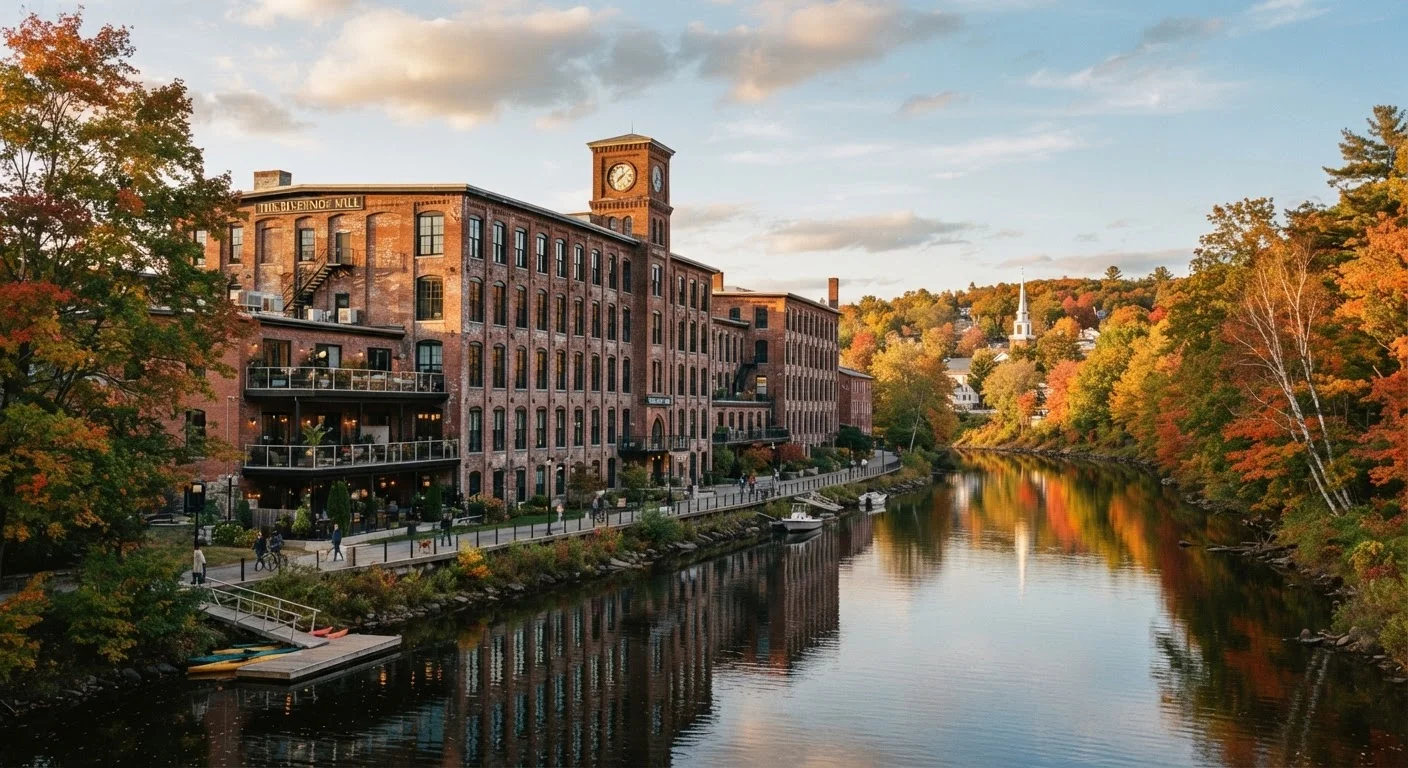
Photo credit: ExploreRoute.net | Travel Made Simple
Once driven by industry, these New England towns now harbour art scenes, local breweries, and walkable main streets that most visitors never find.
Key Takeaways
- Several New England mill towns have transformed post-industrial decline into thriving arts and culinary scenes.
- These towns offer walkable downtowns, rich architectural heritage, and local culture without the tourist crowds.
- Visiting during shoulder season often reveals the most authentic community atmosphere and fewest visitors.
- Each town retains its working-class character, giving travelers a grounded alternative to polished resort destinations.
- Proximity to major cities makes most of these towns accessible as weekend trips without lengthy detours.
The Second Life of the American Mill Town
There is a particular kind of beauty in a building that has outlasted its original purpose. Across New England, hundreds of textile and paper mills — once thundering with looms and printing presses — have been standing in varying states of quiet for decades. Some crumbled. Others were razed. But a surprising number have been pulled back from the edge by the exact qualities that made them useful in the first place: space, structure, and proximity to rivers that once powered their machinery and now anchor their identity.
The reinvention happening in these towns is not the self-conscious kind marketed to tourists. It tends to emerge slowly — a ceramics studio occupying a former dye house, a brewpub spreading across an old weave room, a farmers market settling into a mill yard on Saturday mornings. What arrives is something that keeps these places off the tourist map even as they quietly flourish: authenticity without the performance of it.
For frequent travelers who have done the Vermont covered-bridge circuit and the Maine coast loop, these towns offer something richer — a chance to witness a community mid-reinvention, where the past is still visible in the brickwork and the future is being invented in the storefronts.
Easthampton, Massachusetts
Tucked between the Holyoke Range and the Connecticut River in the Pioneer Valley, Easthampton has spent the past two decades quietly becoming one of the most artist-dense small cities in New England. The Keystone Mills complex — a sprawling brick campus dating to the 1880s — now hosts a colony of working artists, photographers, and craftspeople whose open studio events draw visitors from across the region.
What makes Easthampton feel different from its more famous neighbor Northampton is the lack of performance. The food scene here is genuinely local: a Vietnamese restaurant that has served the same neighborhood for years, a cooperative coffee shop, a record store that doubles as a community gathering point. The Manhan Rail Trail runs directly through town, offering an easy two-wheeled route through former industrial corridors now edged with wildflowers. Arrive on a weekend morning and the town feels entirely lived-in rather than staged for visitors.
Easthampton's artist colony emerged organically inside actual 1880s mill buildings — not a curated destination, but a working creative community.
Biddeford, Maine
Until fairly recently, Biddeford occupied an uncomfortable place in Maine's travel imagination — too close to the tourism magnet of Kennebunkport to be ignored, but too gritty to be included. That friction has become its defining characteristic. The Pepperell Mill Campus along the Saco River now spans more than a million square feet of converted industrial space housing a rotating cast of small businesses, including textile studios, a distillery, and a theater company.
The downtown along Main Street is genuinely walkable and genuinely eclectic — a Franco-American cultural center sits near a natural wine bar, reflecting the town's layered history as both an immigrant working-class community and an emerging creative hub. The Saco River provides kayaking access in warmer months, and the proximity to Biddeford Pool, a quiet coastal village largely overlooked by visitors, means that a weekend here can span industrial history, river recreation, and tidal marshes within a few miles. Getting here before wider discovery is genuinely still possible.
Biddeford's Franco-American heritage gives the town a cultural depth that most Maine coastal itineraries never encounter.
Putnam, Connecticut
Putnam sits in the Quiet Corner of Connecticut — a region that openly markets its own obscurity — along the Quinebaug River in the state's northeastern corner. The old mill district here has evolved into one of New England's more unusual economic reinventions: an antique and design destination anchored by dozens of dealers operating out of former factory floors, creating a kind of permanent flea market inside industrial architecture.
But Putnam's appeal extends well beyond shopping. The Rotary Park along the river gives the town a genuine gathering place, and the surrounding Quinebaug and Shetucket Rivers Valley National Heritage Corridor — sometimes called the Last Green Valley for its remarkable darkness at night — offers hiking and birding trails through landscapes that connect directly to the region's mill history. The town is small enough that a single afternoon reveals its full geography, but rich enough in texture that two days feel appropriate.
Putnam's antique district occupies actual mill floors — a living economic reinvention that turns industrial bones into cultural infrastructure.
Woonsocket, Rhode Island
Rhode Island's smallest cities punch well above their weight, and Woonsocket — on the Blackstone River near the Massachusetts border — is an underappreciated example. The Museum of Work and Culture, operated by the Rhode Island Historical Society, occupies a former textile mill and tells the story of French-Canadian immigrant workers who shaped the town's identity across generations. It is one of the more focused and emotionally resonant small museums in all of New England.
The Blackstone River itself is central to understanding the region's significance: the corridor between Woonsocket and Pawtucket is often called the birthplace of the American Industrial Revolution, and the Blackstone River Bikeway offers a scenic off-road route through this landscape. The town's Main Street reflects its layered immigrant heritage — bakeries, social clubs, and a Franco-American cultural vibrancy that hasn't been polished for outside consumption. That roughness, for the right traveler, is exactly the point. Anchoring a full trip around Woonsocket requires some patience, but rewards it generously.
The Museum of Work and Culture in Woonsocket is among New England's most honest and moving industrial heritage sites.
Lewiston, Maine
Maine's second-largest city is rarely included on any travel itinerary, which says more about the limits of travel imagination than it does about Lewiston's character. The Bates Mill complex — a 19th-century cotton mill that once employed thousands — has been undergoing phased redevelopment for years, and the surrounding Lisbon Street corridor is home to an evolving food scene shaped significantly by the city's large Somali and Central African immigrant communities, among the largest per capita in the United States.
That demographic reality gives Lewiston an energy that is genuinely unlike anywhere else in New England. The farmers market, the halal butchers, the Somali-owned restaurants alongside old-school French-Canadian diners — it is a town where the meaning of New England identity is being renegotiated in real time. Bates College, whose campus borders the downtown, adds a further layer of cultural programming through its museum of art and public lecture series. For travelers willing to engage with complexity rather than comfort, Lewiston is irreplaceable.
Lewiston's Somali and Central African communities have transformed the city into a genuinely singular cultural destination in New England.
North Adams, Massachusetts
North Adams occupies the far northwestern corner of Massachusetts in the Hoosac Valley, hemmed in by the Berkshire Hills and accessible via the Mohawk Trail — itself one of New England's great scenic backroads. The town's reinvention is perhaps the most dramatic on this list: MASS MoCA, the Massachusetts Museum of Contemporary Art, opened in 1999 inside a 26-acre former factory complex and is now one of the largest contemporary art museums in the world by square footage.
What keeps North Adams from feeling like a cultural theme park is everything that exists around MASS MoCA: the working-class neighborhoods, the independent hardware stores, the view corridors down Church Street toward the mountains. The Hoosac Tunnel — a 19th-century engineering achievement that took 24 years and significant human cost to complete — sits just east of town and can be viewed from a public trailhead. For travelers for whom forgotten historic sites are as compelling as contemporary art, North Adams is a genuinely layered destination.
MASS MoCA transformed a 26-acre industrial complex into one of the world's largest contemporary art museums — without erasing the town around it.
Planning a Mill Town Itinerary
Most of these towns pair naturally with one another. Easthampton and Northampton sit just minutes apart in Massachusetts, making a single overnight stay in the Pioneer Valley rewarding. Biddeford and Saco in Maine are twin cities separated by the Saco River, and a single afternoon is rarely enough to do either justice. For those road-tripping across the region, lesser-known backroads often connect these towns more scenically than the interstates suggest.
Visit During Shoulder Season for Best Results
September through early October and late April through May tend to offer the most genuine window into daily life in these towns. Summer draws some visitors, and deep winter can limit what's open or accessible. Shoulder season also means you're more likely to encounter locals at farmers markets, open studios, and community events rather than navigating around organized tourist activity. Check individual town event calendars before arriving — many of the best experiences in these places are community-organized and not widely advertised.
It is worth noting that the success of these reinventions is uneven — some towns have seen new investment accelerate gentrification pressures, and not every local resident experiences revitalization the same way. Traveling with curiosity and spending locally — at independent shops, community markets, and resident-owned restaurants — is one way to engage more meaningfully with the community beyond its aesthetic transformation. As traveler interest reshapes lesser-known places, the habits visitors bring with them matter as much as the destinations they choose.

Author
Hidden Destinations Editorial Team
Hidden Destinations Editorial Team is the collective byline for our editorial team and contributor network. Articles published under this byline or an editorial pen name are researched, written, and reviewed according to our editorial standards for clarity, consistency, and independence before publication.
View all articles →