
Understanding Airline Codeshares and Why Your Ticket Might Show Two Carrier Names
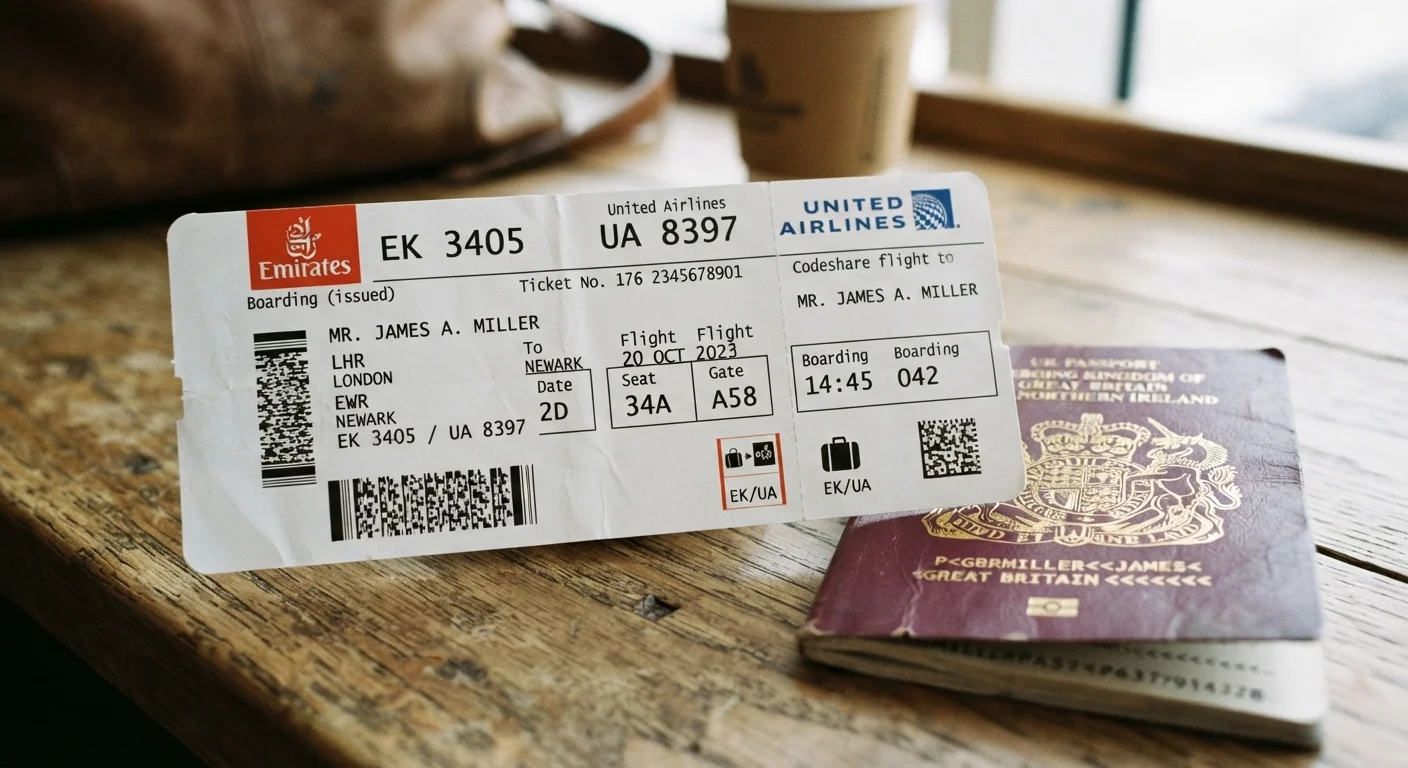
Photo credit: ExploreRoute.net | Travel Made Simple
In this article
Codeshare agreements mean the airline that sells your ticket isn't always the one that flies you. Learn what this means for check-in, baggage, and service.
Key Takeaways
- Your boarding pass may show the selling airline's code, but the operating airline runs the actual flight.
- Check-in procedures, baggage allowances, and lounge access are typically governed by the operating carrier.
- Frequent flyer miles may accrue to either airline depending on which loyalty program you provide at booking.
- Codeshares are legal and common — they exist to expand route networks without requiring airlines to fly new aircraft.
- Always confirm which airline operates your flight to avoid confusion at the airport.
What a Codeshare Actually Does
When you look at your itinerary and see something like "AA 4521, operated by British Airways," you are looking at a codeshare in action. American Airlines (the marketing carrier) has placed its flight number on a British Airways (the operating carrier) departure. You paid American, you checked in with British Airways, and you flew on a British Airways aircraft.
This arrangement benefits airlines by letting them offer routes they do not physically fly. A carrier can fill a gap in its network — say, a transatlantic route — by partnering with an airline that already operates that corridor. From the airline's perspective, it sells more tickets and appears to offer a broader network; from the partner's perspective, it fills more seats on existing flights.
Codeshares are closely tied to, but distinct from, airline alliances. Major groupings like Star Alliance, oneworld, and SkyTeam formalize cooperation between member carriers, and codeshare agreements are one of the primary tools alliances use to knit networks together. How alliances shape route choices and rewards is worth understanding alongside codeshares, since the two concepts reinforce each other.
~17,000
Codeshare agreements active globally
Industry analysts estimate approximately 17,000 codeshare agreements exist worldwide, reflecting how deeply the practice is embedded in commercial aviation.
3
Major global airline alliances using codeshares
Star Alliance, oneworld, and SkyTeam collectively account for the majority of the world's international air traffic, with codeshare agreements as a foundational coordination tool.
What Codeshares Mean at the Airport
The most practical confusion codeshares create happens at check-in. Because your ticket was issued by the marketing carrier, your first instinct may be to head to that airline's counter. In most cases, however, you need to check in with the operating carrier — the one whose tail is on the plane.
Baggage allowances are another friction point. The operating carrier's policies govern what you can bring, though some agreements align rules with the marketing carrier. When those policies differ, the lower allowance usually applies in practice. Confirm with both carriers before you travel, particularly on international itineraries where checked bag rules diverge significantly.
Lounge access follows similar logic. If your ticket entitles you to lounge access, the operating carrier's lounge is typically the one you can use, not the marketing carrier's. There are exceptions — especially within tight alliance partnerships — so verify before you count on it.
Always Confirm the Operating Carrier Before Arriving
Before heading to the airport, search your confirmation email or booking record for the phrase "operated by." That phrase identifies the airline whose counter you need to find, whose baggage rules apply, and whose aircraft you will board. Setting a reminder to check this detail — especially on connecting itineraries — takes seconds and can prevent significant disruption.
Understanding how airport terminals and gates are structured can also prevent confusion when you're hunting for the operating carrier's check-in desks. See how airport layouts are structured for a useful primer.
Frequent Flyer Miles, Fare Classes, and Codeshare Bookings
Miles accrual on codeshare flights is governed by the fare class on your ticket and the partnership terms between carriers. A ticket booked in an economy fare class that earns miles at 100% on the marketing carrier may earn at a lower rate — or not at all — when credited to the operating carrier's program. The inverse is also possible.
The safest approach is to identify your earning priority before booking and enter that loyalty program number during checkout. If you are targeting elite status, misattributed miles can quietly slow your progress. Fare class codes determine more than just price; they set the mileage accrual rate and upgrade eligibility for every ticket, including those on codeshare flights.
Pricing is another nuance. Because the marketing carrier controls the ticket sale, fares for the same physical seat can appear at different price points depending on which carrier you book through. Why the same seat costs different amounts explains the mechanics behind this in detail.
Codeshares Are Disclosed at Booking
US Department of Transportation rules require airlines to disclose codeshare arrangements at the point of sale, so the operating carrier's identity should appear in your booking flow before you pay. If it is not immediately visible, look for a flight details or itinerary breakdown section. Awareness of this disclosure requirement means you always have the information — you just need to know where to find it.
Frequently Asked Questions

Author
Smart Air Travel Editorial Team
Smart Air Travel Editorial Team is the collective byline for our editorial team and contributor network. Articles published under this byline or an editorial pen name are researched, written, and reviewed according to our editorial standards for clarity, consistency, and independence before publication.
View all articles →