
Sleeping on a Plane: What Actually Works and What Doesn't
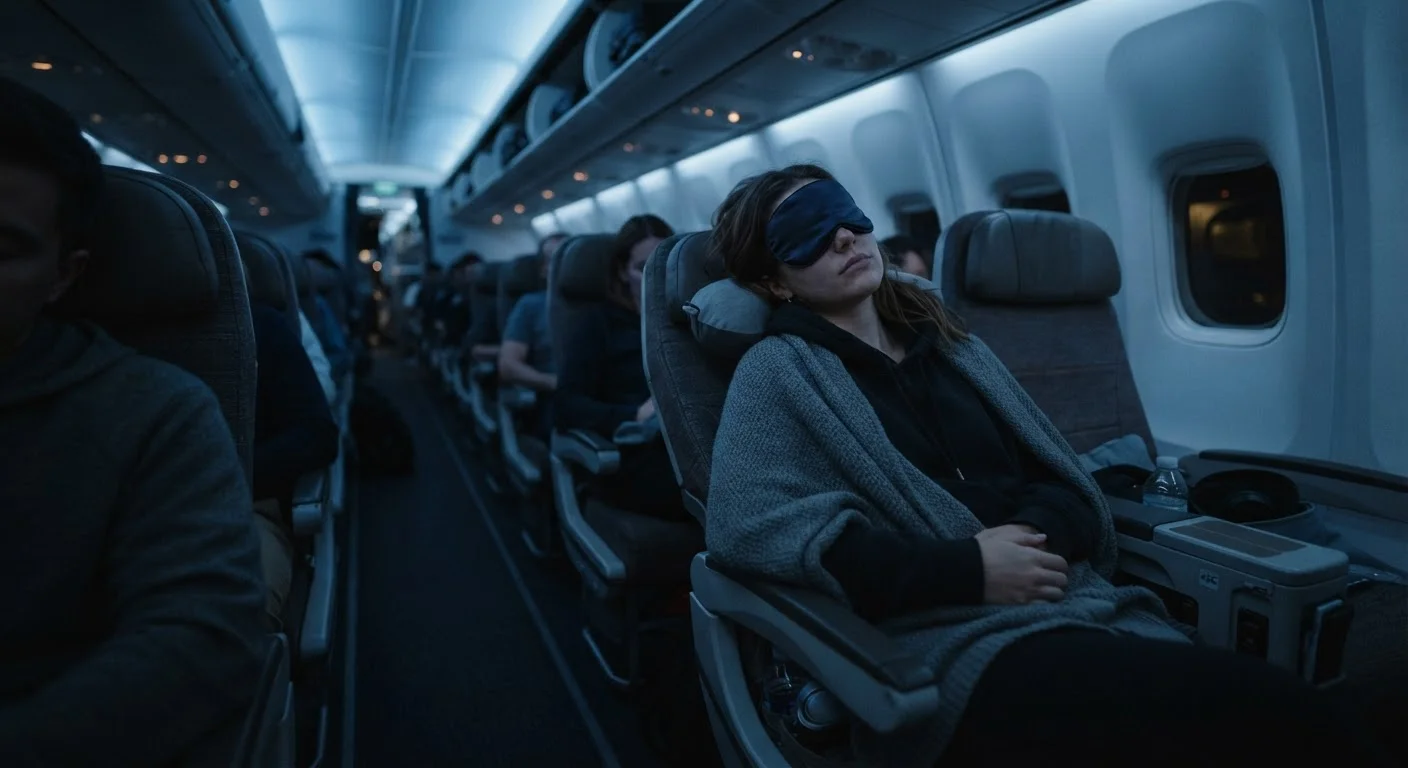
Photo credit: ExploreRoute.net | Travel Made Simple
Separating evidence-based sleep strategies from popular myths so you can land feeling genuinely rested rather than just hopeful.
Key Takeaways
- Alcohol disrupts sleep architecture on planes, despite feeling like a sleep aid.
- Seat position and timing matter far more than most accessories for achieving real rest.
- Melatonin's effectiveness for in-flight sleep is modest and context-dependent.
- Noise-cancelling headphones reduce cognitive fatigue even when you're not fully asleep.
- Matching your sleep window to destination nighttime is the single highest-leverage habit.
Why In-Flight Sleep Is Hard — and Misunderstood
Sleeping on a plane is one of the most-discussed in-flight challenges, yet the advice circulating among travelers frequently contradicts the underlying physiology. The cabin environment is genuinely hostile to sleep: pressurized air is drier than most deserts, ambient noise sits between 75 and 85 decibels depending on the aircraft, and seat geometry in economy class prevents the recline angle needed for natural spinal alignment. Against this backdrop, popular shortcuts — alcohol, maximum pillow count, full blackout — often address symptoms rather than causes.
Part of the broader guide to in-flight comfort from gate to landing, this article focuses specifically on separating evidence-based sleep strategies from the myths that persist because they feel intuitively correct. Understanding what's actually happening in your body at altitude is the first step toward making genuinely better choices.
Myth
A glass or two of wine will help you sleep better on a long flight.
Fact
Alcohol at altitude suppresses REM sleep and increases sleep fragmentation, leaving you more fatigued on arrival.
The cabin environment — lower oxygen partial pressure, low humidity, and pressurization equivalent to roughly 6,000–8,000 feet — already stresses the body. Adding alcohol accelerates dehydration and, critically, disrupts sleep architecture. Research on alcohol and sleep consistently shows reduced REM sleep duration and more frequent awakenings in the second half of the sleep cycle. The drowsiness alcohol induces is real, but the sleep quality that follows is measurably worse. If you want to arrive rested, water and electrolytes serve you far better than a nightcap.
Myth
A neck pillow is all you really need to sleep comfortably in a standard seat.
Fact
Neck pillows address only one of several obstacles to in-flight sleep; without recline, darkness, and noise management, they have limited effect.
Neck support matters — unsupported head nodding is a genuine sleep disruptor — but it's only one variable. Seat recline angle, ambient light, engine and airflow noise, and your circadian timing all exert stronger influence on whether you actually fall and stay asleep. For a more grounded look at what each comfort accessory realistically delivers, see our accessory-by-accessory breakdown. A well-chosen neck pillow combined with an eye mask and noise management yields compounding benefits — but no single item compensates for poor positioning or flying at the wrong circadian moment.
Myth
Taking melatonin before boarding guarantees better sleep on the plane.
Fact
Melatonin is a circadian signal, not a sedative; its benefit depends heavily on dosage timing relative to your current and destination time zones.
Melatonin helps shift the body's internal clock but produces only mild sedative effects compared to prescription sleep aids. Its usefulness on a flight depends on whether you're taking it at the right biological moment — specifically, when your body would not otherwise produce it. Taking melatonin mid-afternoon on an eastward overnight flight may be well-timed; taking it indiscriminately every flight is unlikely to help and may confuse your circadian rhythm further. Consult a healthcare professional before using melatonin regularly, particularly if you take other medications or have underlying health conditions. This information is general in nature and does not constitute medical advice.
Myth
The window seat is always the best choice for sleeping.
Fact
The optimal seat for sleep depends on your individual sleep style, flight duration, and how often you need to move.
Window seats offer a surface to lean against and control over the shade — genuine advantages for many sleepers. But they also trap you against the fuselage for hours. Frequent movers, those prone to stiffness, or anyone who drinks a lot of water mid-flight may sleep better in an aisle seat where they can stand and stretch without disturbing neighbors. The window vs. aisle comparison for overnight flights explores the real physiological trade-offs in more detail. Neither seat universally wins.
Myth
You should sleep as much as possible on the plane to arrive rested.
Fact
Sleeping strategically — aligned with your destination's nighttime — is more effective than simply maximizing total in-flight sleep hours.
Indiscriminate sleep on a plane can reinforce your origin time zone and worsen jet lag on arrival. Sleep researchers generally recommend timing in-flight sleep to align with destination nighttime where possible, particularly on long-haul eastward flights where the circadian adjustment is hardest. If you land in the morning and immediately sleep through the day, your circadian clock receives conflicting signals. For a clear explanation of how jet lag differs from general travel fatigue, the article on jet lag vs. travel fatigue is a useful companion read.
Myth
Staying completely still helps you sleep; moving around just wakes you up.
Fact
Periodic movement improves circulation and can reduce the physical discomfort that prevents sleep onset.
Prolonged immobility causes muscle stiffness, reduces circulation, and increases discomfort — all of which fragment sleep. A short walk to the galley, ankle rotations, and gentle stretching in the aisle can ease physical tension and make returning to your seat and sleeping easier. This is also important for circulatory health on very long flights. A practical in-flight movement routine provides a sensible framework that works within economy class constraints.
What Actually Moves the Needle
The strategies that consistently improve in-flight sleep share a common thread: they work with physiology rather than against it. Timing your sleep window to destination nighttime, managing light exposure with a quality eye mask, reducing cognitive load with noise-cancelling audio, and staying well-hydrated throughout the flight address the actual barriers. Seat selection, as discussed in the myth pairs above, is a meaningful variable too — and worth deciding deliberately rather than defaulting to habit.
75–85 dB
Typical economy cabin noise level
Aircraft cabin noise measurements consistently fall in this range, comparable to a busy restaurant or highway traffic, making unassisted sleep physiologically harder.
~6,000–8,000 ft
Equivalent cabin pressurization altitude
Most commercial aircraft cabins are pressurized to this equivalent altitude, reducing blood oxygen saturation modestly and contributing to fatigue and reduced sleep quality.
20%
Typical cabin relative humidity
Cabin humidity often drops below 20%, far lower than typical indoor environments, accelerating dehydration that disrupts both comfort and sleep.
Preparation before boarding also matters. Arriving sleep-deprived makes the challenge harder, not easier. Travelers who board already fatigued often sleep in fragmented bursts that don't consolidate into restorative rest. Boarding well-rested and targeting a specific sleep window — rather than hoping to pass out from exhaustion — is a more reliable approach. If sleep tourism as a broader discipline interests you, the emerging field of sleep-focused travel offers a wider lens on how rest is being taken more seriously as a travel priority.
Prescription Sleep Aids on Planes Carry Real Risks
Some travelers use prescription sedatives for long-haul flights, but these carry meaningful risks in a cabin environment: reduced ability to respond to emergencies, increased risk of deep-vein thrombosis from prolonged immobility, and potential disorientation on arrival. Always consult a qualified healthcare professional before using any sleep medication for travel, and never combine sedatives with alcohol.

Author
Smart Air Travel Editorial Team
Smart Air Travel Editorial Team is the collective byline for our editorial team and contributor network. Articles published under this byline or an editorial pen name are researched, written, and reviewed according to our editorial standards for clarity, consistency, and independence before publication.
View all articles →