
Round-Trip vs. One-Way Cruise Itineraries: Planning Around Each Style
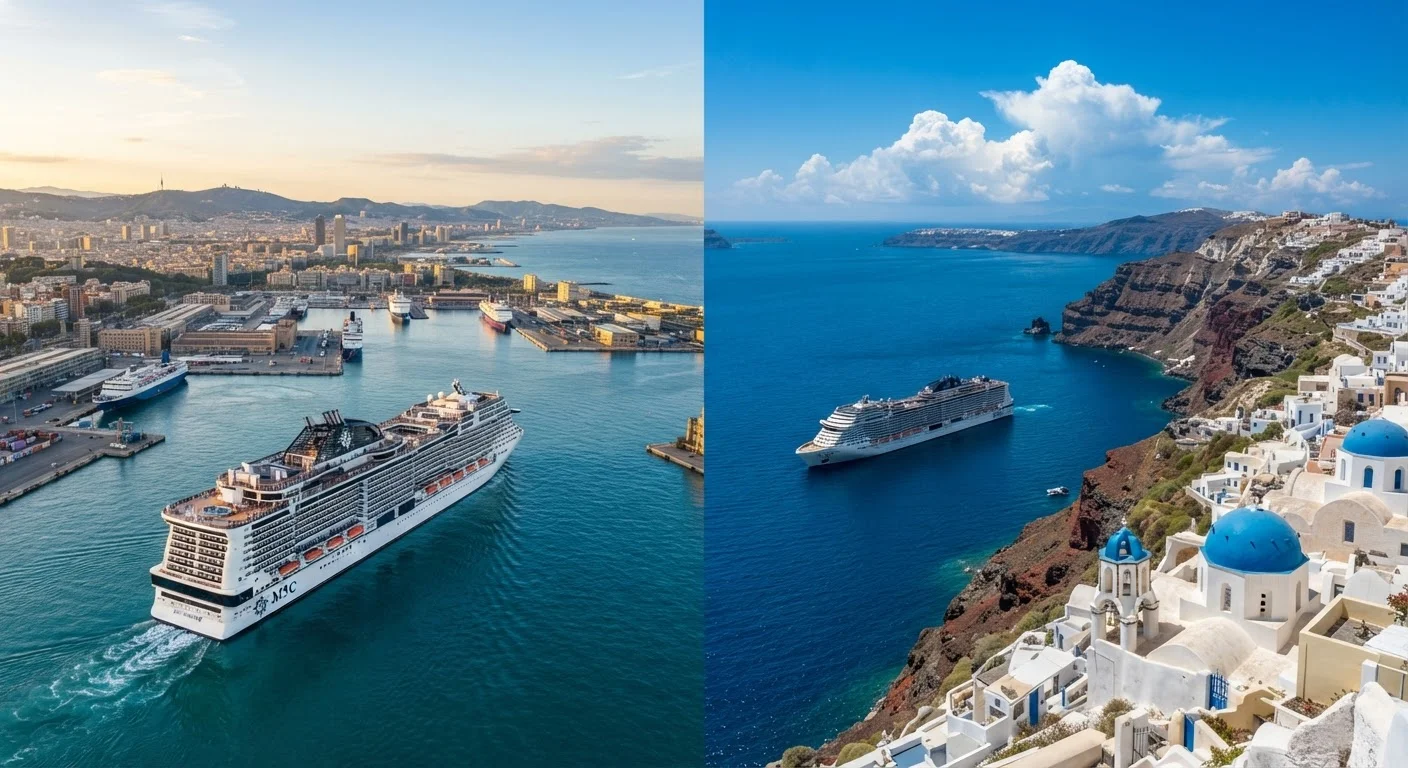
Photo credit: ExploreRoute.net | Travel Made Simple
In this article
Round-trip sailings offer convenience; one-way routes open up new geography. Weigh the logistics, costs, and flexibility of each approach.
Key Takeaways
- Round-trip itineraries depart and return to the same port, simplifying flights and pre-cruise logistics.
- One-way (point-to-point) cruises cover more geographic ground but require coordinating two separate flight bookings.
- Repositioning voyages are a specialized category of one-way sailing often featuring rare port combinations.
- Your budget for flights, not just the cruise fare, is a critical factor when comparing the two formats.
- Neither style is universally superior — the right choice depends on travel priorities, flexibility, and geography.
Single flight booking simplifies all air travel
Round-trip cruises anchor your air travel to one city, making it straightforward to book a single round-trip flight without coordinating arrival and departure from different airports.
Easier to plan pre- and post-cruise arrangements
With both embarkation and disembarkation at the same port, pre-cruise hotel stays and transfers are optional extras rather than logistical necessities.
Generally lower total trip cost
Avoiding a second one-way flight from a foreign disembarkation port typically reduces overall trip spend, particularly when flying internationally.
Familiar structure suits first-time cruisers
The self-contained nature of a round-trip sailing reduces the number of moving parts, making it a more manageable format for those new to cruise travel.
Requires two separate flight bookings
Flying into one port city and home from another means booking — and paying for — two one-way tickets, which are often more expensive than a standard round-trip fare.
Pre-cruise logistics at embarkation port are essential
Arriving in an unfamiliar city the day before departure is strongly advisable, adding hotel and transfer costs that round-trip travelers can more easily sidestep.
Flight disruptions carry higher stakes
A missed connection en route to a one-way cruise departure has no easy resolution — if the ship sails without you, catching it at the next port may be the only option.
Limited geographic repetition between itineraries
Because the ship travels linearly without looping back, the variety between consecutive sailings in the same region may be lower unless the cruise line offers substantially different one-way routes.
What Defines Each Itinerary Structure
Before weighing the trade-offs, it helps to understand what each format actually involves. A round-trip cruise departs from a homeport and returns to that same port at the end of the voyage — think sailing out of Miami and returning to Miami after a seven-night Caribbean loop. The ship's schedule is self-contained, and your travel logistics are anchored to a single city.
A one-way cruise — sometimes called a point-to-point sailing — starts in one port and ends in another. A classic example is a Mediterranean itinerary that begins in Barcelona and concludes in Venice. Repositioning cruises, where ships move between seasonal deployment regions, represent an extended variant of this format. For a deeper look at how cruise terminology maps to real itinerary structures, see the Cruise Itinerary Terms Decoded glossary.
These structural differences cascade into nearly every planning decision that follows — from airfare to port-day density to how much geographic variety you actually experience.
Advantages and Disadvantages of Round-Trip Cruises
Round-trip sailings dominate the cruise market for good reason: they are logistically lean. You book one round-trip flight, arrange transfers to and from a single port city, and the ship does the geographic work. Pre- and post-cruise hotel nights become optional rather than essential.
Single flight booking simplifies all air travel
Round-trip cruises anchor your air travel to one city, making it straightforward to book a single round-trip flight without coordinating arrival and departure from different airports.
Easier to plan pre- and post-cruise arrangements
With both embarkation and disembarkation at the same port, pre-cruise hotel stays and transfers are optional extras rather than logistical necessities.
Generally lower total trip cost
Avoiding a second one-way flight from a foreign disembarkation port typically reduces overall trip spend, particularly when flying internationally.
Familiar structure suits first-time cruisers
The self-contained nature of a round-trip sailing reduces the number of moving parts, making it a more manageable format for those new to cruise travel.
The trade-off is geographic repetition for those sailing the same region multiple times. A round-trip Caribbean itinerary can feel familiar after two or three voyages, and the route itself is constrained by the need to loop back to the origin port — limiting how far afield any single sailing can venture. Frequent cruisers who have thoroughly explored a region often find round-trip sailings less compelling over time.
Advantages and Disadvantages of One-Way Cruises
One-way itineraries open up route possibilities that round-trip formats simply cannot replicate. A transatlantic crossing, a full Norwegian coastal transit, or a cruise from Tokyo to Vancouver covers geography that no circular route can match. For travelers motivated by maximizing new destinations, the format is inherently appealing — and transatlantic crossings represent one of the most iconic expressions of one-way sailing.
Requires two separate flight bookings
Flying into one port city and home from another means booking — and paying for — two one-way tickets, which are often more expensive than a standard round-trip fare.
Pre-cruise logistics at embarkation port are essential
Arriving in an unfamiliar city the day before departure is strongly advisable, adding hotel and transfer costs that round-trip travelers can more easily sidestep.
Flight disruptions carry higher stakes
A missed connection en route to a one-way cruise departure has no easy resolution — if the ship sails without you, catching it at the next port may be the only option.
Limited geographic repetition between itineraries
Because the ship travels linearly without looping back, the variety between consecutive sailings in the same region may be lower unless the cruise line offers substantially different one-way routes.
The logistical overhead is real. Two separate flight bookings are required — one to the embarkation port and one home from the disembarkation port — and these are rarely symmetric in cost or convenience. Open-jaw ticketing (flying into one city and out of another) can mitigate this, as explored in our guide to open-jaw ticket strategy. Travelers should also budget time and accommodation for arrival at the start port.
2x
Flight bookings required vs. round-trip
One-way cruises typically require separate inbound and outbound flights, doubling the air travel coordination compared to a round-trip sailing from a home region.
14–35 days
Typical repositioning cruise duration
Repositioning sailings, a specialized one-way format, commonly run two to five weeks as ships transit between seasonal deployment regions.
The Special Case of Repositioning Cruises
Repositioning sailings deserve specific attention within the one-way category. These voyages occur when cruise lines move ships between their summer and winter deployment regions — transatlantic crossings in spring and fall being the most common example. Because lines need to move the ship regardless of passenger revenue, repositioning fares have historically offered strong value relative to itinerary length.
Repositioning Cruises and Port Frequency
Repositioning voyages often include more consecutive sea days than standard itineraries — sometimes four to seven in a row on a transatlantic passage. Travelers accustomed to daily port calls should weigh this carefully. Those who enjoy onboard life, enrichment programming, and the rhythm of extended ocean time tend to find repositioning sailings genuinely rewarding rather than monotonous.
The routing on repositioning cruises tends to be unusual: a mix of ports that would never appear together on a standard seasonal itinerary, combined with extended sea-day stretches. They suit travelers comfortable with a slower pace and genuinely interested in the voyage itself, not just port visits. For a fuller breakdown of what to expect, our guide to repositioning cruises covers the format in depth.
How to Choose Based on Your Priorities
The most useful lens is not which format is better in the abstract, but which one fits your specific travel priorities. Start with the geography question: are you deepening your knowledge of a region (where round-trip often makes more sense) or trying to traverse a broad geographic arc (where one-way earns its complexity)?
Next, evaluate your airfare flexibility. One-way cruises become significantly more attractive when positioned alongside flights that make geographic sense — flying into Lisbon and home from Copenhagen because you were planning to see both cities anyway. If the flights feel like a logistical burden rather than a natural complement, the round-trip format will likely deliver a smoother overall trip. Aligning your itinerary format to your travel style is ultimately the most reliable guide to the right structure.
Consider port density as well. One-way routes tend to be more linear, enabling each port stop to build on the last geographically. Round-trip itineraries sometimes revisit similar port clusters by necessity. Travelers who prize narrative geographic progression often find one-way sailings more satisfying — particularly on Mediterranean itineraries where the Eastern, Western, and Adriatic regions each form a coherent arc.

Author
Cruise Journeys Editorial Team
Cruise Journeys Editorial Team is the collective byline for our editorial team and contributor network. Articles published under this byline or an editorial pen name are researched, written, and reviewed according to our editorial standards for clarity, consistency, and independence before publication.
View all articles →