
Understanding Biomes: A Field Reference for Wild Landscape Types Around the World
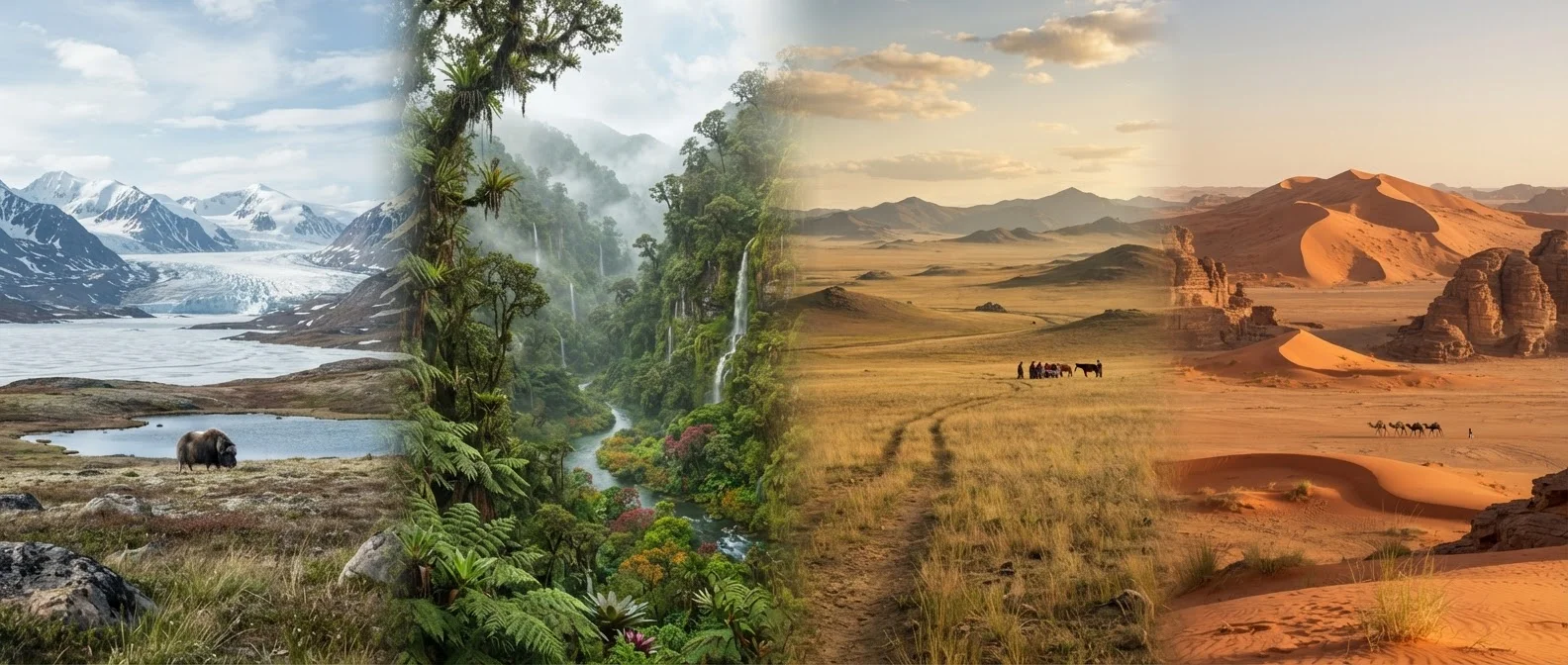
Photo credit: ExploreRoute.net | Travel Made Simple
In this article
A concise reference to the world's major biomes—tundra, cloud forest, steppe, and more—and what distinguishes each from a traveller's perspective.
Why Biomes Matter to the Serious Traveller
Most frequent travellers have stood at the edge of something they couldn't quite name—a landscape that felt neither jungle nor desert, neither alpine nor coastal, but something altogether its own. That feeling of productive disorientation is exactly what biome literacy helps resolve. A biome is a large-scale ecological community defined primarily by climate, vegetation structure, and the organisms adapted to it—not by geography or political boundary. The Patagonian steppe and the Mongolian steppe share more ecological logic with each other than either does with nearby mountain ranges in their respective regions.
Understanding biomes reframes where you choose to go and what you notice when you arrive. It's the difference between ticking off a country and genuinely reading a landscape. For travellers drawn to uncrowded, pristine places, biome knowledge is especially practical: the most overlooked destinations on Earth are often underloved precisely because they belong to biomes that haven't been glamorised—not because they're any less remarkable.
See also: why uncrowded landscapes stay pristine — the science behind how low visitor pressure sustains ecological health across biome types.
| Number of major biomes | 8–14 (varies by classification system) (WWF Global 200 Ecoregion framework) |
| Largest terrestrial biome | Boreal forest (taiga) (Covers approximately 27% of Earth's land surface) |
| Most species-rich biome | Tropical rainforest (Estimated to contain over 50% of all terrestrial species) |
| Most threatened biome type | Tropical dry forest (Less than 10% of original cover remains intact in many regions) |
| Defining tundra feature | Permafrost (year-round frozen subsoil) (Limits vegetation to mosses, sedges, and dwarf shrubs) |
| Cloud forest altitude range | Typically 1,500–3,500 m elevation (Varies by latitude and regional climate patterns) |
The Major Biomes: A Field Reference
The number of recognised biomes varies by classification system, but the following eight represent the major landscape types a traveller is most likely to encounter or seek out deliberately.
Tropical Rainforest
Concentrated near the equator in the Amazon basin, Central Africa, and island Southeast Asia, tropical rainforests receive heavy rainfall year-round and sustain the highest species density of any terrestrial biome. The canopy layers—emergent, canopy, understory, forest floor—each host distinct communities of life. For travellers, access is often slow and conditions are humid and demanding; the reward is biodiversity that no other biome matches.
Cloud Forest (Tropical Montane Forest)
A subset of tropical forest occurring at altitude—typically between 1,500 and 3,500 metres—cloud forests are characterised by persistent low cloud cover, extraordinary epiphyte (plant-on-plant) density, and remarkably high endemism. Monteverde in Costa Rica and the Albertine Rift highlands of East Africa are notable examples. Because cloud forests are thermally isolated by altitude, their species evolve in relative isolation, making them among the most biologically distinct places on the planet.
Temperate Deciduous Forest
Spanning much of the eastern United States, Western Europe, and parts of East Asia, this biome is defined by seasonal leaf loss and a rhythm of dormancy and renewal. Ancient remnants—such as the Białowieża Forest on the Poland-Belarus border—preserve a structural complexity long since cleared elsewhere.
Boreal Forest (Taiga)
The world's largest terrestrial biome by area, the taiga stretches across northern Canada, Scandinavia, and Russia in a nearly unbroken band of coniferous forest. Winters are extreme, summers brief but intensely alive. Travellers willing to visit in early autumn encounter a landscape of rare, uncrowded quiet.
Tundra
Found in the Arctic and at high elevations (alpine tundra), the tundra is defined by permafrost, minimal precipitation, and vegetation limited to mosses, lichens, sedges, and low shrubs. The apparent emptiness disguises extreme ecological sensitivity—footprints here can take decades to disappear.
Grassland and Steppe
Grasslands encompass both tropical savannas (East Africa, northern Australia) and temperate steppes (Central Asia, the American Great Plains, the Patagonian plateau). What unites them is precipitation too low for forest but sufficient to prevent full desertification. The Eurasian steppe in particular remains one of the largest, least-visited wild landscapes on Earth.
Desert (Hot and Cold)
Deserts are defined by aridity—less than 250 mm of annual precipitation—not necessarily by heat. Cold deserts like the Gobi and the Atacama's higher reaches share the classification with the Sahara and Arabian Peninsula. Life in deserts is not absent but concentrated: survival strategies here are among the most extreme in the natural world.
Wetlands and Freshwater Systems
The Pantanal in South America, the Okavango Delta in Botswana, and the Sundarbans mangroves along the Bay of Bengal represent wetland biomes of extraordinary productivity. Often underestimated by travellers expecting dramatic scenery, wetlands sustain disproportionate wildlife density and act as irreplaceable water filtration systems.
Biome
A large-scale ecological community characterised by a dominant vegetation type and climate regime. Biomes are not defined by geography but by the ecological conditions that shape them.
Endemism
The ecological state in which a species exists only within a defined geographic area and nowhere else on Earth. High endemism is a marker of evolutionary isolation, common in cloud forests and island ecosystems.
Epiphyte
A plant that grows on another plant for physical support rather than nutrients—mosses, ferns, and orchids in cloud forests are characteristic examples. They are indicators of high atmospheric humidity.
Permafrost
Ground that remains frozen for two or more consecutive years. Found beneath most tundra landscapes, permafrost is structurally critical and highly sensitive to warming and surface disturbance.
Biological Soil Crust
A living community of cyanobacteria, fungi, mosses, and lichens that forms a fragile crust on desert soils. It is essential for soil stability and nutrient cycling, and is destroyed by foot or vehicle traffic.
Canopy Layer
The primary upper layer of a forest formed by the crowns of dominant trees. In tropical rainforests, the canopy functions as a near-continuous ceiling that intercepts most sunlight before it reaches the forest floor.
Taiga
Another term for boreal forest — the vast coniferous belt stretching across the high latitudes of the Northern Hemisphere. It represents the world's largest terrestrial biome by surface area.
Savanna
A tropical or subtropical grassland with scattered trees and a pronounced wet-dry seasonal cycle. Savannas in East Africa and northern Australia support some of the most visible large-mammal populations on Earth.
For travellers considering terrain-specific accommodation to match these landscapes, desert camps, jungle lodges, and arctic cabin options offer a practical comparison of lodging approaches by biome type.
Reading Biomes Responsibly in the Field
Biome knowledge carries an ethical dimension. The same features that make a landscape rare—its isolation, its endemism, its ecological intactness—also make it vulnerable. Tundra soils disturbed by off-trail walking recover on geological timescales. Cloud forest streams are acutely sensitive to introduced pathogens. Desert crusts, known as biological soil crusts, can be destroyed by a single footstep and take over a century to regenerate.
Before visiting any biome, it is worth consulting official park or reserve guidance, and reviewing any entry or permit requirements with the relevant national authority. Conditions, access rules, and seasonal restrictions vary widely and change over time—never rely on secondhand accounts as definitive.
Verify Entry and Access Before You Travel
Access rules, permit requirements, and seasonal closures for biome-sensitive areas change regularly and differ significantly by country and reserve. Always consult the relevant national park authority or government travel advisory before planning a visit. Conditions on the ground may differ from published guides or traveller accounts, particularly in remote regions.
For travellers seeking a broader ethical framework for this kind of travel, responsible travel in fragile natural ecosystems covers environmental awareness and fieldcraft in depth. And if you find yourself puzzling over terminology in the field, adventure travel terminology every outdoor traveler should know provides a clear glossary for the language of wilderness travel.

Author
Hidden Destinations Editorial Team
Hidden Destinations Editorial Team is the collective byline for our editorial team and contributor network. Articles published under this byline or an editorial pen name are researched, written, and reviewed according to our editorial standards for clarity, consistency, and independence before publication.
View all articles →