
Desert Camps, Jungle Lodges, Arctic Cabins: Matching Landscape to Lodging Style
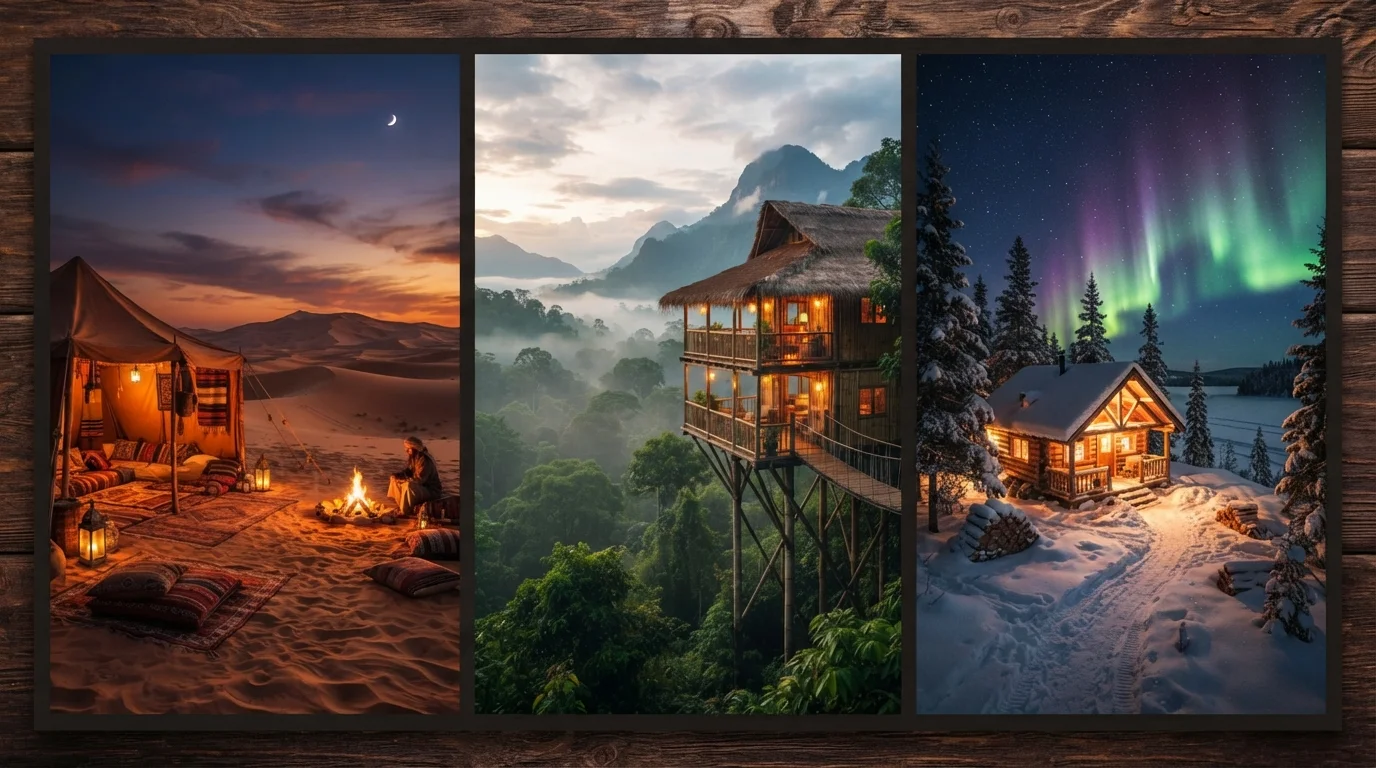
Photo credit: ExploreRoute.net | Travel Made Simple
In this article
Different environments call for very different unconventional stays. A practical comparison of terrain-specific lodging approaches.
Key Takeaways
- Each landscape type — desert, jungle, Arctic — imposes distinct structural and logistical requirements on its lodging.
- Comfort levels, privacy, and environmental exposure vary significantly across terrain-specific stay categories.
- Choosing the right lodging style for a given environment improves safety, immersion, and overall trip satisfaction.
- Sustainability and environmental impact differ considerably between desert camps, jungle lodges, and polar cabins.
- Seasonality and access infrastructure are critical planning factors that vary by biome and lodging type.
Why Landscape Should Drive Lodging Decisions
Most travelers choose accommodations based on price, amenities, or proximity to a city center. But in extreme or remote environments — desert, jungle, polar — the terrain itself is the main attraction. Lodging that fights against its landscape creates friction; lodging that responds to it creates immersion.
This principle, explored in depth in our framework for location-first travel planning, holds that geography shapes not just what you see from your window, but how you sleep, eat, move, and perceive time. Terrain-specific stays are built around this reality — their architecture, materials, and daily rhythms are calibrated responses to extreme conditions rather than adaptations of standard hospitality formats.
For experienced travelers already fluent in mainstream destinations, the shift toward landscape-driven lodging represents a meaningful upgrade in trip design — one that demands more research but delivers a fundamentally different kind of stay. See also our broader field guide to unconventional stays for adjacent lodging categories worth considering.
Desert Camps: Open Sky, Controlled Exposure
Desert lodging occupies a design paradox: maximum openness in the harshest of environments. Properly conceived desert camps use orientation, shade structures, and thermal mass to regulate the extreme temperature swings — often 40°F or more between midday and midnight — that define arid climates. Canvas-walled tents on raised platforms, sunken courtyard structures, and low-profile adobe compounds all address the same core problem: keeping occupants comfortable when the environment is actively hostile.
The appeal is a specific kind of silence and a sky unmarred by light pollution — conditions that many travelers describe as disorienting in the most productive way. Desert stays come with unique climate and infrastructure realities that travelers should understand before arrival: water scarcity, limited emergency access, and UV intensity all require preparation well beyond packing sunscreen.
What desert camps do exceptionally well is enforce presence. There is no scrolling through TV channels or wandering a hotel corridor — the landscape commands attention at every hour.
Time Your Desert Stay Strategically
Shoulder seasons — spring and early autumn — typically offer the most hospitable conditions in desert environments, combining cooler temperatures with extended daylight. Midsummer arrivals in arid regions like the American Southwest or Saharan Africa can expose travelers to dangerous heat that limits outdoor activity to early morning and evening hours. Always verify conditions with local operators and check government travel advisories before booking.
Jungle Lodges: Density, Biodiversity, and Managed Discomfort
Jungle lodging sits at the intersection of ecological access and managed exposure to an environment that is genuinely relentless. Humidity routinely exceeds 90%, insects are omnipresent, and the forest is in constant, audible motion. Well-designed jungle lodges don't apologize for these conditions — they contextualize them.
Elevated structures on stilts allow air circulation and separate guests from ground-level fauna. Open-air dining pavilions and screened sleeping quarters represent the practical middle ground between experiencing the rainforest and surviving it. Eco-lodges, treehouses, and riverside camps each offer different tradeoffs in comfort, access, and environmental footprint.
Sustainability credentials matter here more than in almost any other lodging category, given how ecologically sensitive the surrounding habitat typically is. It's worth understanding the distinction between genuine conservation operators and superficially branded alternatives — a distinction covered in detail in our piece on eco-lodges vs. eco-certified hotels.
| Desert Camp | Jungle Lodge | Arctic Cabin | |
|---|---|---|---|
| Primary environmental challenge | Heat, UV, water scarcity | Humidity, insects, fauna | Cold, darkness, isolation |
| Typical structure type | Canvas tent or adobe compound | Elevated stilt lodge or treehouse | Insulated timber or prefab cabin |
| Wildlife exposure level | Low to moderate | High and constant | Low; megafauna occasional |
| Sustainability considerations | Water use, land disturbance | Ecosystem fragility, carbon access | Energy consumption, permafrost |
| Best season to visit | Shoulder seasons (spring/fall) | Dry season varies by region | Winter for aurora; summer for light |
| Ideal traveler profile | Minimalist, stargazing, solitude | Naturalist, birder, eco-traveler | Cold-weather, photography, isolation |
| Connectivity and access | Often remote, 4WD routes | Boat or small aircraft common | Seasonal road or snowmobile access |
Arctic Cabins: Thermal Safety, Light Cycles, and Isolation
Polar and subarctic lodging presents a fundamentally different design challenge: the primary threat is thermal rather than biological. Arctic cabins must maintain livable interior temperatures — often against sustained exterior conditions well below freezing — while managing condensation, energy consumption, and limited infrastructure. Properly built polar cabins use triple-glazed windows, superinsulated walls, and vestibule entry systems that prevent cold air from flooding interior spaces each time the door opens.
The experience of staying in these environments is shaped by light more than almost any other factor. In summer, near-continuous daylight disrupts sleep schedules; in winter, near-total darkness requires psychological adjustment. Cold-climate accommodations present distinct conditions travelers should understand in advance, including heating systems, access roads that may close seasonally, and the logistical reality of being genuinely remote.
For travelers drawn to aurora viewing, ice-landscape photography, or simply the stripped-down clarity of extreme winter, a well-positioned Arctic cabin delivers an experience that is difficult to replicate elsewhere. The key is matching expectations to conditions rather than assuming the landscape will adapt to you.
70%+
Of Earth's land is considered extreme terrain
Deserts, boreal forests, and polar regions collectively cover the majority of the planet's landmass, yet represent a small fraction of global hospitality infrastructure.
40°F
Typical daily temperature swing in desert environments
Many arid regions experience a difference of 40°F or more between afternoon highs and pre-dawn lows, making thermal management central to desert lodging design.

Author
Where to Stay Editorial Team
Where to Stay Editorial Team is the collective byline for our editorial team and contributor network. Articles published under this byline or an editorial pen name are researched, written, and reviewed according to our editorial standards for clarity, consistency, and independence before publication.
View all articles →