
Hill Towns of Southern Italy Beyond Cinque Terre
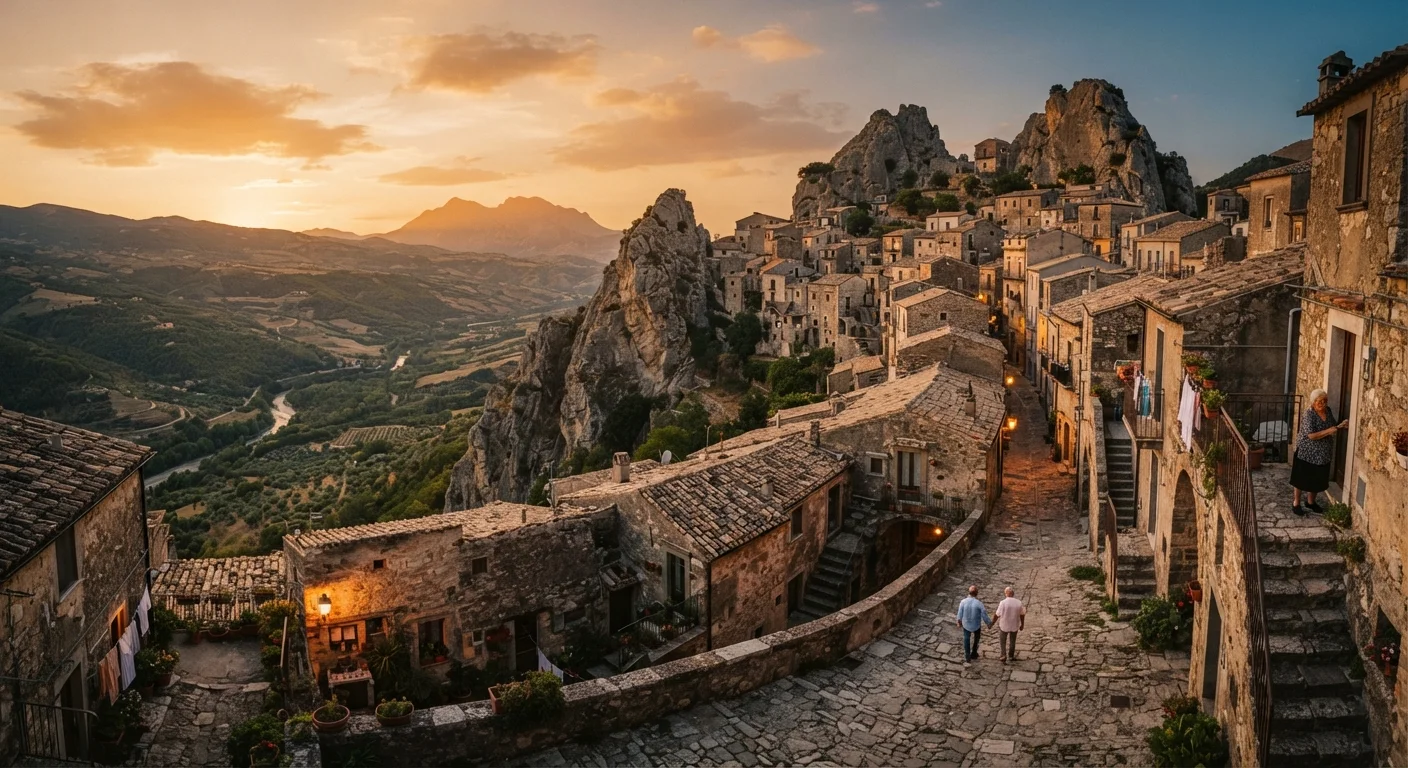
Photo credit: ExploreRoute.net | Travel Made Simple
In this article
Calabria, Basilicata, and Molise hide medieval hilltop villages that see a fraction of Cinque Terre's footfall yet offer comparable drama and far more authenticity.
Key Takeaways
- Regions like Calabria, Basilicata, and Molise hold medieval hilltop villages largely overlooked by international travelers.
- Many of these towns preserve Norman, Byzantine, and Greek cultural layers rarely found elsewhere in Europe.
- Visitor numbers remain a fraction of Cinque Terre's, meaning genuine local life continues undisturbed.
- Some villages participate in Italy's 'borghi più belli' (most beautiful villages) network without attracting mass tourism.
- Seasonal accessibility and limited English signage require more advance planning than northern Italian destinations.
The Italy That Tourism Forgot
Every spring, thousands of travelers squeeze along the pastel-stacked cliffside trails of Cinque Terre, jostling for the same photographs and waiting in long queues at the same trattorias. It is genuinely beautiful — but it is no longer a secret, and the crowds have fundamentally changed the experience. Meanwhile, a different Italy sits largely unwatched a few hundred miles south: a landscape of ancient limestone ridges, abandoned Norman fortresses, and hill towns where shepherds still outnumber selfie sticks.
The regions of Calabria, Basilicata, and Molise are among the least-visited corners of the European Union. This is not because they lack drama or depth — it is largely a consequence of geography, infrastructure investment, and the gravitational pull of northern Italy's well-worn tourist circuit. For the frequent traveler who already knows Rome and the Amalfi Coast and is hungry for something more honest, these southern highlands offer an experience that feels genuinely earned. Think what inland towns offer over coastal ones — richer cultural sediment, quieter streets, and encounters with local life that have not yet been curated for outside consumption.
What 'Most Beautiful Villages' Certification Means
Several towns in this article belong to the I Borghi più belli d'Italia (The Most Beautiful Villages of Italy) association, a network of small municipalities recognized for architectural and cultural heritage. Membership signals a baseline of preservation standards and visitor infrastructure, but it does not imply the same level of tourist development as northern Italian destinations. Facilities, English-language signage, and accommodation options vary widely — independent research before visiting is strongly recommended.
Seven Hill Towns Worth the Detour
Civita di Bagnoregio, Lazio–Umbria Border
Technically straddling the boundary between Lazio and Umbria rather than the deep south, Civita di Bagnoregio earns its place here as a conceptual entry point. Reached only by a pedestrian footbridge over a dramatic eroded valley of tufa cliffs, it is sometimes called la città che muore — the dying city — because the plateau it occupies is slowly crumbling. A handful of full-time residents remain. Walk through at dusk when the day-trippers have retreated, and you encounter something rare: silence inside a medieval town that has been continuously inhabited for millennia.
At dusk, after day-trippers leave, Civita di Bagnoregio offers a silence that feels genuinely medieval.
Pietrapertosa, Basilicata
Wedged into the jagged Dolomiti Lucane — a range of eerily sculpted rock spires in the heart of Basilicata — Pietrapertosa clings to the cliff face at roughly 1,088 meters above sea level, making it one of the highest villages in the region. The rock formations surrounding it blur the boundary between architecture and geology; from a distance, the town seems to grow directly from the stone. A via ferrata route and a zip-line called the Volo dell'Angelo (Angel's Flight) connect it to the nearby village of Castelmezzano, though the real draw is simply wandering the steep stone lanes, which see a fraction of even regional Italian tourist traffic.
Pietrapertosa appears to grow directly from its cliff face, blurring architecture and geology.
Matera's Satellite Villages, Basilicata
Matera itself has become known — it was a European Capital of Culture in 2019 — but the villages scattered across the surrounding Murgia plateau remain obscure. Places like Miglionico and Montescaglioso preserve the same cave-dwelling heritage and Norman church architecture without the boutique hotels and food tours that have arrived in Matera proper. The plateau landscape here is stark and ancient: deep ravines carved by centuries of erosion, golden in the afternoon light, dotted with rupestrian churches whose frescoes are slowly returning to the rock from which they were painted.
Matera's satellite villages preserve cave-dwelling heritage without the boutique tourism that followed the Capital of Culture designation.
Gerace, Calabria
Gerace occupies a near-impregnable limestone promontory in the Calabrian Aspromonte foothills, and it was precisely this defensive geography that allowed it to survive waves of coastal raiding through the early medieval period. Its Norman cathedral, the largest in Calabria, incorporates columns salvaged from the ancient Greek city of Locri Epizefiri on the coast below — a literal layering of civilizations within a single building. The town counts only a few hundred permanent residents today, and on weekday mornings the streets can feel almost suspended in time, with laundry strung between ochre stone buildings and cats sleeping on cathedral steps.
Gerace's Norman cathedral incorporates ancient Greek columns, layering civilizations within a single building.
Agnone, Molise
Molise is sometimes described as Italy's forgotten region — so lightly visited that its existence is the subject of a running cultural joke among Italians themselves. Agnone, in the Molisano highlands near the Abruzzo border, is remarkable for an unexpected reason: it has operated a bell foundry, the Pontificia Fonderia Marinelli, since at least the 11th century, making it one of the oldest family-run businesses in the world. The town sits at nearly 800 meters on the ridges above the Verrino Valley, with a handsome historic center of pale stone palazzi and a pace of life that has more in common with the 19th century than the present. The foundry welcomes visits; experiencing the ancient casting process is a genuinely unusual encounter with living artisan heritage.
Agnone's bell foundry has operated continuously since at least the 11th century — one of the world's oldest family businesses.
Pentedattilo, Calabria
The name translates as 'five fingers' in Greek, a reference to the extraordinary basalt outcrop — shaped uncannily like a hand — on which this village was built. Much of Pentedattilo was abandoned after a catastrophic earthquake in 1783 and remains in deliberate ruin: roofless stone houses, collapsed archways, and frescoed church walls open to the sky. A small community has reoccupied part of the village in recent decades, and the contrast between the ghost-town ruins and the reviving inhabited section gives Pentedattilo an atmosphere unlike anywhere else in Italy. It is a place that rewards slow exploration and rewards photographers without requiring any staging.
Pentedattilo's earthquake ruins and partial revival create an atmosphere unlike anywhere else in southern Italy.
Bova, Calabria
Bova is the cultural heart of the Greko-speaking community of Calabria — a linguistic minority that preserves a dialect descended from ancient Greek, spoken continuously in these Aspromonte villages for over two millennia. The language, known as Greko or Calabrian Greek, is now spoken by only a small number of elderly residents, making Bova a place of linguistic and anthropological significance as much as scenic beauty. The village sits at 900 meters with sweeping views to the Ionian Sea, and its small museum of Greko culture and heritage provides context that transforms a visit from scenic detour into genuine encounter with one of Europe's rarest living cultural traditions.
Bova preserves Greko, a dialect descended from ancient Greek spoken continuously for over two millennia.
Traveling These Routes by Road
The SS106 coastal highway and the A3 autostrada provide access spines, but reaching most hill towns requires branching onto narrow provincial roads. Consider basing yourself in a larger town — Cosenza, Matera, or Campobasso — and making day or overnight trips into the highlands. The hidden scenic drives of this region reward unhurried driving; leave generous time between destinations and avoid night driving on mountain roads.
Planning Your Route South
Reaching these towns requires more forethought than booking a Cinque Terre rail pass. Rental cars are almost essential for navigating the interior, and the winding mountain roads — while scenic — demand confidence behind the wheel. Those combining hill towns with a wider Mediterranean journey might consider pairing an Adriatic cruise leg with overland exploration; see how different Mediterranean cruise routes compare for itinerary ideas that position southern Italy ports as departure points rather than mere stopovers.
Entry requirements, road regulations, and local conditions can change; always verify current travel guidance with official government sources before finalizing plans. The reward for the extra logistical effort is access to a version of Italy that most international visitors will never encounter — one where the piazza empties at midday for a genuine riposo, where the dialect shifts valley by valley, and where the food on your plate reflects a regional tradition that predates the nation itself. For travelers drawn to the buried and overlooked, southern Italy's hill towns sit alongside the subterranean historic sites that reward curiosity far more than convenience.

Author
Hidden Destinations Editorial Team
Hidden Destinations Editorial Team is the collective byline for our editorial team and contributor network. Articles published under this byline or an editorial pen name are researched, written, and reviewed according to our editorial standards for clarity, consistency, and independence before publication.
View all articles →