
Mountain Villages of the Caucasus: Georgia, Armenia, and Azerbaijan Off the Usual Route
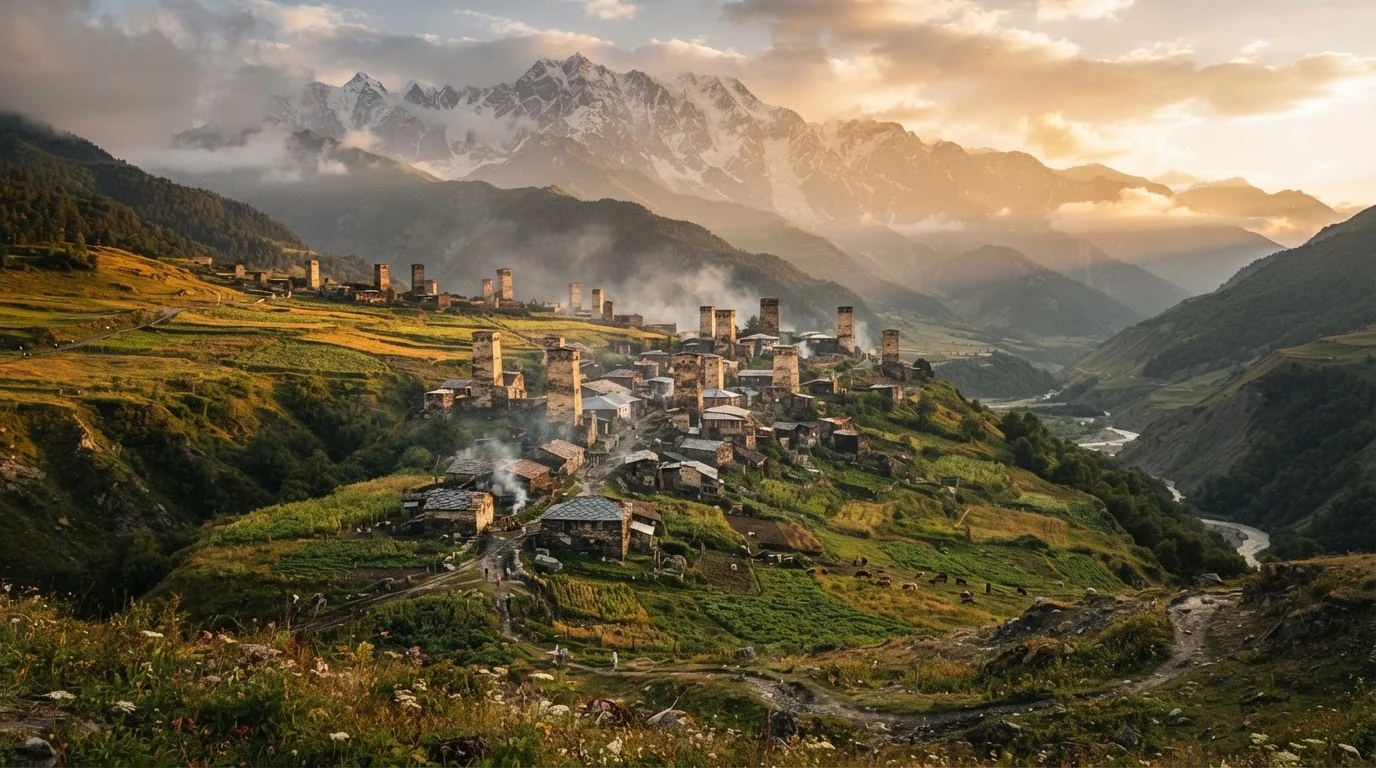
Photo credit: ExploreRoute.net | Travel Made Simple
In this article
High-altitude villages across the South Caucasus preserve ancient architecture, living traditions, and landscapes that remain largely undiscovered by international tourism.
Where the Caucasus Keeps Its Secrets
Between the Black Sea and the Caspian, a spine of mountains holds dozens of villages that international tourism has, for the most part, quietly ignored. The South Caucasus — Georgia, Armenia, and Azerbaijan — has begun drawing curious travelers to its capital cities, but the highland communities above those cities operate on an entirely different rhythm: older, quieter, and far more revealing about how people have actually lived in this corner of the world for a thousand years or more.
These are not destinations invented for visitors. They are working communities where grape varieties predate Rome, defensive towers were built before the Crusades, and carpets still encode the genealogy of the families who weave them. What follows is a reference guide to the villages that reward patient, independently minded travelers willing to venture beyond the obvious routes. For a broader sense of how this approach to travel translates across other ranges and regions, see our guide to overlooked regions.
| Countries covered | Georgia, Armenia, Azerbaijan |
| Typical elevation range | 1,000 – 2,200+ meters above sea level |
| Best travel window | Late May through September for highland access (Road closures vary; verify locally) |
| UNESCO World Heritage sites included | Upper Svaneti (Georgia), listed 1996 (UNESCO World Heritage List) |
| Languages encountered | Georgian, Armenian, Azerbaijani, Svan, Khinalug, Russian |
| Visa requirements | Vary by country and nationality; verify before travel (Check official government sources) |
Georgia: Svaneti, Tusheti, and the Forgotten Northeast
Mestia in Upper Svaneti is Georgia's most visited highland town — and even it sees a fraction of the traffic that comparable Alpine destinations handle. Beyond Mestia, the road toward Ushguli climbs through four villages collectively recognized as a UNESCO World Heritage Site, where medieval Svan towers cluster so densely they resemble a skyline frozen in the 12th century. The towers served as clan refuges during blood feuds and foreign invasions alike, and many remain structurally intact, maintained by the families who still live in their shadows.
Tusheti, in the northeast, is accessible only via the Abano Pass — a rough mountain track that closes under snow for roughly half the year. The village of Omalo sits at around 1,800 meters and serves as a loose hub for a network of hamlets that still practice transhumance, moving livestock to high pastures each summer. The architecture here is distinctly different from Svaneti: lower stone houses with flat roofs, positioned to catch maximum sun across a short growing season.
Further east, the Alazani Valley villages of Kakheti — Georgia's primary wine region — offer a contrasting highland encounter. Sighnaghi is well-known, but the smaller communities dotting the southern slopes of the Greater Caucasus above the valley floor, such as Gremi (notable for its 16th-century fortress-church complex), receive far fewer visitors despite their remarkable state of preservation.
Transhumance
The seasonal movement of livestock between lower winter pastures and higher summer grazing land. Many Caucasus highland communities still practice transhumance, shaping the rhythms of village life from spring through autumn.
Svan Tower
Defensive stone structures built by Svan clan families in Upper Svaneti, Georgia, typically between the 9th and 13th centuries. They served as refuges during conflict and remain a defining feature of the Mestia and Ushguli skylines.
Intangible Cultural Heritage
A UNESCO designation recognizing living traditions, practices, and knowledge — such as craft techniques, oral traditions, or performing arts — that communities maintain and transmit across generations.
Abano Pass
A high mountain road in northeastern Georgia providing seasonal access to the Tusheti region. It typically remains closed from autumn through late spring due to snow and ice, limiting access to the summer months.
Khinalug Language
A Northeast Caucasian language spoken exclusively in the village of Khinalig in Azerbaijan's Quba District. With only a few thousand speakers, it is considered one of the most linguistically isolated languages in the Caucasus.
Armenia: Syunik and the Depths of the North
Armenia's southern province of Syunik contains landscapes that feel geologically extreme — deep gorges, volcanic plateaus, and villages perched on formations that appear almost deliberate in their drama. Tatev, named for its 9th-century monastery, sits at the end of a canyon road and is most often reached via what is marketed as the world's longest non-stop double track reversible aerial tramway. That engineering feat aside, the village itself — a cluster of stone houses around the monastery walls — is worth exploring on foot for an afternoon rather than treating as a cable-car photo opportunity.
In the north, Dilijan is sometimes called the "Armenian Switzerland" for its forested hills, though the comparison undersells its distinctiveness. The surrounding communities of Haghartsin, accessible through oak and beech woodland, contain monastic complexes dating from the 10th through 13th centuries where daily Orthodox liturgy continues largely uninterrupted by tourist schedules. Travelers who understand the value of slowing down in small towns will recognize the particular quality of arriving somewhere with no rigid itinerary.
Entry Requirements and Safety: Verify Before You Go
Visa rules, border crossing arrangements, and travel advisories across Georgia, Armenia, and Azerbaijan can shift with little notice, and some border crossings between these countries are not open to all nationalities. Always check the current guidance from your government's official travel advisory service and the embassies of each country before finalizing plans. Seasonal road closures in highland areas are common and should be confirmed with local sources at the time of travel.
Azerbaijan: Lahij, Khinalig, and the Living Craft Villages
The Azerbaijani highlands produce two categories of experience that complement each other well: craft villages with documented artisan traditions, and genuinely remote communities where altitude and infrastructure have preserved a way of life largely unchanged since the medieval period.
Lahij, in the Ismayilli District, is an extraordinary example of the former. The village's coppersmithing tradition — hammered vessels, trays, and decorative objects produced using techniques passed through generations — earned it recognition on UNESCO's Intangible Cultural Heritage list. The main street functions simultaneously as workshop and market, and the cobblestone lanes beyond it contain one of the Caucasus region's best-preserved examples of traditional merchant-town architecture.
Khinalig, at roughly 2,200 meters in the Quba District, is among the highest permanently inhabited settlements in the Caucasus. Its residents speak a distinct language — Khinalug — unrelated to Azerbaijani and spoken by only a few thousand people, making it one of the rarest linguistic communities in the world. Access involves a winding mountain road from Quba; conditions vary significantly by season, and travelers should verify road status locally before attempting the route. The village's stone architecture and its position above the treeline give it a visual severity that is genuinely unlike anywhere else in the region.
For those planning overland routes connecting these highland communities, the hidden scenic drives resource offers a useful framework for thinking about road-based exploration in unfamiliar territory. And for travelers who have already explored comparable terrain in Europe, the hill towns of southern Italy provide an instructive point of comparison — similar medieval logic, entirely different light.
~2,200 m
Elevation of Khinalig village, Azerbaijan
One of the highest permanently inhabited settlements in the entire Caucasus mountain range.
9th century
Founding era of Tatev Monastery, Armenia
The monastery complex in Syunik Province has been in continuous religious use for over a millennium.
~5,000
Estimated Khinalug language speakers
The Khinalug language is considered one of the most linguistically isolated communities in the world, spoken only in a single Azerbaijani village.

Author
Hidden Destinations Editorial Team
Hidden Destinations Editorial Team is the collective byline for our editorial team and contributor network. Articles published under this byline or an editorial pen name are researched, written, and reviewed according to our editorial standards for clarity, consistency, and independence before publication.
View all articles →