
Fall Foliage Drives Outside New England That Deserve More Attention
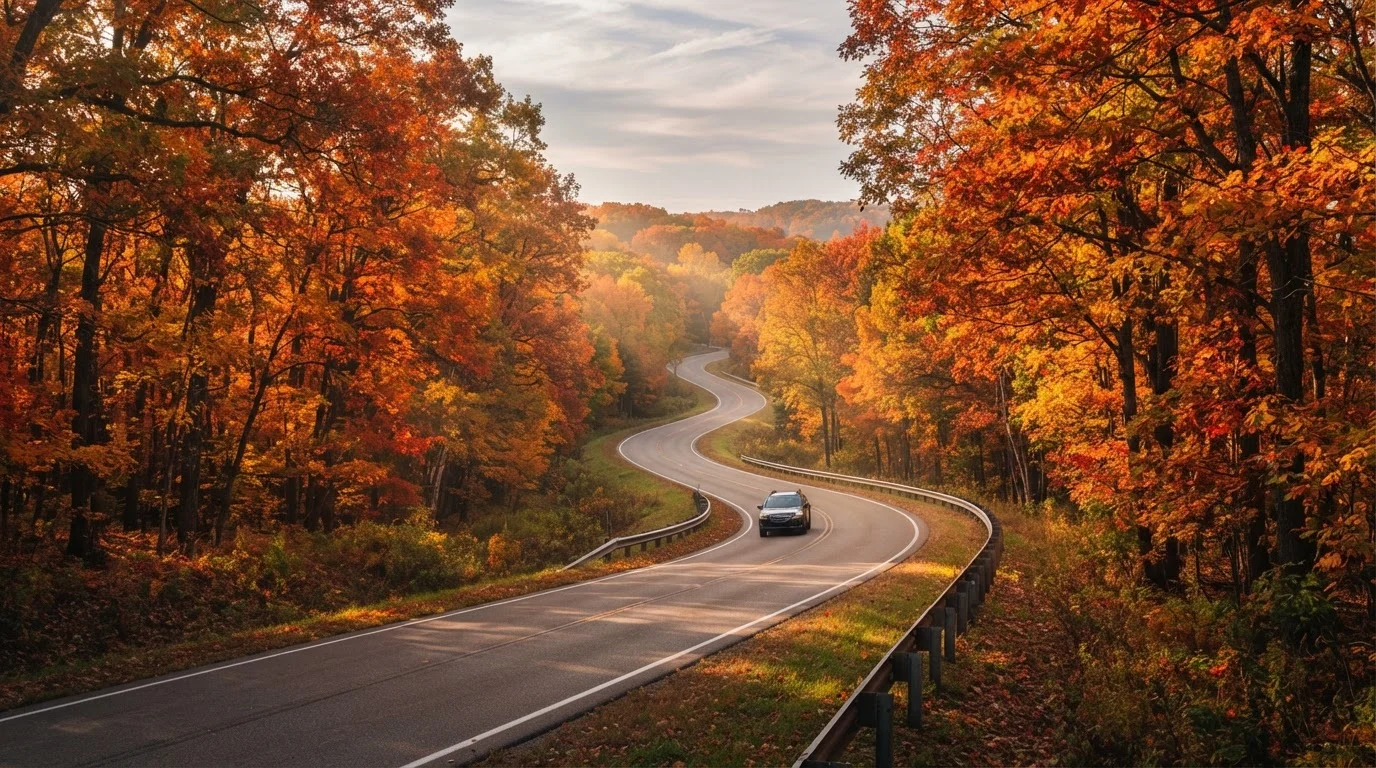
Photo credit: ExploreRoute.net | Travel Made Simple
In this article
Appalachian Ohio, the Ozarks, and Michigan's Upper Peninsula all produce spectacular autumn color — with far fewer crowds than Vermont.
Key Takeaways
- Several regions outside New England produce fall foliage that rivals Vermont's without the crowds or price premiums.
- Appalachian Ohio, the Ozarks, and Michigan's Upper Peninsula each offer distinct autumn driving experiences worth planning a trip around.
- Peak color windows shift by elevation and latitude, giving flexible travelers multiple windows to catch prime conditions.
- Many of these drives connect small towns with authentic local character that rewards slower, more curious exploration.
The Case for Looking Beyond Vermont
Every October, leaf-peeping traffic stacks up along Vermont's Route 100 and New Hampshire's Kancamagus Highway while equally breathtaking drives go nearly empty a few states west or south. The Northeastern foliage circuit is genuinely beautiful — but it's also genuinely crowded, and accommodation costs spike sharply during peak weeks. The good news: North America's hardwood forest belt extends far beyond New England, and the science behind the color show — shorter days and cooling nights triggering pigment changes in deciduous trees — plays out just as dramatically in the Ozarks, the Upper Peninsula, and the Appalachian plateau of Ohio.
If you're part of the growing cohort of travelers chasing authentic discovery over Instagram-validated scenery, these five drives belong on your radar. For a broader framework on finding underrated routes anywhere in the country, our complete hidden scenic drives guide is a solid starting point.
The Hocking Hills Scenic Byway, Appalachian Ohio
Southeastern Ohio is one of the most underestimated autumn destinations in the eastern United States. The Hocking Hills region sits at the western edge of the Appalachian Plateau, where deep sandstone gorges carved by glacial meltwater create a layered topography that lights up with sugar maple, red oak, and tulip poplar each fall. State Route 374 winds through the heart of the region, linking Hocking Hills State Park with quieter hollows and ridge roads that most out-of-state visitors never reach.
Expect a mix of fiery reds and soft golds typically peaking in mid-October. The terrain is dramatic enough — cliffs, waterfalls, hemlock-shaded canyons — that the drive itself competes with the foliage for your attention. Small towns like Logan and Nelsonville provide locally owned restaurants and lodging options that keep the experience grounded in genuine regional character.
Ohio's sandstone gorges create layered, dramatic scenery that rivals any New England hillside in October.
The Pig Trail Scenic Byway, Arkansas Ozarks
Arkansas Highway 23 — known locally as the Pig Trail — runs for roughly 20 miles through the Boston Mountains, the highest and most rugged section of the Ozark Plateau. The road earns its nickname from tight switchbacks that demand attentive driving and reward it with views across canopies of white oak, black gum, and hickory shifting into their autumn palette. The surrounding Ozark National Forest absorbs most visitors, leaving the byway itself refreshingly uncrowded even during peak weeks.
The Pig Trail connects Fayetteville in the north to the Arkansas River Valley in the south, making it an ideal addition to a longer Arkansas loop. Combine it with the nearby Talimena National Scenic Byway across the Oklahoma border for an extended Ozark foliage experience that few travelers outside the region know exists.
The Pig Trail's switchbacks through the Boston Mountains deliver Ozark foliage with almost no tourist traffic.
M-28 and the Lake Superior Shore, Michigan's Upper Peninsula
Michigan's Upper Peninsula operates on a different calendar from the rest of the Midwest. By late September, birch, aspen, maple, and tamarack are already turning along M-28 — the two-lane highway that traces the southern edge of the UP from Ironwood to Newberry. Pull north toward the Lake Superior shore and the drama intensifies: stands of birch glowing yellow against slate-grey water, and the occasional glimpse of the Pictured Rocks shoreline in the distance.
The UP's relative remoteness is precisely its appeal. Distances between towns are real, fuel up accordingly, and cell coverage is patchy in stretches. That same remoteness means the kind of solitude that's nearly impossible to find along any New England foliage route on a mid-October weekend. The region is part of a broader set of landscapes covered in eight overlooked regions worth exploring.
Birch and tamarack along Lake Superior's shore create an autumn palette unlike anywhere else in the Midwest.
The Talimena National Scenic Byway, Oklahoma and Arkansas
Stretching 54 miles along the crest of the Ouachita Mountains between Talihina, Oklahoma, and Mena, Arkansas, the Talimena Byway ranks among the most visually impressive drives in the South — and remains almost entirely off the national radar. The ridge-top alignment means you're often above the treeline looking down into valleys carpeted with shortleaf pine, red maple, and blackgum. Color typically peaks in late October to early November, later than most northern routes.
Overlooks along the route provide unobstructed views into both states simultaneously. The byway passes through the Ouachita National Forest, and interpretive panels at pullouts give useful context about the geology and ecology of the highlands. Traffic is light enough on weekdays that you can stop mid-road for a photo without inconveniencing anyone.
The Talimena Byway's ridge-top position puts you above the canopy, looking down into two states at once.
The Blue Ridge Parkway's North Carolina Section
The Virginia stretch of the Blue Ridge Parkway gets more attention, but the North Carolina section — particularly the stretch between Asheville and the Tennessee border — arguably delivers more visual variety per mile. Elevation changes are sharper, the parkway dips into coves filled with old-growth hardwoods, and the Great Balsam Mountains provide a moody backdrop when clouds settle into the valleys. Peak color at the higher elevations arrives in mid-October; lower coves hold color into early November.
Unlike the rest of this list, this route isn't obscure — but it's consistently overlooked in favor of the Virginia section by travelers who start their drive from Washington. Beginning in Asheville and heading southwest inverts the typical itinerary and rewards you with a finale at the dramatic Waterrock Knob overlook above 6,000 feet of elevation.
Starting the Blue Ridge Parkway from Asheville and heading southwest turns a familiar route into a fresh discovery.
Plan Smart, Drive Well
None of these routes require elaborate logistics, but a little preparation goes a long way. Peak color typically arrives two to three weeks later than New England's, meaning mid-to-late October through early November is often prime time for the southern routes. Elevations matter: higher ridgelines in the Ouachitas or the UP change first, valley floors follow. Always check current road conditions before heading into remote stretches — some Forest Service roads become impassable after early-season rain or snowfall. For an honest look at the trade-offs of visiting wild places outside high season, our off-season wilderness guide covers what travelers often overlook.
Time Your Drive for a Weekday
Even the least-known routes on this list can attract regional visitors on fall weekends. Hitting the road Tuesday through Thursday dramatically improves your odds of having overlooks and pullouts to yourself. It also tends to make lodging in small towns easier to arrange — proprietors at independent inns and cabins are often more flexible on weekday rates, though availability and pricing will always vary.
The South and Midwest also hold surprises well beyond autumn — scenic drives across the Deep South offer year-round alternatives for those bitten by the backroad travel bug.

Author
Road Trip Culture Editorial Team
Road Trip Culture Editorial Team is the collective byline for our editorial team and contributor network. Articles published under this byline or an editorial pen name are researched, written, and reviewed according to our editorial standards for clarity, consistency, and independence before publication.
View all articles →