
Security Theatre vs. Real Screening: Separating Myth from Fact at the Checkpoint
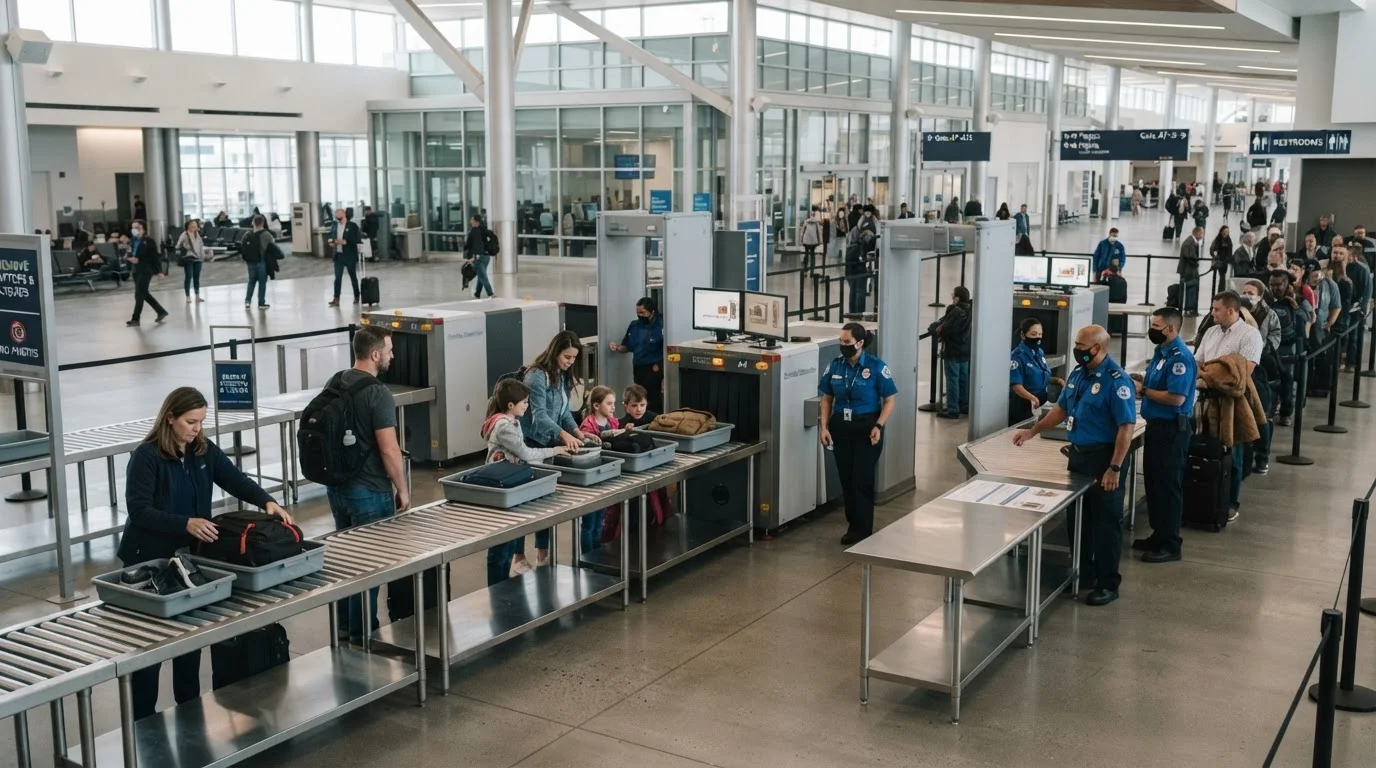
Photo credit: ExploreRoute.net | Travel Made Simple
In this article
From laptop rules to shoe removal, airport security is surrounded by half-truths. We separate the genuine requirements from the widespread misconceptions.
Key Takeaways
- Shoe removal is not universally required — it depends on the airport, country, and traveler program.
- The 3-1-1 liquids rule applies to carry-on bags only; checked luggage has different restrictions.
- TSA PreCheck and similar programs change which procedures apply to enrolled travelers.
- Metal detectors and millimeter-wave scanners serve different but complementary security functions.
- Arriving early matters, but understanding the rules matters more for a smooth checkpoint experience.
Why Airport Security Breeds Misconceptions
Airport security checkpoints generate more traveler confusion than almost any other part of the flying experience. Rules vary by country, airport, airline, and traveler enrollment status — and they've changed repeatedly since post-9/11 procedures were introduced. Add inconsistent enforcement and rushed passengers passing tips to one another, and a thriving ecosystem of half-truths emerges.
The cost is real: misinformed travelers slow down lines, face unexpected bag checks, or arrive carrying prohibited items. The myths below represent the most persistent and consequential misunderstandings, corrected against current TSA guidance and established security practice. For a broader look at travel misconceptions, see trip research myths that lead travelers astray.
Myth
You always have to remove your shoes at airport security, no matter what.
Fact
Shoe removal is required at U.S. standard screening lanes but is not a universal global standard, and TSA PreCheck members are exempt from it at participating airports.
The U.S. shoe-removal requirement dates to 2001 and applies specifically to passengers in standard TSA screening lanes. Outside the United States, many countries — including most of Europe — do not require shoes to be removed as a default step, though officers can request it based on individual assessment. Within the U.S., TSA PreCheck enrollees keep their shoes on as part of the expedited screening benefit. The rule is real where it applies, but it is far from universal.
Myth
The 3-1-1 liquids rule applies to everything you're carrying, including checked bags.
Fact
The 3-1-1 rule applies exclusively to liquids, aerosols, and gels in carry-on baggage. Checked bags have separate, different restrictions.
TSA's 3-1-1 rule limits carry-on liquids to containers of 3.4 oz (100 ml) or less, all fitting in a single quart-sized clear bag, with one bag per passenger. Checked luggage is not subject to this rule — you can pack full-size shampoo bottles in a checked bag. However, checked bags have their own prohibitions: certain flammable substances, lithium batteries above specific watt-hour thresholds, and other hazardous materials may not be checked regardless of size. Confusing the two sets of rules leads travelers to either unnecessarily discard carry-on items or, more dangerously, incorrectly assume checked bags face no restrictions.
Myth
Being pulled aside for additional screening means you're on a watch list.
Fact
Secondary screening is frequently random or algorithmically triggered and does not indicate that a traveler has been flagged in any long-term database.
TSA and equivalent agencies use randomized screening as a deliberate security measure — predictable patterns can be exploited. Automated systems also flag passengers based on factors such as one-way tickets purchased close to departure, cash payments, or inconsistencies in travel documents. None of these automatically indicate criminal suspicion or a watch list entry. Actual watch list matches trigger a different, more formal process managed through the Traveler Redress Inquiry Program (TRIP). If you are regularly selected for secondary screening and believe it is in error, TRIP provides a formal dispute mechanism.
Myth
Millimeter-wave scanners expose travelers to harmful radiation.
Fact
Advanced imaging technology used at U.S. checkpoints uses non-ionizing millimeter-wave energy, which is fundamentally different from ionizing radiation such as X-rays.
The scanners deployed at TSA checkpoints use millimeter-wave technology that emits radio-frequency energy, not ionizing radiation. Ionizing radiation — the kind associated with health risks at high exposures — includes X-rays and gamma rays, which carry enough energy to remove electrons from atoms. Millimeter-wave energy does not. The backscatter X-ray machines that did use ionizing radiation were phased out of U.S. airports by 2013. The current technology has been reviewed by multiple independent bodies. Travelers who prefer not to use the scanner can request a pat-down instead — this is a stated option, not a special accommodation.
Myth
Laptops must always be removed from bags at every airport security checkpoint.
Fact
Laptop removal is required in standard U.S. screening lanes, but TSA PreCheck members and many international checkpoints do not require it.
Standard TSA screening requires laptops to be removed from bags and placed flat in a separate bin so X-ray operators get a clear image of the device. TSA PreCheck members can leave laptops in their bags. International airports vary widely: some follow a similar removal policy, others use higher-resolution CT scanners that can image laptops inside bags without removal. When traveling internationally, follow the instructions posted at the checkpoint or given by officers rather than assuming U.S. rules apply. Removing your laptop unnecessarily wastes time; failing to remove it when required triggers a bag search that wastes more.
Myth
A boarding pass on your phone is less reliable at security than a paper pass.
Fact
Mobile boarding passes are fully accepted at TSA checkpoints and are scanned using the same barcode verification process as paper passes.
TSA has accepted mobile boarding passes for years, and most major U.S. airports have barcode scanners at document check stations designed for both formats. The practical risks of a mobile pass — screen brightness too low, app failure, dead battery — are traveler management issues, not security or acceptance issues. Keeping your screen at full brightness before reaching the checkpoint and having the pass open before you queue eliminates most problems. A paper backup can be printed at airport kiosks if needed, but it is a convenience choice rather than a requirement.
What Actually Determines Your Checkpoint Experience
Checkpoint procedures aren't arbitrary — they reflect layered, risk-based protocols designed to adapt to known threat profiles. Understanding that framework helps explain why rules differ between travelers and why consistency can feel elusive.
~10 million
TSA PreCheck enrollees in the U.S.
TSA has reported enrollment figures in this range, reflecting widespread adoption of risk-based screening programs that alter standard checkpoint procedures for eligible travelers.
~93%
U.S. airports with PreCheck lanes
TSA PreCheck is available at more than 200 U.S. airports, covering the vast majority of domestic commercial flight departures and meaningfully changing the checkpoint experience for enrolled passengers.
Trusted traveler programs like TSA PreCheck change the ruleset that applies to you at participating U.S. airports: shoes stay on, laptops stay in the bag, and liquids don't need to be separated. Before enrolling, it's worth understanding exactly what each program covers. Our breakdown of TSA PreCheck, Global Entry, and CLEAR explains the distinctions clearly.
How you pack also shapes how long you spend at the checkpoint. Screeners flag bags when dense or overlapping items obscure the x-ray image — not because the contents are suspicious, but because visibility is limited. Packing your carry-on so security doesn't slow you down outlines practical organization strategies that help bags clear on the first pass.
International Rules Are Not Identical to U.S. Rules
Checkpoint procedures outside the United States are set by each country's civil aviation authority and can differ significantly from TSA standards. Liquid limits, electronics requirements, and prohibited items may vary. Always check the official guidance for your departure country before traveling internationally, and do not assume U.S. experience transfers directly.
For a step-by-step walkthrough of the entire checkpoint process, the airport security complete walkthrough covers every stage from queue entry to collection bin. Knowing the sequence in advance eliminates most on-the-spot uncertainty.

Author
Smart Air Travel Editorial Team
Smart Air Travel Editorial Team is the collective byline for our editorial team and contributor network. Articles published under this byline or an editorial pen name are researched, written, and reviewed according to our editorial standards for clarity, consistency, and independence before publication.
View all articles →