
Jet Lag vs. General Travel Fatigue: Understanding the Difference
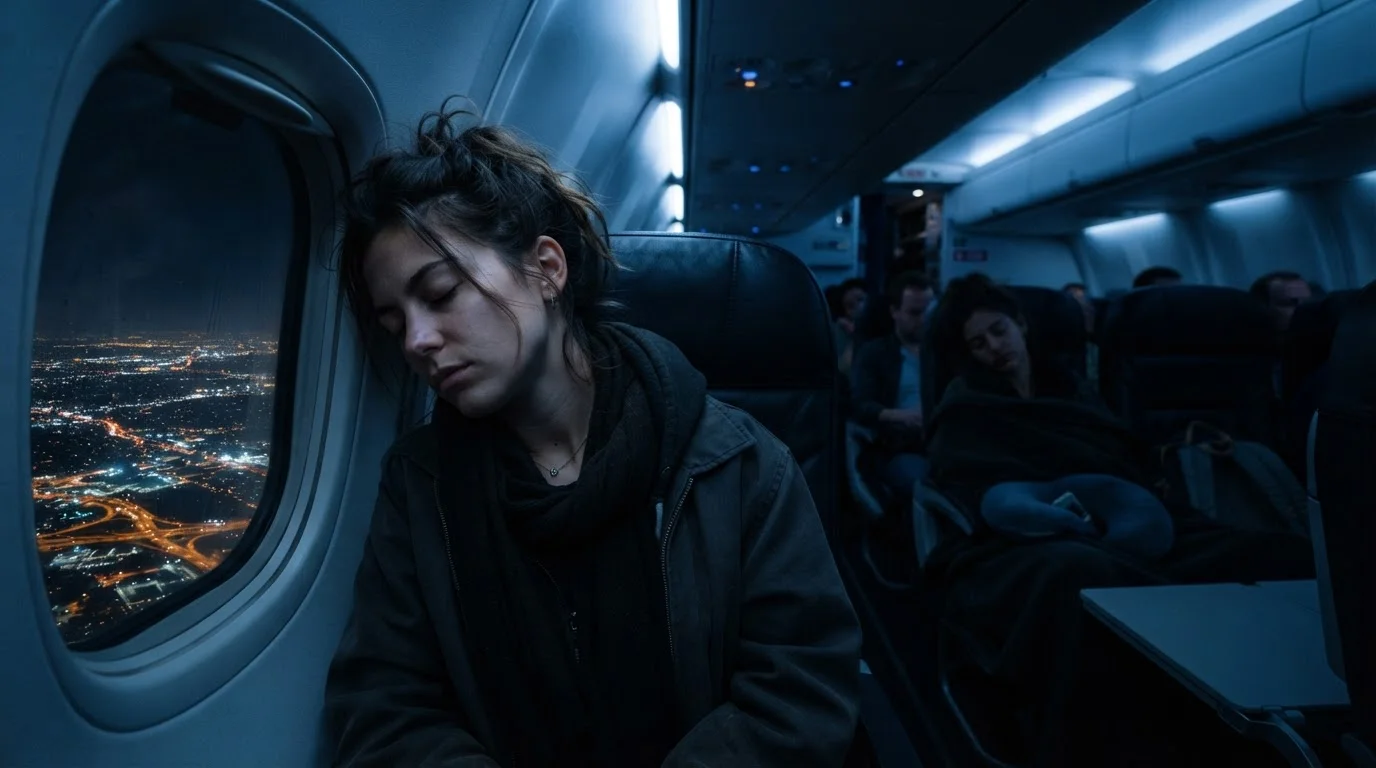
Photo credit: ExploreRoute.net | Travel Made Simple
In this article
Not every post-flight exhaustion is jet lag. Learn what distinguishes circadian disruption from ordinary tiredness and why it matters for recovery.
Key Takeaways
- Jet lag is a circadian rhythm disorder; general fatigue is caused by physical and logistical travel stressors.
- Jet lag symptoms persist for days and scale with the number of time zones crossed; general fatigue typically resolves with a single good night's sleep.
- Eastward travel tends to produce more severe jet lag than westward travel due to the body's natural circadian rhythm length.
- Hydration, movement, and light management address both conditions, but timing strategies are specific to jet lag.
- Misidentifying jet lag as ordinary tiredness can lead to recovery approaches that slow — rather than accelerate — adaptation.
Two Different Problems, Two Different Solutions
Frequent flyers often lump post-flight exhaustion into a single category, but jet lag and general travel fatigue are physiologically distinct. Treating one with the other's remedy doesn't just fail — it can actively delay recovery. The distinction starts with understanding what each condition actually is.
Jet lag (formally circadian rhythm sleep-wake disorder, jet lag type) occurs when the body's internal clock — driven by the suprachiasmatic nucleus in the hypothalamus — is out of sync with the local day-night cycle at the destination. The clock does not reset instantaneously; it shifts roughly one to one-and-a-half hours per day, meaning a six-hour eastward crossing can leave your physiology misaligned for four to six days. Symptoms include sleep-onset insomnia, early waking, daytime drowsiness, reduced concentration, and gastrointestinal disturbance — all timed to the body's origin-zone rhythms rather than local ones.
General travel fatigue has no circadian component. It is the accumulated toll of a travel day: cabin dehydration from low-humidity air, hours of immobility, disrupted pre-flight sleep, airport stress, and caloric irregularity. These are recoverable with straightforward rest and rehydration, usually within a single sleep cycle. For a deeper look at how the flight environment itself stresses the body, see why your body feels so different at 35,000 feet.
| Criterion | Jet Lag | General Travel Fatigue |
|---|---|---|
| Root cause | Circadian rhythm misalignment | Physical & logistical travel stressors |
| Onset pattern | Worsens on days 2–3 post-arrival | Peaks immediately after landing |
| Resolution time | Days to over a week | One to two full sleep cycles |
| Key symptom | Inverted alertness/sleep timing | General tiredness and body aches |
| Travel direction effect | Worse flying east than west | Not direction-dependent |
| Time zones required | Typically 3+ zones crossed | Occurs regardless of zones |
| Primary recovery lever | Light exposure timing | Sleep, hydration, movement |
How to Tell Which One You Have
The clearest diagnostic marker is timing and persistence. General travel fatigue peaks immediately after landing and resolves with a full night's sleep. Jet lag often feels tolerable on arrival day — adrenaline and novelty mask it — then deepens on days two and three as the circadian mismatch becomes undeniable.
A second marker is sleep architecture. With general fatigue, you fall asleep easily and sleep through the night. With jet lag, you may lie awake during local nighttime hours (your body reads them as mid-afternoon) or wake at 4 a.m. feeling fully alert. Cognitive performance — the ability to concentrate, recall information, or make decisions — deteriorates in jet lag in ways that extra coffee cannot fully compensate for.
Direction of travel matters too. Eastward flights shorten the perceived day, which conflicts with the human circadian cycle's natural tendency to run slightly longer than 24 hours. Westward travel extends the day, which is easier for most people to accommodate. This is why a New York–London flight tends to produce more pronounced jet lag than the return leg.
~1–1.5 hrs/day
Circadian clock reset rate per day
Research in chronobiology consistently estimates the human circadian system adapts roughly one to one-and-a-half hours per day following a time zone transition.
3+ zones
Time zones needed to trigger jet lag
Aviation medicine guidance generally holds that crossing fewer than three time zones produces minimal circadian disruption; noticeable jet lag emerges beyond that threshold.
~20%
Cabin relative humidity on long-haul flights
Cabin humidity typically drops to around 20% on long-haul flights — well below comfortable indoor levels — contributing significantly to dehydration-related travel fatigue.
If you are unsure whether poor in-flight sleep is making either condition worse, the evidence-based strategies in our guide to sleeping on a plane are worth reviewing before your next long-haul trip.
Recovery Strategies That Match the Cause
For general travel fatigue, the recovery path is straightforward: prioritize sleep at your normal local hour, hydrate systematically (aim for water rather than alcohol or caffeine-heavy beverages during and after the flight), and incorporate movement. Sitting still for extended periods has measurable circulatory effects — an in-cabin movement routine can reduce the residual stiffness and sluggishness that contribute to post-flight tiredness.
For jet lag, light exposure is the most evidence-supported lever. Natural daylight suppresses melatonin production and signals the circadian clock to reset. After an eastward crossing, morning light at the destination accelerates adaptation; avoiding bright light in the late evening helps prevent the clock from shifting in the wrong direction. After westward travel, evening light exposure is beneficial. Strategic short naps (under 30 minutes) can relieve acute sleepiness without reinforcing the misaligned rhythm.
Melatonin supplements are widely discussed in the context of jet lag. They are generally considered low-risk for short-term use, but dosing, timing, and appropriateness vary by individual. Consult a qualified healthcare professional before using any supplement, particularly if you take other medications or have underlying health conditions.
Eastward vs. Westward: Why Direction Matters
The human circadian cycle naturally runs slightly longer than 24 hours, making it easier to extend a day (westward travel) than to compress one (eastward travel). This is why many travelers report that flying from the US to Europe feels harder to recover from than the return journey. Planning key activities — important meetings, athletic events — for the second or third day after an eastward arrival, rather than the first, can help account for this pattern.
Over-programming your itinerary in the belief that pushing through fatigue will accelerate adaptation is a common mistake — and one that can undermine even wellness-focused travel. Why wellness travelers return home feeling worse explores how poor post-travel recovery planning compounds this problem.
This article provides general health information for educational purposes and is not a substitute for professional medical advice. Consult a qualified healthcare provider for guidance specific to your health circumstances.

Author
Smart Air Travel Editorial Team
Smart Air Travel Editorial Team is the collective byline for our editorial team and contributor network. Articles published under this byline or an editorial pen name are researched, written, and reviewed according to our editorial standards for clarity, consistency, and independence before publication.
View all articles →