
Why Your Body Feels So Different at 35,000 Feet
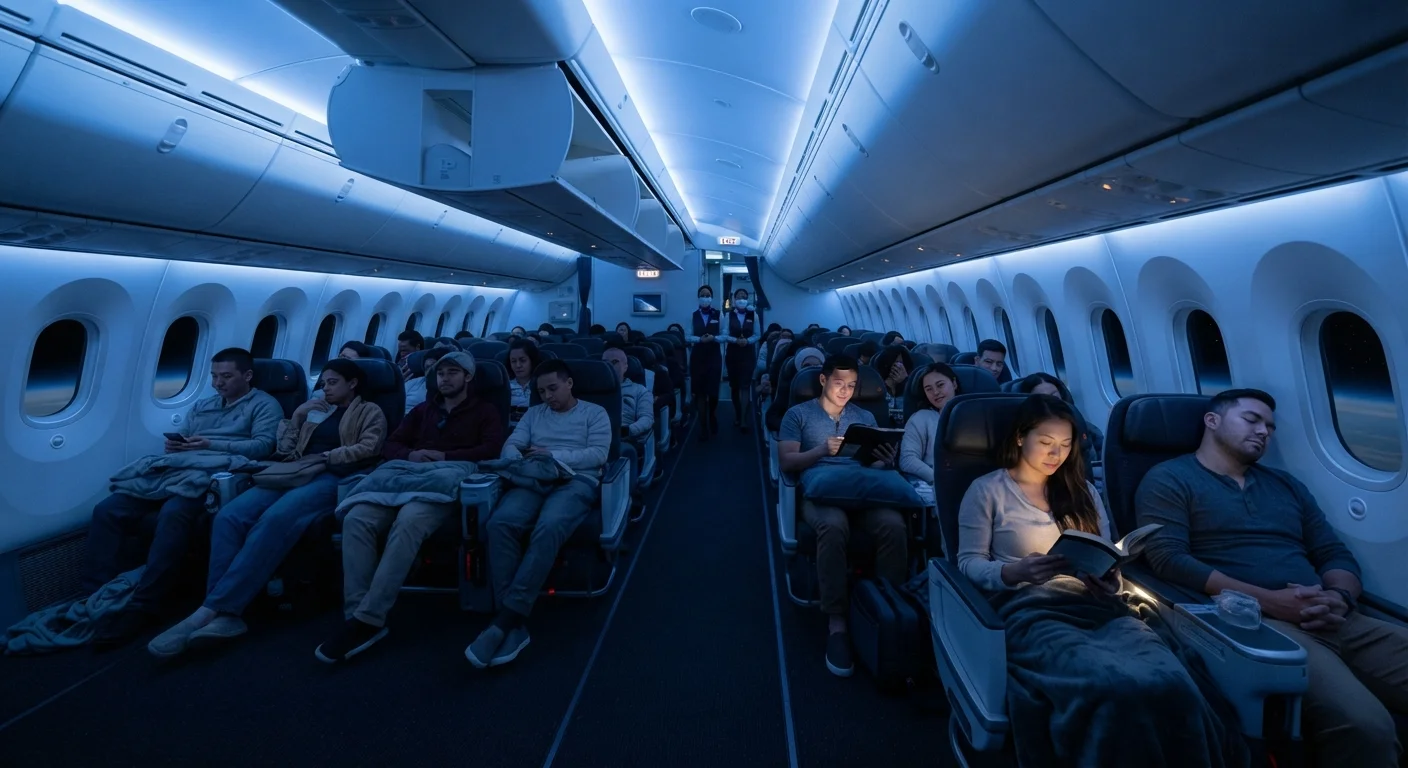
Photo credit: ExploreRoute.net | Travel Made Simple
In this article
Low cabin pressure, dry air, and immobility affect you in measurable ways. Here's what's actually happening to your body during a flight.
Key Takeaways
- Cabin pressure is lower than sea level, reducing how efficiently your blood carries oxygen.
- Humidity inside aircraft cabins typically drops below 20%, drier than most desert environments.
- Prolonged immobility slows circulation and increases the risk of fluid pooling in the lower limbs.
- Gas trapped in your body expands at altitude, explaining bloating and ear discomfort.
- Most in-flight symptoms are manageable with intentional hydration, movement, and clothing choices.
Pressure: The Invisible Force Reshaping Your Physiology
The moment an aircraft climbs above roughly 10,000 feet, the fuselage pressurization system kicks in — but it doesn't replicate sea level. It replicates somewhere between 6,000 and 8,000 feet. That distinction matters more than most passengers realize.
At those effective altitudes, the partial pressure of oxygen in the air you breathe is measurably lower. For healthy adults, this typically results in blood oxygen saturation dropping a few percentage points below the 95–99% range considered normal at sea level. Your body compensates — breathing rate may subtly increase, and your heart may work slightly harder — but the net effect is mild hypoxia sufficient to blunt alertness and contribute to that familiar post-flight fatigue.
Gases in your body also obey basic physics. Boyle's Law dictates that as ambient pressure falls, trapped gas expands. This explains why ears pop during ascent, why sinuses can ache near descent, and why the digestive discomfort of bloating intensifies mid-flight. The gas in your gut at boarding occupies roughly 25–30% more volume by cruising altitude.
For a plain-language breakdown of exactly what these pressure numbers mean in practice, see our guide to cabin humidity, pressure, and recirculated air.
6,000–8,000 ft
Effective cabin altitude on most commercial flights
Aircraft manufacturers and aviation regulators define this as the standard pressurization range for passenger comfort and airframe integrity.
10–20%
Typical relative humidity inside a flight cabin
Most ground-level indoor environments maintain 30–60% relative humidity, making aircraft cabins significantly drier by comparison.
~25–30%
Approximate gas expansion in the gut at cruise altitude
A predictable consequence of Boyle's Law as ambient pressure decreases from ground level to cruising altitude.
Humidity: Why the Cabin Air Is Drier Than a Desert
Commercial aircraft cabins routinely maintain relative humidity levels between 10% and 20%. For context, the Sahara Desert averages around 25%. This extreme dryness isn't a design failure — it's a structural reality. Introducing more moisture into the cabin would accelerate corrosion of the airframe over time, a trade-off aircraft manufacturers have historically favored on the side of structural integrity.
Passengers feel this dryness in specific, predictable ways: parched throat, dry nasal passages, irritated contact lenses, and skin that feels tighter by the time of landing. More importantly, the body loses water vapor through breathing and skin transpiration at a faster rate than in typical indoor environments — without most people consciously noticing.
Dehydration in this context doesn't mean dramatic thirst. It often manifests as fatigue, headache, and reduced cognitive sharpness — symptoms easily attributed to travel stress rather than their actual cause. For a structured look at managing this, our article on staying hydrated in the air covers the practical side in depth.
Hydrate Before You Board, Not Just During
By the time you feel thirsty at altitude, mild dehydration may already be underway. Starting a flight well-hydrated gives your body a meaningful buffer against the cabin's extremely low humidity. Water is generally more effective than coffee or alcohol, both of which can increase fluid loss through diuresis.
Immobility and Circulation: What Sitting Still Actually Does
Economy seating in most commercial aircraft allows for limited natural movement, and most passengers don't use what space they have. Sitting in a fixed position for hours reduces blood flow velocity in the lower limbs — the calf muscles, which normally act as a venous pump when walking, contribute almost nothing when you're stationary.
The visible result is swollen feet and ankles. The less visible concern is that prolonged immobility increases the risk of deep vein thrombosis (DVT) — blood clots forming in the deep veins of the legs — particularly in passengers with pre-existing risk factors. Medical guidance consistently cites long-haul flying (typically flights over four hours) as a period warranting attention to circulation.
This isn't a reason to avoid flying, but it is a reason to move deliberately. Standing in the aisle, flexing calf muscles while seated, and walking to the galley at intervals all help. Clothing choices matter too — what you wear on a long flight, including compression socks, can make a measurable difference in how your circulation holds up over a long journey. For a structured approach to keeping your blood moving, see our in-flight movement and circulation routine.
This article provides general informational content about in-flight physiology and is not a substitute for personal medical advice. Readers with cardiovascular conditions, clotting disorders, or other relevant health concerns should consult a qualified healthcare professional before flying.
Frequently Asked Questions

Author
Smart Air Travel Editorial Team
Smart Air Travel Editorial Team is the collective byline for our editorial team and contributor network. Articles published under this byline or an editorial pen name are researched, written, and reviewed according to our editorial standards for clarity, consistency, and independence before publication.
View all articles →