
Mountain Air vs. Ocean Coastline: Which Natural Setting Supports Recovery Better?
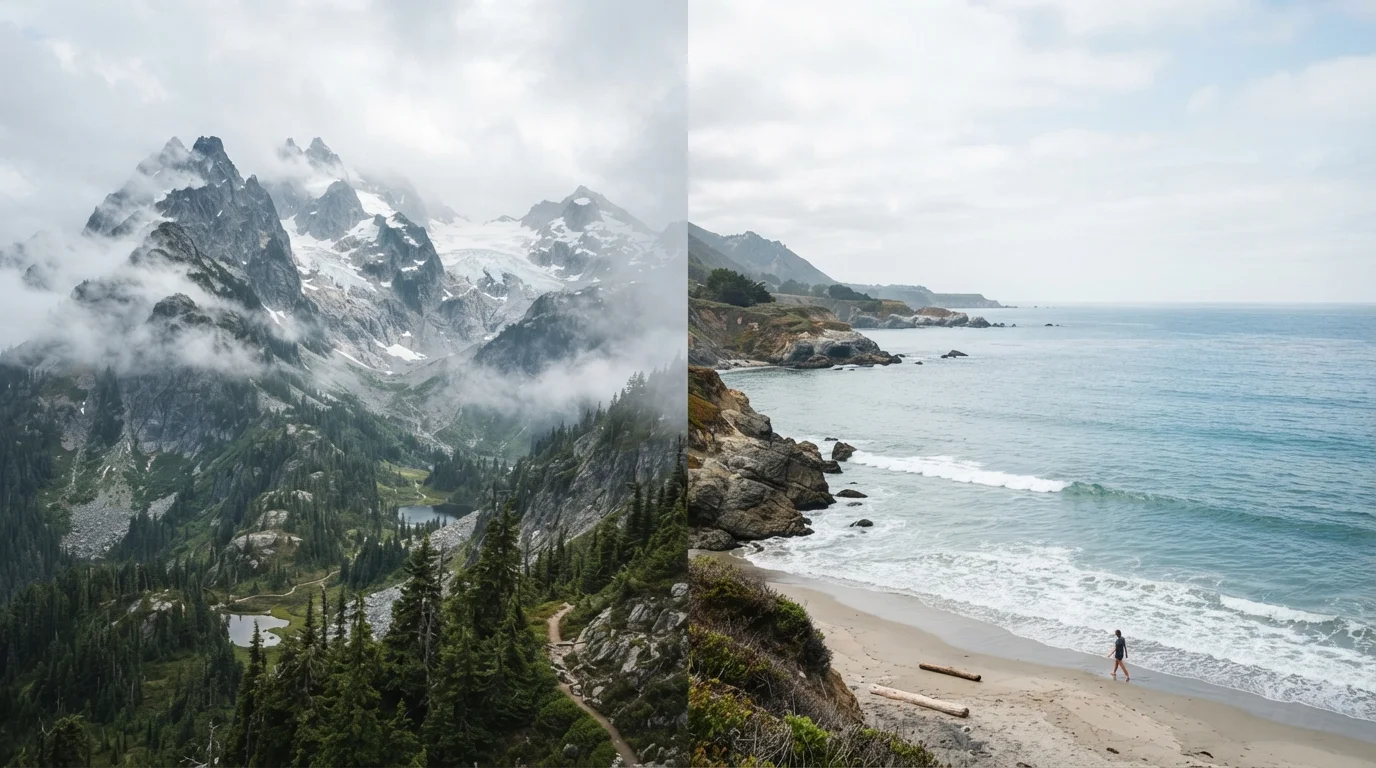
Photo credit: ExploreRoute.net | Travel Made Simple
In this article
High-altitude mountain retreats and coastal environments each offer distinct physiological and psychological effects. Compare what the evidence suggests about each.
Key Takeaways
- Mountain environments offer reduced air pressure and cooler temperatures that can affect sleep, breathing, and cardiovascular function.
- Coastal settings provide consistent humidity, negative ion concentration near breaking waves, and lower elevation that most people tolerate easily.
- Neither setting universally outperforms the other — individual health profiles, recovery goals, and personal preferences determine which is better suited.
- Altitude carries real physiological risks for certain travelers; always consult a healthcare provider before planning high-elevation stays.
- Both environments support mental well-being through nature immersion, though the mechanisms and intensities differ.
The Science Behind Nature and Recovery
The idea that natural environments support healing is not merely intuitive — it is grounded in a growing body of psychophysiological research. Studies on ART and Stress Recovery Theory suggest that natural settings lower cortisol levels, reduce sympathetic nervous system activation, and restore directed attention capacity. What researchers continue to examine is whether specific landscape types — mountain versus coastal — produce meaningfully different outcomes.
For frequent travelers already comfortable with mainstream destinations, the more targeted question is practical: when you design a trip around recovery, does elevation or sea level serve you better? The answer depends on the type of recovery you are seeking and, critically, your individual health profile. See our overview of emotionally focused wellness travel for context on how structured programs approach this question.
What Mountain Environments Actually Do to the Body
At elevations above roughly 8,000 feet (2,400 meters), reduced atmospheric pressure means each breath delivers less oxygen. The body responds by increasing respiratory rate, stimulating red blood cell production over time, and shifting cardiovascular output. For healthy, acclimatized individuals, this can enhance aerobic efficiency after several days — a phenomenon exploited by endurance athletes who train at altitude.
However, altitude also carries risks that recovery-focused travelers must take seriously. Acute mountain sickness (AMS) affects a substantial portion of visitors who ascend too quickly, causing headaches, nausea, disrupted sleep, and fatigue — the opposite of restorative. Acclimatization is frequently underestimated, and for travelers with cardiovascular or respiratory conditions, high elevation may be contraindicated. Always consult a qualified healthcare provider before planning stays above significant elevation.
Altitude Is Not Universally Restorative
Travelers with heart conditions, pulmonary issues, pregnancy, or a history of altitude sickness should seek medical guidance before planning stays above 8,000 feet. Even healthy individuals can experience acute mountain sickness if ascent is too rapid. Recovery-focused travel should not introduce new physiological stressors that undermine the goal.
On the psychological side, mountain environments offer dramatic visual scale, reduced ambient noise, and a sense of solitude that research associates with lowered rumination. The practical logistics of high-altitude accommodation also shape the experience — where you sleep matters as much as where you hike.
What Coastal Environments Offer That Mountains Cannot
Sea-level coastal settings eliminate altitude-related physiological stress entirely, making them accessible to a far wider range of health profiles. The marine environment introduces its own distinct variables: higher humidity, salt-laden air, consistent ambient sound from wave action, and — near breaking surf — elevated concentrations of negative ions. While the science on negative ions remains preliminary and contested, the broader psychological effects of blue-space environments are better established. Proximity to open water is associated in multiple studies with reduced anxiety and improved mood.
The rhythmic, predictable sound of waves functions as an auditory anchor, supporting a parasympathetic nervous system state without any physical exertion requirement. This makes coastal settings particularly well-suited to recovery from burnout or prolonged stress, where the body may lack reserves for altitude-induced physiological adaptation.
Match the Setting to Your Recovery Phase
If you are in an early or acute phase of recovery — from burnout, illness, or emotional stress — a coastal environment's lower physiological demand often makes it the more appropriate starting point. Reserve mountain environments for a later phase when your body and mind have sufficient reserves to engage with the additional adaptation required. Gradual elevation gain also significantly reduces altitude sickness risk.
For travelers weighing solitude as a recovery factor, our comparison of inland versus coastal wilderness explores how these landscape types differ in access, logistics, and the quality of quiet they offer.
Side-by-Side: Recovery Factors Compared
The table below summarizes how each environment compares across the dimensions most relevant to a recovery-focused traveler. Note that individual variation is significant — these are general patterns, not guarantees.
| Recovery Factor | Mountain Setting | Ocean Coastline | |
|---|---|---|---|
| Physiological accessibility | Limited — altitude screening advised | Broad — suitable for most health profiles | |
| Oxygen availability | Reduced at elevation | Normal sea-level levels | |
| Sleep quality | Often disrupted until acclimatized | Generally unaffected by environment | |
| Stress reduction (evidence base) | Moderate — solitude and scale contribute | Strong — blue-space research well-established | |
| Physical effort required | Higher — terrain demands exertion | Lower — passive immersion possible | |
| Sensory environment | Crisp air, silence, dramatic vistas | Rhythmic sound, salt air, open horizon | |
| Risk of adverse effects | AMS risk at high elevation | Minimal for most travelers |
Choosing the Right Setting for Your Recovery Goals
For physical recovery — particularly for active travelers coming off intense training, injury, or illness — the decision hinges substantially on your body's relationship with altitude. Healthy individuals who acclimatize well may find the mountain environment uniquely invigorating over a multi-day stay. Those with cardiovascular concerns, sleep disorders, or compromised respiratory function are generally better served by coastal settings, where the physiological baseline remains familiar.
For mental and emotional recovery, both environments demonstrate value, but through different mechanisms. Mountains offer scale, perspective, and the kind of effortful engagement — hiking, navigating terrain — that produces restorative fatigue and a sense of achievement. Coastal environments offer passive restoration: the sensory input of ocean air, sound, and horizon does the work without demanding physical output. Travelers recovering from burnout in particular may benefit from the lower-effort coastal model. Our guide to digital detox and meditation retreats explores how structured programming in either environment can amplify these effects.
This article is for general informational and educational purposes only and does not constitute medical advice. Readers with health conditions or concerns should consult a qualified healthcare professional before making decisions about high-altitude or other travel environments.

Author
Specialty Travel Editorial Team
Specialty Travel Editorial Team is the collective byline for our editorial team and contributor network. Articles published under this byline or an editorial pen name are researched, written, and reviewed according to our editorial standards for clarity, consistency, and independence before publication.
View all articles →