
Resort Stays vs. City Hotels: Choosing the Right Base for Your Trip
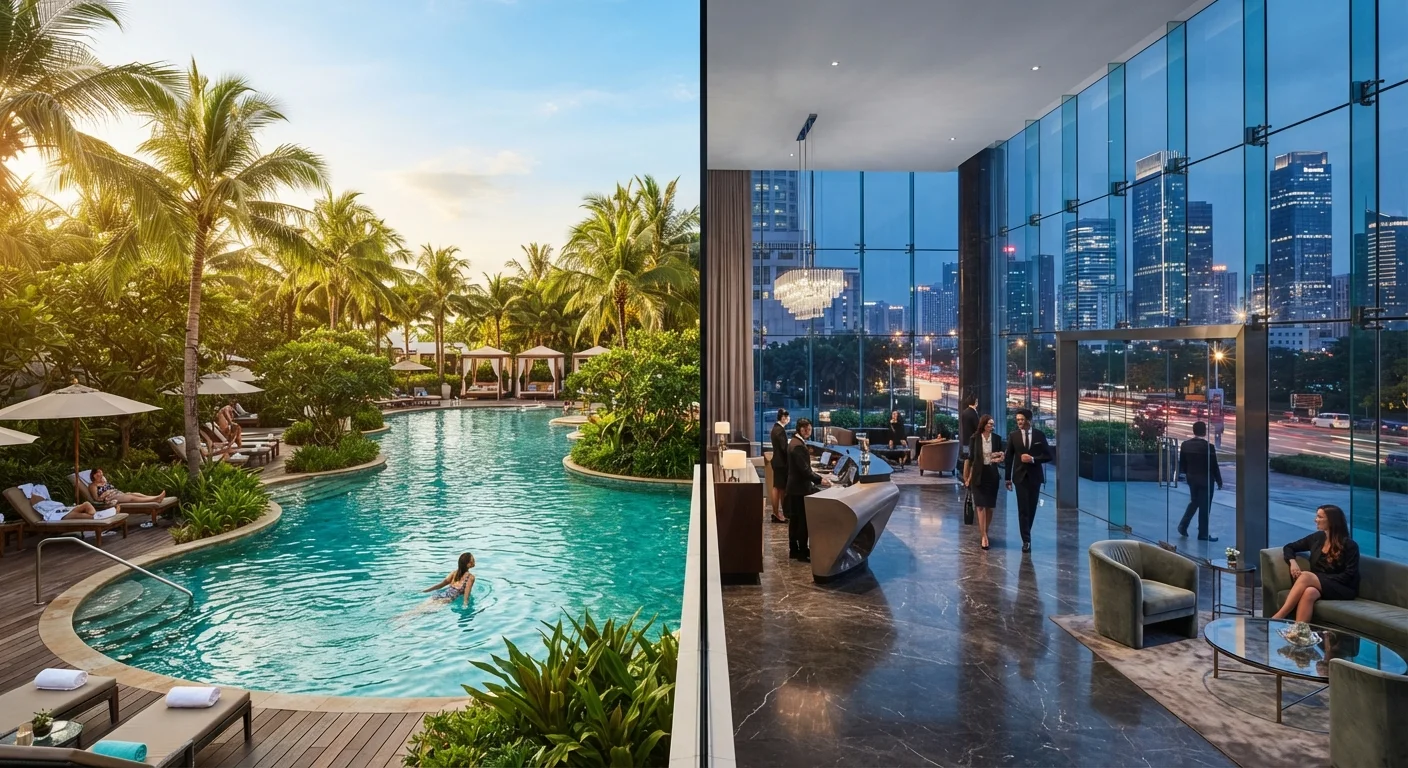
Photo credit: ExploreRoute.net | Travel Made Simple
In this article
Resorts and city hotels serve fundamentally different trips. Understand the trade-offs before you commit to either.
Key Takeaways
- Resorts work best when the property itself is part of the trip's purpose — not just where you sleep.
- City hotels prioritize access to urban neighborhoods, transit, and cultural landmarks over in-house amenities.
- Your daily rhythm — active exploration vs. structured relaxation — is the clearest signal for which style fits.
- Group composition matters: families with young children often benefit more from resort infrastructure than solo or couple travelers.
- Neither style is inherently more luxurious; both can offer premium experiences within their own logic.
- Mixing both styles across a multi-destination trip is a legitimate and often rewarding strategy.
The Fundamental Difference in What Each Delivers
The clearest way to frame this choice: a resort is a destination; a city hotel is a base. That distinction carries more practical weight than star ratings, price points, or amenity lists.
A resort is designed to keep you on-property — or at least to make staying there as rewarding as venturing out. Pools, spas, curated dining, programming, and often a distinct sense of place are all engineered to satisfy. The location itself is frequently part of the draw: beachfront, mountain-set, or island-perched, the surroundings become inseparable from the stay.
A city hotel operates on a different value proposition. Its job is to provide a comfortable, well-located base from which you leave every morning and return every evening. The room is functional and the location is strategic — ideally near transit, cultural districts, or business centers — but the city around you is the experience, not the property itself. As our editors explore in depth, urban hotel geography can shape an entire trip in ways that room quality simply cannot.
| Criterion | Resort Stay | City Hotel |
|---|---|---|
| Primary value | On-property experience and amenities | Location access and urban mobility |
| Ideal trip length | 4–10 nights of focused relaxation | 2–5 nights of active exploration |
| Best group type | Families, couples, groups seeking structure | Solo travelers, couples, business travelers |
| Dining approach | On-site restaurants; often bundled | External dining; local restaurant scene |
| Activity sourcing | Curated by the property | Self-directed from the city |
| Cultural immersion | Filtered through hospitality context | Direct and immediate |
| Cost predictability | Higher upfront; fewer daily surprises | Lower base rate; variable daily spend |
| Space and pace | Expansive grounds; slower rhythm | Compact rooms; faster pace |
How Your Travel Personality Should Guide the Decision
Experienced travelers often choose intuitively, but it's worth making the logic explicit. Ask yourself: How do I want to feel at the end of each day? If the answer involves structured stillness — a spa treatment, a long pool afternoon, a sunset cocktail on a terrace — a resort's contained environment suits that rhythm. If the answer involves fatigue from walking, the smell of a street market, or lingering over a late dinner somewhere local, a city hotel's lean footprint is the right match.
Trip purpose is equally diagnostic. A honeymoon built around romance and leisure calls for different infrastructure than a cultural trip through a capital city. Families navigating mixed age groups often find resort logistics — on-site childcare programs, all-inclusive dining, activity scheduling — dramatically reduce daily friction. Solo travelers and couples on discovery trips frequently find resort life too curated, even isolating, compared to the spontaneity a city base affords.
For a deeper framework on aligning accommodation style to trip type, see our guide on matching your trip type to the right hotel style.
63%
Travelers who prioritize location over amenities
According to a hospitality consumer survey by Skift Research, the majority of frequent travelers rank proximity to key attractions or transit as their top booking criterion for city trips.
4.2 nights
Average resort stay length vs. 2.6 for city hotels
Industry data from STR Global indicates resort properties consistently see longer average length of stay than urban hotels, reflecting their role as destination experiences rather than transit bases.
Trade-Offs Worth Naming Honestly
Neither format is without compromises. Resorts often come with premium price tags — particularly all-inclusive properties where food and beverage costs are bundled in. That bundling has real value for families or groups who'd otherwise spend heavily dining out, but it can feel like paying for a system you're only partially using as a couple or solo traveler who eats lightly.
City hotels, conversely, can deceive with low nightly rates that don't account for how much you'll spend in restaurants, on transport, and on entry fees once you're immersed in a dense urban environment. For extended stays, that daily outlay compounds quickly — a dynamic our editors examine in the comparison of extended-stay hotels and aparthotels, where cooking access and space become material considerations.
There's also the question of authenticity. Resort environments are highly managed; local culture is often filtered through a hospitality lens. City hotels, especially those embedded in residential or mixed-use neighborhoods, drop you closer to unmediated local life — though that too carries trade-offs around noise, access, and comfort for travelers less accustomed to urban density.
Resort Classifications Vary Widely
The term 'resort' covers a broad spectrum — from all-inclusive beach properties with hundreds of rooms to intimate boutique lodges with a single pool. Don't assume all resorts share the same level of activity programming, dining variety, or price structure. A smaller resort in a remote setting may offer far more genuine immersion than a large-scale all-inclusive. Clarifying what type of resort experience you're evaluating will sharpen the comparison with any city hotel alternative.
When a Hybrid or Sequential Strategy Makes Sense
For trips spanning ten days or more, particularly in a country with distinct regional zones, a sequential approach — beginning with a city hotel to orient yourself, then transitioning to a resort for recovery and immersion — can yield the most satisfying overall experience. You absorb urban context first, then shift into a slower register without the cognitive dissonance of rushing to do both simultaneously.
If your destination itself spans multiple environments, the choice may be made for you by geography. Many travelers visiting Southeast Asia, for instance, naturally split time between a city base and a coastal resort property — not as a luxury but as a practical response to what different regions offer. The same logic applies to trips that blend alpine access with urban culture; our editors examine that dynamic directly in the mountain lodge vs. valley hotel comparison.
For travelers drawn to something beyond either format, unique stays offer a third path — accommodation where the lodging itself is the point, whether that's a working vineyard, a floating bungalow, or a converted heritage building that no resort or city hotel could replicate.

Author
Where to Stay Editorial Team
Where to Stay Editorial Team is the collective byline for our editorial team and contributor network. Articles published under this byline or an editorial pen name are researched, written, and reviewed according to our editorial standards for clarity, consistency, and independence before publication.
View all articles →