
Matching Your Trip Type to the Right Hotel Style
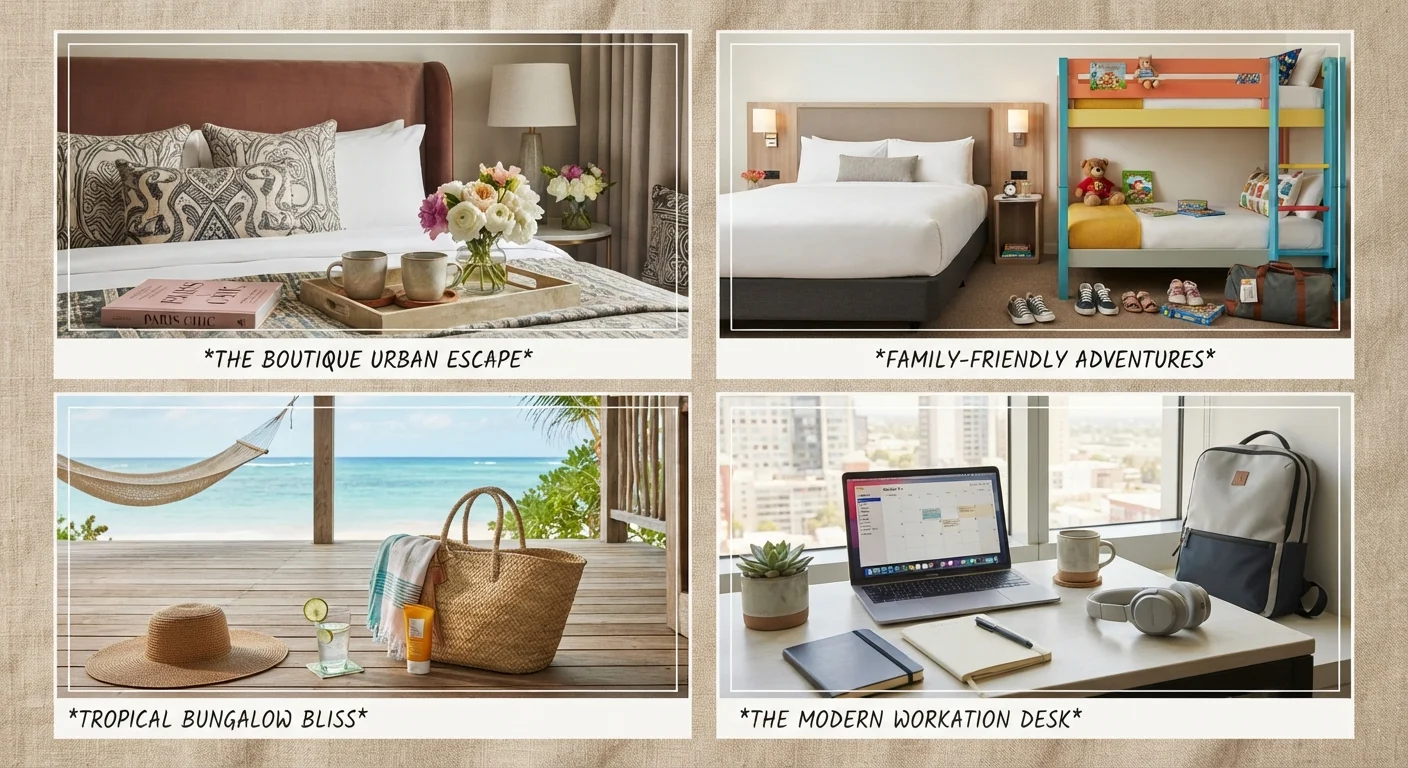
Photo credit: ExploreRoute.net | Travel Made Simple
In this article
Solo adventure, family reunion, or workation? Different travel purposes call for fundamentally different accommodation styles.
Key Takeaways
- Your trip's primary purpose — not your budget — should be the first filter when choosing a hotel style.
- Solo travelers, families, couples, and remote workers each have distinct accommodation needs that affect the whole trip.
- Hotel categories like boutique, resort, aparthotel, and design hotel are purpose-built for different travel contexts.
- Neighborhood and hotel type together shape your daily experience more than room amenities alone.
- Matching lodging style to trip type reduces friction and increases the overall quality of the experience.
Why Hotel Style Is a Trip Design Decision
Most travelers pick a hotel by filtering on price and star rating, then wonder why the stay felt slightly off. A five-star resort is a poor fit for a solo cultural explorer who wants to disappear into a city's neighborhoods. A trendy boutique property in a walkable arts district is an equally poor fit for a family of five who need interconnecting rooms and a pool.
Hotel style — the structural category of accommodation you choose — is a design decision with downstream consequences. It determines how you move through a destination, how much social friction or privacy you encounter, and whether the physical space supports what you actually came to do. Resorts and city hotels serve fundamentally different trips, and the gap between them is wider than most travelers account for before booking.
The steps below walk through a practical decision framework: start with your trip's core purpose, then layer in group composition, mobility needs, and length of stay. By the end, you'll have a clear rationale for choosing a hotel style rather than just a hotel room.
What you will need
How to Match Your Trip to the Right Hotel Style
Follow these steps in sequence. Each one narrows your options based on real travel behavior rather than marketing categories.
Identify Your Trip's Core Purpose
Before comparing room types or amenity lists, name what the trip is fundamentally for. Is it rest and decompression? Cultural exploration? Adventure and physical activity? A family milestone? Remote work with leisure layered in? Your answer eliminates entire categories immediately. A decompression trip rarely benefits from a city-center boutique hotel with a buzzing rooftop bar. An exploration trip rarely benefits from an all-inclusive resort designed to keep you on property.
Map Your Group Composition to Space Needs
Solo travelers prioritize social infrastructure (common areas, communal dining, design hotels with interesting guest profiles) or privacy and walkability depending on temperament. Couples often benefit most from boutique properties with strong sense of place. Families need interconnecting rooms or suites, in-property dining flexibility, and on-site programming for children. Groups of friends frequently find that vacation rentals outperform hotels on communal space, but hotel-style check-in convenience and daily housekeeping remain compelling for shorter stays. Planning alone gives you total freedom; planning with others introduces compromise — and that dynamic extends directly to accommodation decisions.
Factor in Your Mobility Pattern
Are you using your accommodation as a true base — returning each evening after full days out — or as a destination in itself? Base-camp travelers need efficient check-in, strong location, and reliable storage for gear. Destination-stay travelers (those spending long hours on property) need compelling amenities: pools, dining variety, programming, or distinctive architecture. Road trippers staying one or two nights at each stop have different needs again — convenience, parking, and frictionless departure matter most. For this last group, a practical comparison of accommodation types suited to road travelers is worth reviewing separately.
Assess Trip Length Against Hotel Format
A one-night or two-night stay suits almost any hotel format — even a cramped urban room is manageable for 48 hours. Stays of five nights or more, however, expose format weaknesses: no kitchen access becomes an expense and logistical problem; a lack of workspace becomes genuinely disruptive; a loud common area stops being atmospheric and starts being tiring. At the one-week mark, consider whether a serviced apartment or aparthotel format would serve better than a traditional hotel room, particularly if cooking flexibility or laundry access matters to you.
Cross-Check Against the Destination's Lodging Landscape
Not every destination offers every hotel category equally. Rural destinations may offer farmstays, country inns, or guesthouses rather than design hotels — and those formats often fit the context better anyway. Three common types of rural lodging serve three very different experiences. Island destinations introduce transport logistics that interact directly with lodging placement — especially when moving between islands. In those contexts, where you sleep shapes how easily you move. Match your chosen hotel style to what the destination actually offers and rewards.
The Style-Purpose Alignment Test
Before confirming a booking, ask: does this property make my primary trip purpose easier or harder? If the answer isn't immediately 'easier,' the hotel style likely doesn't fit the trip — regardless of reviews, photos, or price. A property that scores well on general quality but poorly on trip-purpose alignment will consistently disappoint in practice.
Special Contexts Worth Calling Out
Workations and extended business travel deserve particular attention. When a trip stretches beyond five or six nights and work is part of the equation, standard hotel rooms create genuine friction — the desk is often poor, kitchen access is nonexistent, and costs compound quickly. Extended-stay hotels and aparthotels differ meaningfully in practice, and the right choice depends on whether you need hotel-style services or apartment-style autonomy.
Culturally immersive trips call for a different lens entirely. Travelers seeking genuine local texture often find that chain hotels — however comfortable — insulate rather than integrate. Regional lodging traditions like ryokans, riads, and pousadas embed cultural meaning into the building itself, making the accommodation part of the destination rather than a base from which to visit it.
Terrain-specific adventures involve a separate calculus altogether. If your trip centers on landscape — desert, jungle, arctic — standard hotel categories may not apply at all. Different environments call for very different unconventional stays, and the lodging form often determines how closely you actually engage with the landscape rather than observing it from a distance.
Avoid Letting Aesthetics Override Function
Design-forward hotels, particularly boutique properties with strong visual identities, attract bookings based on photographs rather than stay experience. A beautifully styled room with a poor bed, thin walls, or a location that requires a 25-minute taxi to anywhere relevant will undermine a trip regardless of how well it photographs. Aesthetics and function are not mutually exclusive — but when they conflict, function governs the quality of the actual stay.
Location Within the Destination Matters Too
Choosing the right hotel style solves half the equation. The other half is where within your destination that property sits. A boutique hotel in the wrong neighborhood can undermine everything a boutique hotel is supposed to deliver. The district you stay in shapes your entire trip — particularly in dense cities where a 15-minute walk can mean crossing between entirely different urban ecosystems.
For travelers weighing a wider range of stay types — from unconventional lodging that turns accommodation into an adventure to location-specific choices — lodging options tailored to specific destination types offer a useful complement to the hotel-style framework built here.

Author
Where to Stay Editorial Team
Where to Stay Editorial Team is the collective byline for our editorial team and contributor network. Articles published under this byline or an editorial pen name are researched, written, and reviewed according to our editorial standards for clarity, consistency, and independence before publication.
View all articles →