
The Hotel Style Spectrum: From Budget Basics to Grand Luxury
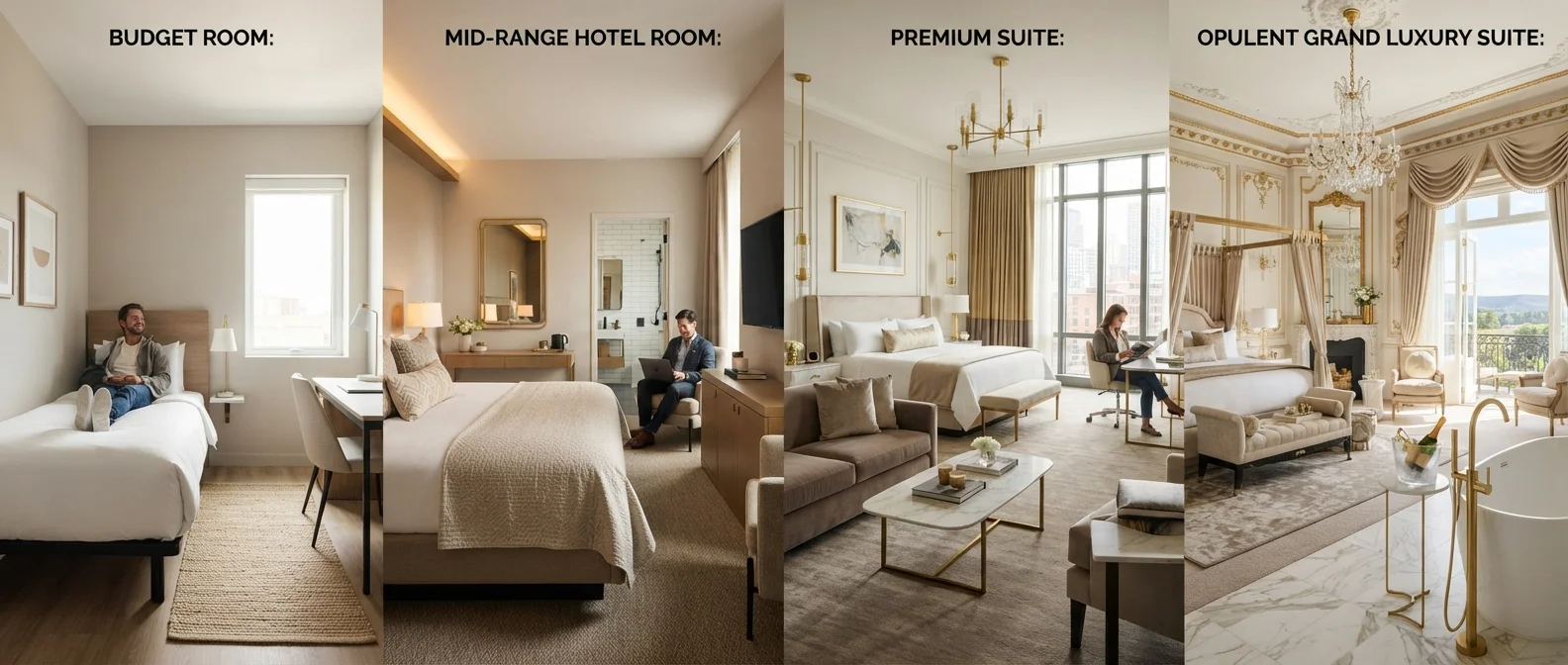
Photo credit: ExploreRoute.net | Travel Made Simple
In this article
A clear breakdown of every major hotel category, what defines each, and which traveler personality each style suits best.
Why Hotel Categories Matter More Than Star Ratings
Star ratings are a blunt instrument. A three-star property in Tokyo may outperform a four-star in a smaller market, and self-described "luxury" boutiques often share that word with internationally flagged resorts commanding ten times the nightly rate. As our editors explore in Reading Between the Lines of a Hotel's Self-Description, the language hotels use to describe themselves is largely unregulated marketing — which means travelers need a more reliable framework.
Understanding hotel style as a spectrum — from stripped-back economy properties to grand full-service luxury — gives you a structural map for every trip. The right category isn't simply about budget; it's about the kind of experience, service model, and environment that fits your specific travel purpose.
| Number of major hotel style tiers | 5–6 broadly recognized categories (General industry classification framework) |
| Star rating standardization | Not globally uniform (Varies by country and classification body) |
| Boutique hotel typical size | Under 100 rooms in most markets (Common industry benchmark) |
| Select-service share of US hotel supply | Largest segment by property count (U.S. hotel industry structure reporting) |
| Primary luxury differentiator | Service depth and material quality (Hospitality industry editorial consensus) |
The Full Spectrum: Every Major Hotel Style Defined
The hotel industry broadly organizes properties into tiers and types that reflect both service depth and physical concept. Here's how each category is generally defined — and who it suits best.
Economy and Budget Hotels
These properties prioritize functional comfort over amenity breadth. Expect clean rooms, reliable Wi-Fi, and a simple breakfast option, but little beyond that. They suit cost-conscious travelers, road-trippers using a property purely as a sleeping base, or frequent business travelers billing their own expenses. Consistency and location-efficiency are the value proposition here.
Midscale and Select-Service Hotels
A significant portion of the hotel market lives here. Select-service properties offer many of the physical features of a full-service hotel — fitness room, on-site food and beverage, branded décor — without a full restaurant, concierge team, or bell staff. Well-suited for weekend leisure travelers and mid-tier corporate guests who want comfort without the premium overhead.
Full-Service Upscale Hotels
These are the workhorses of business travel and group events. Multiple dining outlets, meeting spaces, 24-hour room service, and staffed concierge desks define the experience. They anchor convention districts and airport corridors, but can also be found in resort destinations. Travelers here value service reliability and on-property completeness.
Boutique and Lifestyle Hotels
Boutique properties are defined by their individuality rather than a service tier. They're typically smaller, independently owned or part of a soft brand, and heavily designed to reflect their local context. A boutique hotel in New Orleans will feel categorically different from one in Portland — that specificity is the entire point. Ideal for design-conscious travelers, solo adventurers, and anyone who finds chain uniformity dulling.
Luxury and Grand Hotels
True luxury is characterized by anticipatory service, genuine material quality, and an absence of friction across every touchpoint — not simply high prices. Historic grand hotels carry additional layers: architectural legacy, storied guest histories, and a sense of occasion that newer builds rarely replicate. Worth considering for milestone trips, not necessarily as a default travel mode.
Experiential and Specialty Formats
Beyond the service-tier spectrum sit formats defined entirely by setting or concept — overwater bungalows, treehouses, working ranches, cave hotels. Our editors break these down in detail in Overwater Bungalows and Other Experiential Hotel Formats Worth Understanding. These properties are often destination experiences in themselves, where the accommodation is the primary draw rather than a support structure for other activities.
Select-Service Hotel
A property that offers key physical amenities — fitness center, limited food service, branded design — without the full staffing or service depth of an upscale or luxury hotel. Common in business travel corridors and suburban markets.
Full-Service Hotel
A hotel that provides a comprehensive on-property experience including multiple dining venues, concierge service, bell staff, and meeting or event facilities. Typically found in major urban centers and resort destinations.
Boutique Hotel
A smaller, independently designed property that emphasizes local character and distinctive aesthetics over standardized service templates. Size, individuality, and sense of place are its defining traits.
Soft Brand
A collection framework offered by major hotel companies that allows independent properties to access booking infrastructure and loyalty programs while retaining their individual identity and name.
Anticipatory Service
A hallmark of true luxury hospitality in which staff address a guest's needs before they're stated — based on preference history, contextual cues, or attentive observation.
Experiential Hotel
A property whose primary appeal is defined by its physical setting or conceptual format — such as an overwater bungalow or a cliffside cave room — rather than its service tier.
Matching Style to Trip Context
No single hotel category is universally correct — context drives the call. A boutique inn that delights on a solo cultural trip may frustrate a family of four needing multiple beds and a pool. A grand luxury resort built for leisurely pacing can feel misaligned on a fast-moving city itinerary where you're out the door by 7 a.m.
For a deeper dive into how trip purpose should guide your property type — whether you're traveling solo, hosting a reunion, or managing a workation — see Matching Your Trip Type to the Right Hotel Style. Location also reshapes the calculus: what's available in a dense city center differs sharply from a coastal or mountain setting, which our Stay by Location hub addresses by destination type.
One important caveat: classification systems themselves aren't globally consistent. A four-star designation carries very different expectations depending on the country and the body awarding it, a complexity our editors unpack in Hotel Categories Across Different Countries. When traveling internationally, treat star ratings as a rough orientation rather than a precise quality guarantee.
Budget Doesn't Determine Category Alone
A traveler spending modestly on a solo city trip may still prefer a boutique property over a budget chain for the same nightly rate — especially in markets where independent options are competitively priced. Hotel style is as much about philosophy and fit as it is about price tier. Align your choice with what you actually value during that specific trip, not just what fits the broadest budget band.
Finally, if your trip includes a cruise leg, the accommodation framework shifts entirely — cabins have their own category logic. Cabin Categories Decoded maps that parallel spectrum clearly.

Author
Where to Stay Editorial Team
Where to Stay Editorial Team is the collective byline for our editorial team and contributor network. Articles published under this byline or an editorial pen name are researched, written, and reviewed according to our editorial standards for clarity, consistency, and independence before publication.
View all articles →