
Sunken and Submerged: Drowned Settlements That Still Exist Below Waterlines
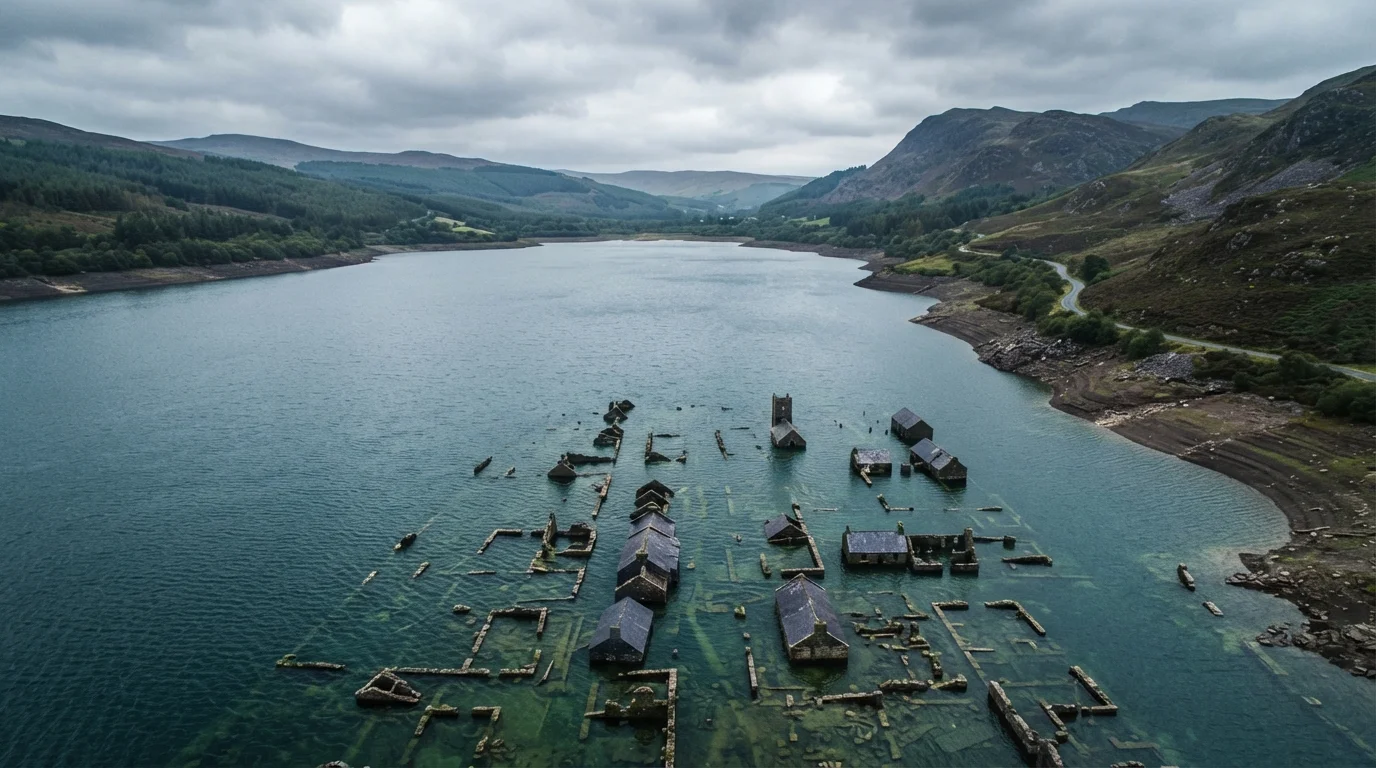
Photo credit: ExploreRoute.net | Travel Made Simple
In this article
Reservoirs, rising seas, and ancient floods have swallowed entire towns. A look at the submerged sites that surface divers and historians still study.
Key Takeaways
- Hundreds of towns worldwide were deliberately flooded during dam and reservoir construction throughout the 20th century.
- Low water levels during droughts periodically expose submerged structures, drawing visitors and researchers to witness them firsthand.
- Underwater archaeology has documented entire street grids, church spires, and bridges still standing beneath reservoir surfaces.
- Coastal submersion from tectonic activity and sea-level rise has preserved ancient port towns on the seafloor for millennia.
- Access to these sites varies — some are protected dive zones while others are viewable from the surface during specific seasons.
What Happens When a Town Goes Under
There is a particular kind of silence that archaeologists and divers describe when they descend through the thermocline of a reservoir and find a cobblestone street stretching ahead of them, lamppost still upright, doorways still framing empty thresholds. It is history preserved not by burial in sand but by the far stranger act of drowning.
Drowned settlements fall into two broad categories. The first are the deliberately inundated — communities sacrificed in the name of engineering progress, their residents relocated while bulldozers stood by to ensure the dam wall held. The second are the ancient submerged, swallowed by post-glacial seas, tectonic shifts, or river migrations over centuries or millennia. Both categories leave behind sites of extraordinary historical weight, and both continue to be studied in ways that reshape our understanding of how people lived.
For frequent travelers drawn to cities that history nearly erased, drowned settlements offer something even more visceral: not the slow erosion of time, but a single, documented moment of ending.
Verification Before You Travel
Access rules, permitted dive zones, and site visibility conditions change frequently at submerged settlement locations. Always verify current regulations with local authorities or national heritage bodies before traveling. Entry may be restricted without advance permits, and underwater diving at some sites requires government authorization rather than just dive certification.
Reservoir Towns: Sacrificed for Progress
The 20th century's appetite for hydroelectric power produced some of history's most disorienting acts of civic erasure. Spain's Galicia region offers one of the most striking examples. The medieval village of Aceredo, submerged by the Alto Lindoso reservoir in 1992, re-emerges periodically when drought drops water levels — its stone houses, tavern, and church still standing as though waiting for residents to return. When it surfaced during a prolonged drought period in early 2022, photographs of the ghostly streetscape circulated worldwide.
China's Lion City — Shi Cheng — provides perhaps the most cinematic example of deliberate inundation. Submerged beneath Qiandao Lake in Zhejiang Province in 1959 during the construction of the Xin'an River hydroelectric dam, the 1,400-year-old city rests between 26 and 40 meters below the surface. Its five-story archways, decorative wooden beams, and stone lion sculptures remain largely intact. Dive operators now offer guided descents, though visitors should verify current access permissions and dive certification requirements before planning a trip.
1,300+
Towns and villages flooded by China's Three Gorges Dam
When the Three Gorges Dam was completed in 2006, it inundated over 1,300 communities, displacing more than one million residents — one of the largest forced relocations in history.
~60
Ancient ships recovered from Thonis-Heracleion
French underwater archaeologist Franck Goddio's expeditions have recovered the remains of more than 60 ancient vessels from the submerged port city, along with thousands of artifacts.
40m
Maximum depth of Shi Cheng's submerged structures
Lion City's ruins descend to approximately 40 meters at their deepest point beneath Qiandao Lake, requiring advanced open-water dive certification to access the lowest sections.
Italy's Val di Resia tells a more recent and politically charged story. A cluster of villages in the Friuli region was submerged by the Vajont Dam reservoir in the early 1960s — a project that ended in catastrophe when a 1963 landslide caused a wave that killed nearly 2,000 people downstream. The submerged villages themselves remain as a kind of memorial beneath the water, studied but rarely visited.
Ancient Ports Lost to Rising Seas
Long before industrial dams, the sea itself was quietly reclaiming coastlines. The ancient Egyptian port city of Thonis-Heracleion sat at the mouth of the Nile and was one of the Mediterranean's great trading hubs before subsidence and possibly earthquakes sent it to the seafloor of Aboukir Bay around the 8th century CE. French underwater archaeologist Franck Goddio's team rediscovered it in 2000, uncovering colossal statues, gold jewelry, and the remains of more than 60 ships. The site continues to yield discoveries with each excavation season.
Along England's Suffolk coast, the medieval town of Dunwich presents a different kind of submersion — not sudden, but incremental. Once a significant North Sea port, Dunwich was claimed gradually by coastal erosion and storm surges beginning in the 13th century. The last church tower disappeared beneath the waves in 1919. Acoustic surveys conducted in recent decades have mapped the seafloor and confirmed the positions of churches, market squares, and harbor structures. On quiet days, locals and visitors report hearing what folklore calls the bells of drowned churches ringing beneath the waves — a romantic embellishment, but one that speaks to how deeply these losses embed themselves in local memory.
These coastal sites occupy a fascinating borderland between archaeology and natural wonders under threat — their ongoing submersion is a process, not a completed event.
Planning a Visit to a Submerged Site
Research water levels before booking travel to reservoir-submerged towns — drought conditions that expose ruins can be temporary and unpredictable. Local tourism offices or regional government websites often publish current reservoir levels. For diving sites, confirm certification requirements and whether guided access is mandatory well in advance of your trip.
How to Engage With These Sites Responsibly
Visiting or learning about drowned settlements sits at the intersection of archaeology, environmental access, and cultural sensitivity. Many of these communities had living residents who were displaced — in some cases against their will and with inadequate compensation. Approaching these sites with that human context in mind matters as much as understanding the architectural details.
For surface viewing, drought conditions at reservoir sites can make ruins visible from shoreline paths or boat tours — always check with local authorities about current water levels and permitted access zones before traveling specifically to see exposed ruins. For diving, certification requirements vary by country and site; some of the most well-preserved sites, like Shi Cheng, have established dive operators, while others fall within protected zones where independent diving is prohibited.
Those drawn to the broader world of hidden and underrated towns will find that drowned settlements represent an extreme end of the spectrum — places removed so completely from the surface world that reaching them requires not just a map, but sometimes a wetsuit. The contrast with water-based travel experiences — explored thoughtfully in our look at overwater and floating accommodations — could not be more complete: one places you above the water in comfort; the other invites you beneath it to confront what the water has taken.
For those drawn to what lies beneath ground rather than water, the subterranean historic sites hidden beneath modern cities offer a parallel form of discovery — vertical rather than aquatic, but equally disorienting in the best possible way.
Frequently Asked Questions

Author
Hidden Destinations Editorial Team
Hidden Destinations Editorial Team is the collective byline for our editorial team and contributor network. Articles published under this byline or an editorial pen name are researched, written, and reviewed according to our editorial standards for clarity, consistency, and independence before publication.
View all articles →