
Reading a Small Town Like a Local: Markets, Architecture, and Public Squares
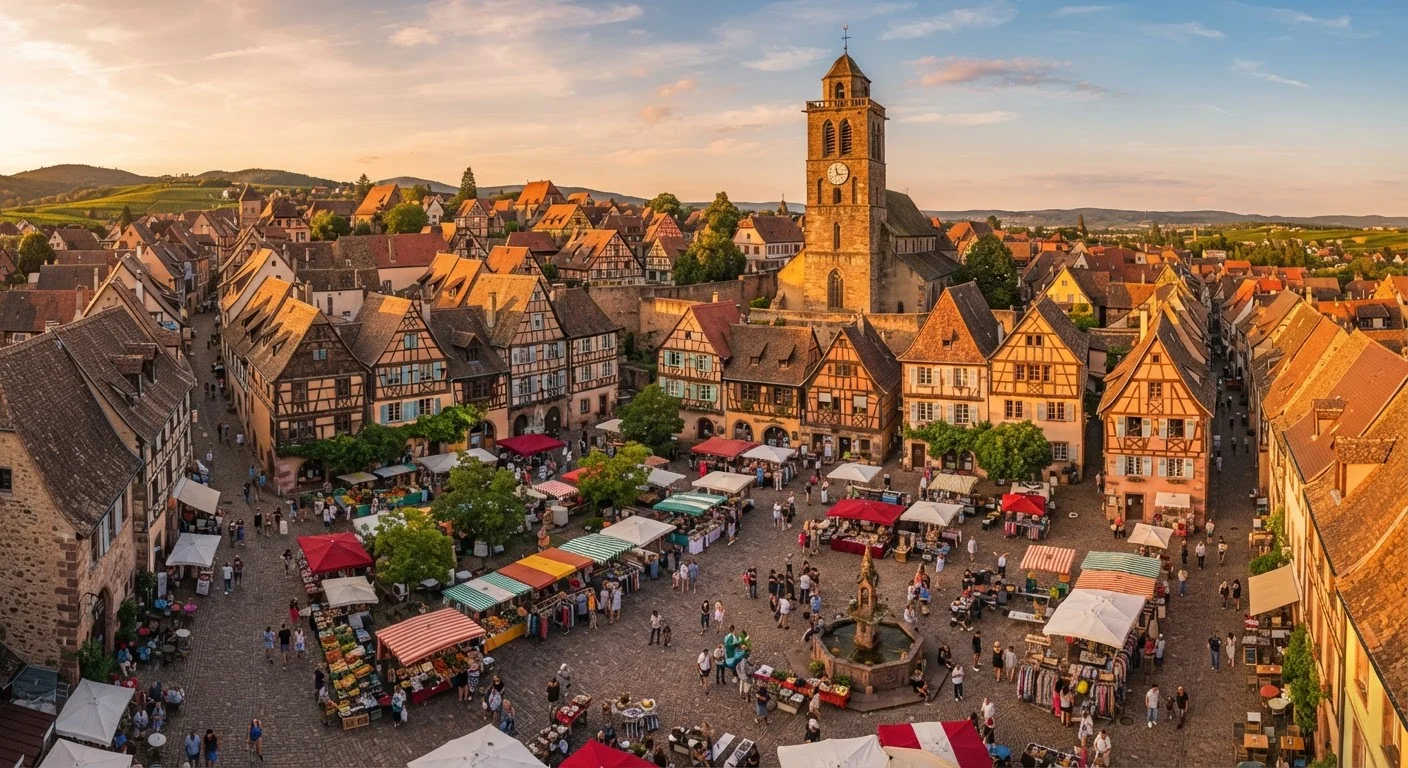
Photo credit: ExploreRoute.net | Travel Made Simple
In this article
The market square, the church, the bus stop — every small town tells its story through its spaces. Learn to decode what you see when you wander.
Key Takeaways
- A town's market reveals its economic rhythms, regional agriculture, and social hierarchy better than any guidebook.
- Architectural styles tell the story of who held power, when, and what they wanted to project.
- The public square is a social barometer — observe who uses it, when, and how.
- Peripheral details like bus stops, laundry, and shop signage often reveal more than official monuments.
- Reading a town requires slowing down, not speeding up — linger longer in fewer places.
- Respectful observation is always the foundation; curiosity should never override local privacy or custom.
The Market as the Town's Living Archive
Walk into any small-town market before 9 a.m. and you are stepping into the most honest cross-section the place has to offer. Not the version curated for visitors, but the one that runs on its own logic — farmers arranging root vegetables by variety, butchers negotiating with restaurateurs, older women comparing the weight of cheeses they've been buying from the same family for thirty years.
What a market sells tells you about the surrounding geography. A highland market in the Balkans will lean heavily on preserved meats, mountain herbs, and handwoven wool — clues to altitude, climate, and centuries of pastoral economy. A coastal West African market reveals the fish catch hierarchy, which villages supply which goods, and which agricultural cycles are currently active. For a richer sense of how markets serve as portals to authentic food culture, the relationship between local markets and genuine food experiences goes well beyond produce stalls.
The layout itself is instructive. Permanent stalls near the center usually belong to long-established vendors with the most social capital. Newer arrivals, seasonal sellers, or those with lower-status goods are often pushed to the periphery. Even the noise gradient — where vendors call out versus where transactions happen quietly — encodes social meaning.
~54%
of the global population lives in urban areas
According to UN data, more than half the world's people now live in cities — making the social patterns preserved in small towns increasingly rare and historically distinctive.
3–5x
longer average stay when travelers slow down
Travel researchers studying immersive versus itinerary-driven tourism have noted that travelers who engage deeply with a single place tend to stay significantly longer than those following multi-stop itineraries, though exact figures vary by study and region.
Architecture as Political and Social Record
A small town's buildings are its autobiography, but they require a reader willing to notice contradictions. The baroque church dominating the central square of a small Carpathian town was not built to serve a few hundred souls — it was built to project the ambition of a bishop, a Habsburg official, or a merchant family wealthy enough to fund its construction. Scale in small-town architecture is rarely accidental.
Look for the layers. A Romanesque foundation beneath a Gothic nave beneath a Baroque facade tells you a building outlasted several eras of power and was renovated by each one to assert contemporary dominance. Unpainted concrete blocks added to a centuries-old structure tell a different story — economic constraint, a postwar rebuilding campaign, or rapid demographic expansion that outpaced resources.
Vernacular architecture — the ordinary houses, the farm buildings, the modest row of shops — often yields more than the set pieces. What materials were locally available? Timber-framed houses indicate nearby forest. Thick limestone walls suggest a regional quarry and a need to manage heat. Covered arcades along shop fronts in a Mediterranean market town evolved as social infrastructure, keeping commerce moving through summer heat.
“The city is not a problem to be solved but a text to be read. Its streets, buildings, and open spaces are sentences in a language that rewards the patient interpreter.”
— Kevin Lynch, Urban planner and author of 'The Image of the City' (1960)
For those interested in how these same reading skills apply across American roadways and landmark structures, reading roadside architecture and signage as American cultural record offers a parallel framework closer to home.
The Public Square as Social Barometer
Sit in a small town's central square at three different times — 7 a.m., noon, and 8 p.m. — and you will observe what amounts to three different communities using the same space. Early morning belongs to the oldest residents and those commuting to work. Midday sees the square serve as a lunch shortcut, a gathering point for government workers, a place where the unemployed sit and the shopkeepers take coffee. Evening is when the square becomes genuinely social — teenagers, families, the slow promenade that many Southern European and Latin American cultures call the paseo or passeggiata.
Notice the monuments. Who is commemorated, and in what posture? A town that centers its square around a war memorial rather than a civic founder tells you something about which collective trauma most defines local identity. A statue facing a particular direction — toward the capital, toward a rival town, toward a church — is never entirely innocent.
Arriving in an unfamiliar small town without a tour group offers practical techniques for using the square as your initial orientation anchor, including how to identify informal gathering points that don't appear on any map.
Visit the Same Square Three Times in One Day
Morning, midday, and evening use of a public square are almost always distinctly different. Resist the urge to move on after a single visit. Returning at different hours costs nothing and produces a far richer understanding of how the space actually functions in the life of the town.
Reading the Margins: Bus Stops, Laundry Lines, and Shop Fronts
The edges of a small town are as revealing as its center. The bus stop schedule — if posted and legible — tells you which larger city the town orbits economically, how frequently people commute, and whether the town functions as a destination or a waypoint. A single early-morning bus to a regional capital and a late-evening return suggests a town whose working population commutes rather than works locally.
Shop signage in multiple languages signals one thing; signage only in a regional dialect or minority language signals something quite different about cultural identity and historical self-sufficiency. A pharmacy next to a school near the square versus a pharmacy on the far edge of town near the hospital reveals how health services are integrated into daily life.
Even laundry, visible from lanes between houses, carries information — the weight and age of the textiles, whether lines are strung between neighbors' walls, whether clothes are dried in full view or shielded. These are not romantic details for their own sake. They are data points that, combined with what you observe in the market and square, begin to compose a portrait more accurate than any travel summary.
Towns that reward this kind of slow, attentive reading are exactly those most travelers walk past on the way to somewhere famous. The misconceptions that keep travelers away from small towns often stem precisely from a failure to look closely enough — to confuse quiet with empty, and unfamiliar with uninteresting.
If you are planning to spend meaningful time in a place you've found through this kind of reading, planning a week-long stay in a town with minimal existing travel content can help you structure that experience without over-engineering it.
Frequently Asked Questions

Author
Hidden Destinations Editorial Team
Hidden Destinations Editorial Team is the collective byline for our editorial team and contributor network. Articles published under this byline or an editorial pen name are researched, written, and reviewed according to our editorial standards for clarity, consistency, and independence before publication.
View all articles →