
Paper Maps vs. GPS Apps: Navigating the Open Road
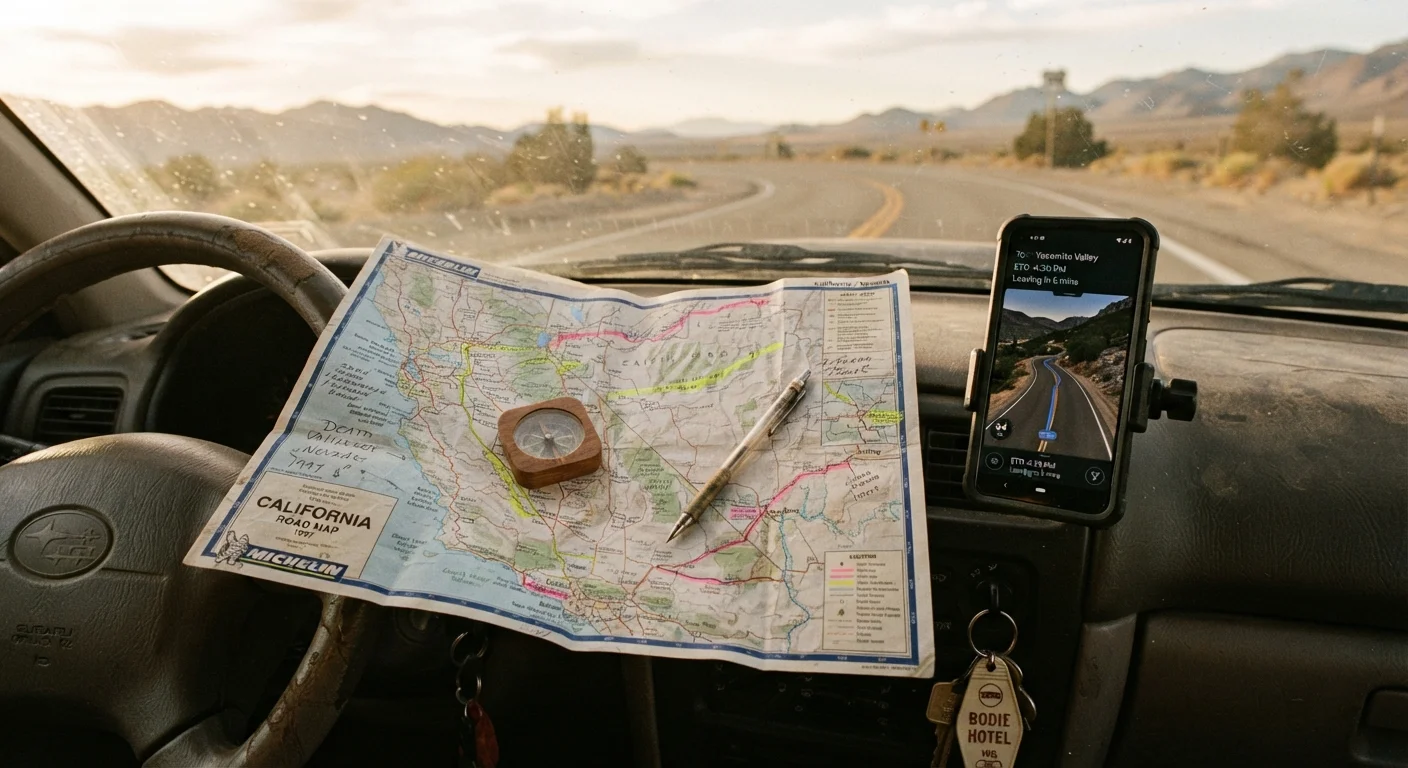
Photo credit: ExploreRoute.net | Travel Made Simple
In this article
A side-by-side look at offline maps and digital navigation tools — when each shines, and why carrying both may be smarter than you think.
Key Takeaways
- Paper maps never lose signal, run out of battery, or crash — making them a reliable backup in remote areas.
- GPS apps excel at real-time rerouting, traffic alerts, and finding nearby services on the fly.
- Many experienced road trippers carry both, using each tool where it performs best.
- GPS apps optimize for speed, which can mean missing scenic or culturally rich routes.
- Paper maps encourage a broader spatial awareness that helps drivers understand a region, not just a route.
The Case for Paper Maps
There's a reason atlas-toting road trippers haven't entirely vanished — paper maps offer something no app can replicate: complete independence from infrastructure. No towers, no satellites, no battery drain. Unfold one and you have the full picture of a region at a glance, from state borders down to county roads that rarely appear on a default GPS screen.
That panoramic perspective is genuinely useful. A paper map lets you see three alternative routes simultaneously, notice a national forest that sits just thirty miles off your planned path, or identify a small town worth a detour — without an algorithm deciding whether it's worth your time. As we explore in why GPS can steer you away from the best drives, navigation apps are built to minimize time, not maximize experience.
Paper maps also build a stronger mental model of geography. Drivers who regularly reference physical maps tend to develop a more intuitive sense of place — where rivers run, how mountain ranges orient, and which corridors connect regions. That spatial fluency pays off when conditions change unexpectedly.
Paper Maps Are Easier to Find Than You Think
State welcome centers, visitor bureaus, gas stations, and many public libraries still stock free or low-cost road maps. AAA members can typically request detailed road atlases through their local office. Before any major road trip, it's worth picking up a current state map for each region you'll be passing through — they're lightweight, foldable, and could prove invaluable if your phone fails.
The Case for GPS Apps
For sheer day-to-day utility, GPS navigation apps are hard to argue against. They update in real time, warn you about accidents two exits ahead, and reroute around road closures before you're already stuck in them. If you're threading through downtown Denver or navigating a tangle of Atlanta interstates, turn-by-turn voice guidance with live lane recommendations is a genuine safety asset — it keeps your eyes on the road instead of a folded page.
Modern mapping apps have also grown well beyond simple directions. Many now layer in user-submitted photos, business hours, fuel prices, and points of interest — making them functional research tools as much as navigators. For a deeper look at how to tap those layers, maps as research tools covers the underused features most travelers scroll past.
Downloadable offline maps have also addressed the classic criticism of GPS apps: signal dependency. Many major apps now let you download regional maps to your device before departure, providing reliable navigation even in areas with limited connectivity.
| Criterion | Paper Maps | GPS Apps |
|---|---|---|
| Signal required | None | Yes (or offline download) |
| Battery required | None | Yes (drains device) |
| Real-time traffic updates | No | Yes |
| Scenic route visibility | High — full regional view | Low — optimized for speed |
| Turn-by-turn voice guidance | No | Yes |
| Points of interest detail | Limited | Extensive |
| Cost | Low or free | Free to low (data costs vary) |
| Geographic spatial awareness | High | Low |
| Backcountry reliability | High | Variable |
When to Use Each — and Why Carrying Both Is Smarter
The most experienced road trippers don't treat this as an either/or decision. They use GPS apps for real-time navigation and urban driving, while keeping a quality state or regional paper map folded in the door pocket for context, backup, and big-picture planning. It's a simple redundancy that costs almost nothing and has saved plenty of trips from turning into genuinely stressful situations.
Pre-trip route planning is one area where each tool plays a distinct role. Planning a route that rewards the journey is best approached with both a bird's-eye geographic view — which a paper map provides naturally — and the waypoint-saving, distance-calculating capabilities of a digital tool. Use them together during the planning phase and you'll hit the road with more confidence and flexibility.
For anyone venturing into genuinely remote territory, the equation shifts further toward analog. Navigation without cell service makes the case clearly: in backcountry or off-grid environments, traditional map-and-compass skills aren't nostalgic — they're essential. Devices fail, batteries deplete, and satellites aren't always enough.
77%
U.S. drivers using smartphone navigation regularly
According to data from the Pew Research Center, a large majority of American adults use their smartphones for navigation while driving.
~1 in 3
GPS users who report being misdirected
Consumer surveys have consistently found that a significant share of GPS users have been routed incorrectly or into problematic situations due to outdated map data.
The bottom line: paper maps and GPS apps aren't rivals — they're complements. Knowing when to reach for each is part of what separates a confident road tripper from one scrambling for a signal at a crossroads with no cell bars in sight.

Author
Road Trip Culture Editorial Team
Road Trip Culture Editorial Team is the collective byline for our editorial team and contributor network. Articles published under this byline or an editorial pen name are researched, written, and reviewed according to our editorial standards for clarity, consistency, and independence before publication.
View all articles →