
A Traveller's Quick-Reference Guide to Airport Codes, Signage, and Status Boards
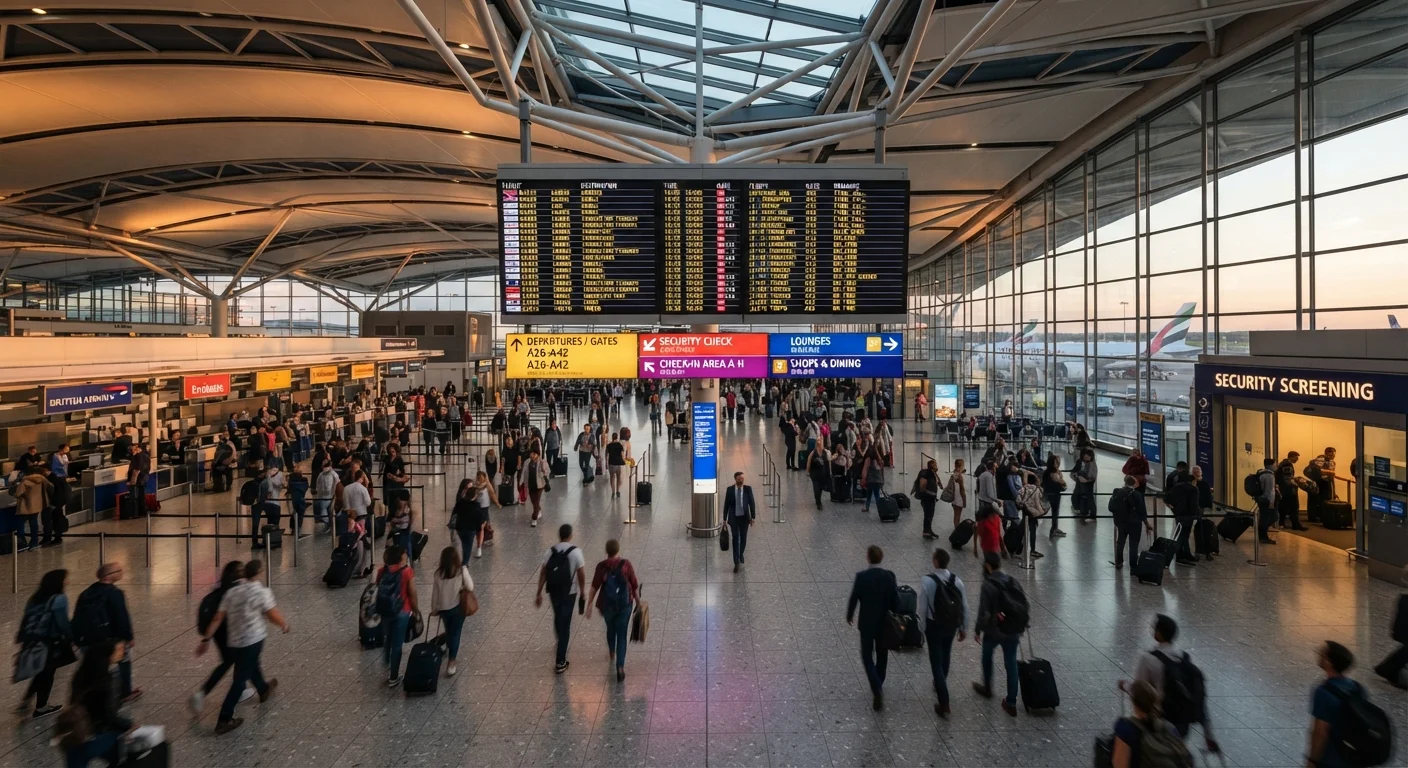
Photo credit: ExploreRoute.net | Travel Made Simple
In this article
IATA codes, FIDS, gate status terminology, and colour-coded signage systems demystified. A compact reference for reading airports more fluently.
IATA and ICAO Codes: The Two Alphabets of Aviation
Every commercial airport operates under two distinct code systems, and confusing them is a common source of traveler frustration. IATA codes — three-letter identifiers such as JFK (New York John F. Kennedy), LAX (Los Angeles International), and LHR (London Heathrow) — are the ones printed on boarding passes and baggage tags. They are assigned by the International Air Transport Association and are what passengers interact with every day.
ICAO codes are four-character identifiers used by air traffic control, flight planning systems, and pilots. KJFK, KLAX, and EGLL are the ICAO equivalents of the examples above. The first character typically indicates a world region (K for the contiguous United States; E for Northern Europe), making ICAO codes useful for understanding a flight's geographic context.
City codes add a third layer. When a metropolitan area is served by multiple airports, IATA sometimes issues a separate metro code: NYC covers all New York–area airports, while CHI covers Chicago's O'Hare (ORD) and Midway (MDW). These metro codes appear in some booking systems and are worth recognizing so you don't accidentally book into the wrong airport.
IATA Code
A three-letter identifier assigned by the International Air Transport Association to commercial airports worldwide. Appears on boarding passes, baggage tags, and booking systems (e.g., ORD for Chicago O'Hare).
ICAO Code
A four-character identifier used in aviation operations, air traffic control, and flight planning. The first character denotes world region; used by pilots and dispatchers rather than passengers (e.g., KORD).
FIDS
Flight Information Display System — the electronic boards in airport terminals showing real-time departure and arrival data including flight number, destination, gate, and status.
Metro Code
An IATA city code representing all airports serving a single metropolitan area (e.g., NYC for all New York–area airports). Used in some booking and search systems.
Airside
The secure area of an airport beyond passport control and security screening, accessible only to passengers with valid boarding passes and airport workers with clearance.
Landside
The public area of an airport before security and immigration checkpoints, accessible to anyone without a boarding pass.
Gate Change
A FIDS status indicator showing that a flight's boarding gate has been reassigned. Passengers should confirm the new gate on both the main FIDS and gate-level screens.
Understanding this hierarchy helps when cross-referencing your itinerary with airport maps, airline apps, and ground transportation boards — all of which may use different code formats. For a deeper look at fare-level codes that also appear on your ticket, see how airline fare class letters work.
Decoding the Flight Information Display System (FIDS)
The large departure and arrival boards dominating every terminal are collectively called the Flight Information Display System, or FIDS. Reading them quickly and accurately is a core airport skill.
| IATA code format | Three letters (e.g., SFO, MIA, CDG) (International Air Transport Association) |
| ICAO code format | Four characters; first denotes region (e.g., K = contiguous US) (International Civil Aviation Organization) |
| Standard FIDS status stages | On Time → Boarding → Final Call → Departed (or Delayed / Cancelled) (Common airport operations practice) |
| Yellow/amber signage function | Gates, departure areas, and forward passenger flow (ICAO Annex 14 signage guidelines) |
| Green signage function | Exits, arrivals, and ground transportation (ICAO Annex 14 signage guidelines) |
| Gate-level FIDS | Updates independently from main hall boards; check both (General aviation operations guidance) |
FIDS displays are typically sorted by scheduled departure or arrival time. Each row contains the flight number, destination or origin city, scheduled time, terminal and gate assignment, and a status field. That status field carries specific meanings:
- On Time — departure is tracking to schedule.
- Delayed — followed by an updated departure time, if known.
- Boarding — gate is open; passengers with boarding priority should proceed.
- Final Call — last boarding opportunity; gate may close shortly.
- Gate Change — the assigned gate has moved; cross-reference the new gate on the board.
- Cancelled — flight will not operate; proceed to the airline's service desk.
- Departed — aircraft has left the gate.
One practical habit: check the FIDS at the gate, not just at the main hall board. Gate-level screens update independently and sometimes reflect status changes sooner, particularly for last-minute gate reassignments. This connects directly to the broader framework covered in the end-to-end airport experience guide.
Colour-Coded Signage: A Universal Visual Grammar
Airport signage systems worldwide follow internationally recognised colour conventions, though specific shades vary by country and airport authority. Understanding the underlying grammar lets you navigate even unfamiliar terminals faster.
Signage Conventions Vary by Country
While ICAO publishes international signage standards, individual airports and national aviation authorities adapt them. Some airports in Asia and the Middle East, for example, use distinct colour palettes or supplement international symbols with local-language text. When travelling to an unfamiliar airport, reviewing its official terminal map before arrival can help you calibrate expectations. Official airport websites typically publish current terminal guides.
In most airports operating under ICAO standards:
- Yellow or amber signs direct passengers to gates, terminals, and departure areas — the forward path of travel.
- Green signs indicate exits, ground transportation, and arrivals pick-up — the path out of the airport.
- Blue signs generally point to services: restrooms, information desks, lounges, and car rentals.
- Red signs mark restricted areas, customs declarations, or prohibited zones.
- White on dark background is common for airline-specific information boards within terminal concourses.
Pictograms play an equally important role. The walking figure with a downward arrow signals baggage reclaim; an aircraft silhouette with an upward arrow marks departures. Familiarising yourself with these symbols before travel reduces cognitive load once you're moving through a busy terminal — a skill that pays off especially when landing internationally, as detailed in the international arrivals step-by-step guide.
Physical layout further reinforces the colour system. In most large airports, the landside (before security) and airside (after security) zones are architecturally separated, with signage density increasing as passengers approach gates. Understanding how terminals and concourses are organised — covered in depth in the anatomy of a modern airport — makes signage far easier to interpret in context.

Author
Smart Air Travel Editorial Team
Smart Air Travel Editorial Team is the collective byline for our editorial team and contributor network. Articles published under this byline or an editorial pen name are researched, written, and reviewed according to our editorial standards for clarity, consistency, and independence before publication.
View all articles →