
Fermentation Across Borders: How Preserved Foods Map a Region's History
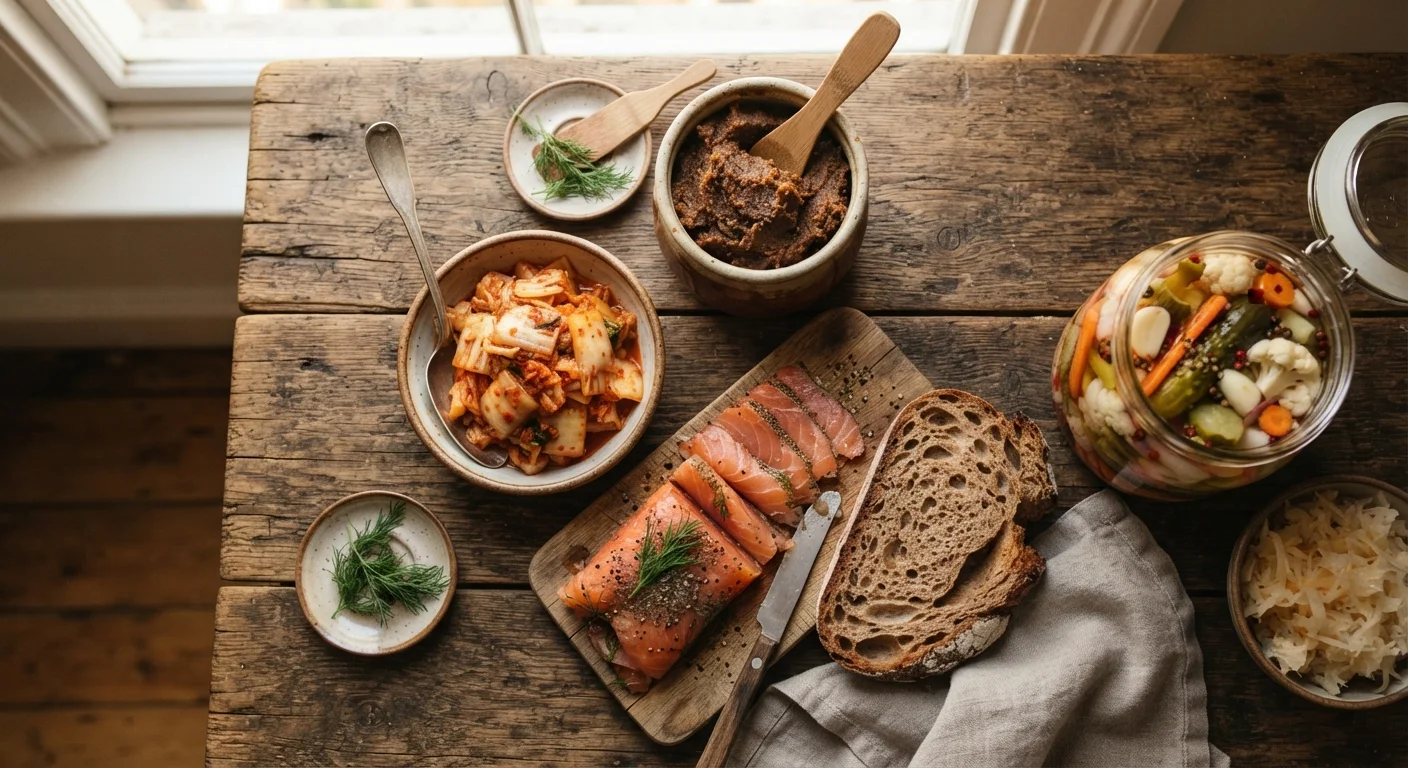
Photo credit: ExploreRoute.net | Travel Made Simple
In this article
From Korean doenjang to Nordic gravlax, fermented foods reveal how communities survived, traded, and evolved. A guide for the curious palate.
Key Takeaways
- Fermented foods encode a region's climate, trade history, and survival strategies in edible form.
- Each fermentation tradition reflects locally available ingredients and microbial ecosystems unique to that place.
- Tasting fermented foods in their place of origin offers deeper cultural insight than any museum exhibit.
- Markets, home kitchens, and small producers are the most reliable sources for authentic fermented foods.
- Understanding fermentation helps travelers ask better questions and engage more meaningfully with food cultures.
What Fermentation Reveals That Recipes Cannot
A recipe tells you what a culture eats. A fermented food tells you how that culture has survived. The brine in a Georgian churchkhela, the funk of a Vietnamese mắm, the slow acidity of a German Sauerbraten marinade — these are not mere flavoring choices. They are the accumulated logic of communities navigating seasons, scarcity, and long-distance trade across generations.
For food-curious travelers, fermentation offers a genuinely different layer of engagement with a destination. It connects landscape to larder in ways that a single restaurant meal rarely achieves. Understanding fermentation — even at a basic level — transforms what might seem like an acquired taste into a legible historical document.
5,000+
Years fermentation has been documented in human food systems
Archaeological evidence of fermented beverages has been traced to ancient Georgia, China, and the Middle East, establishing fermentation as one of humanity's oldest food technologies.
~1/3
Share of global food supply involving fermentation
The Food and Agriculture Organization of the United Nations has noted that fermented foods and beverages account for roughly one-third of the human diet worldwide, across all cultures and regions.
200+
Distinct kimchi varieties documented in Korea
Korea's National Institute of Agricultural Sciences has catalogued more than 200 regional kimchi varieties, reflecting the diversity of microclimates and ingredient availability across the peninsula.
This is part of a broader conversation about what makes regional food cultures distinct. As explored in the world's most distinct regional food cultures, geography and history shape cuisine far more profoundly than individual chefs or trends ever could.
Climate, Survival, and the Logic of the Jar
Every fermentation tradition begins with a constraint. In the Korean peninsula, long winters and a mountainous interior made fresh vegetables scarce for months at a time. The result — kimchi, along with dozens of related preserved banchan — is now so central to Korean identity that it has been recognized by UNESCO as an Intangible Cultural Heritage. Doenjang, Korea's fermented soybean paste, follows the same logic: soybeans available in autumn become a protein-dense staple capable of lasting through the coldest months.
Scan northward to Scandinavia and the same calculus appears in different form. Gravlax — salmon cured with salt, sugar, and dill — originated as a method for preserving the summer salmon run through long winters. Surströmming, Sweden's famously pungent fermented herring, was historically a working-class staple precisely because fermentation made a perishable catch last far longer than salting alone.
Ask About the Process, Not Just the Product
When encountering a fermented food at a market or producer, ask how long it ferments and what season it is made in. These two questions alone will tell you more about a region's climate, agricultural calendar, and food philosophy than any guidebook summary. Producers who make traditionally fermented food are almost always willing to explain — it is a source of genuine pride.
In the Caucasus, where Georgia sits at the intersection of wine trade routes dating back thousands of years, kvevri-fermented wine — made in clay vessels buried underground — reflects both the region's viticultural abundance and its ancient trade connections to Persia and the Silk Road. Georgia is now widely recognized as one of the oldest wine-producing regions in the world.
Reading a Region Through Its Fermentation Vocabulary
The specific microbes involved in fermentation are not interchangeable. They are shaped by altitude, humidity, temperature, and the microbial ecosystems of a specific place. This means a food fermented in one village will taste meaningfully different from the same recipe fermented fifty miles away — a phenomenon Japanese producers call terroir in the context of sake and miso, borrowing the wine world's term for place-specific flavor.
Miso itself is an instructive example. Japan's archipelago produces dozens of regional varieties: pale, sweet Shiro miso from Kyoto reflects the refined aesthetics of imperial court cuisine, while dark, intense Hatcho miso from Aichi Prefecture — aged for up to three years in cedar barrels weighted with stones — speaks to a colder climate and a culture of austere practicality. Tasting both side by side tells you more about Japan's regional diversity than almost any other single experience.
For travelers prepared to look beyond the obvious, fermented foods are available far outside restaurants. Morning markets and home kitchens are where the most authentic and least industrialized versions survive — often sold by the same producers who have been making them for decades.
Traveling With Fermentation as Your Framework
Approaching a destination through its fermentation tradition is a remarkably efficient way to access genuine food culture. It pushes you toward the kinds of producers, markets, and meals that food travelers most commonly miss — the small-batch makers, the seasonal specialties, the dishes that don't translate well to tourist menus.
Before departure, research which fermented staples are foundational to your destination's cuisine, and learn the local vocabulary for them. This kind of preparation — outlined in detail in the pre-trip food research checklist — signals genuine interest to local producers and opens conversations that generic food tourism rarely reaches.
Pasteurization and Authenticity
Many fermented products sold in export markets or upscale hotel shops have been pasteurized — a process that extends shelf life but eliminates the live microbial cultures that define authentic fermentation. When seeking genuinely traditional fermented foods at a destination, look for small-batch producers at local markets rather than packaged products designed for export. The label or vendor can usually tell you whether a product is live-fermented or heat-treated.
Once in the field, let fermented foods be a thread rather than a destination. Ask a market vendor how their kimchi differs from the next stall's. Inquire about seasonal variation in miso production. These questions lead, reliably, to the people and places that make culinary travel genuinely transformative rather than merely photogenic. The planning framework for food-focused trips can help structure this kind of itinerary before you arrive.
Frequently Asked Questions

Author
Specialty Travel Editorial Team
Specialty Travel Editorial Team is the collective byline for our editorial team and contributor network. Articles published under this byline or an editorial pen name are researched, written, and reviewed according to our editorial standards for clarity, consistency, and independence before publication.
View all articles →