
Sleeping in the Jungle: A Practical Look at Rainforest Accommodation
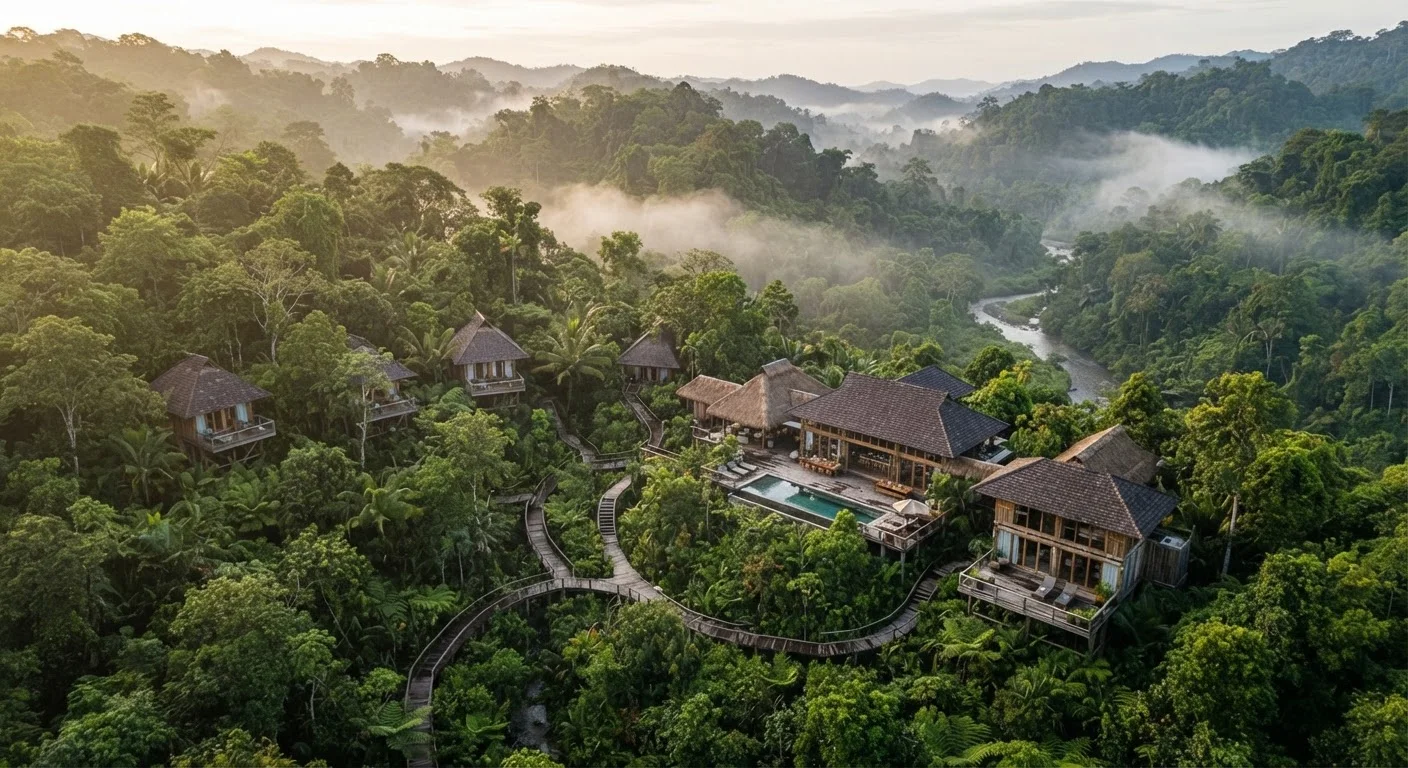
Photo credit: ExploreRoute.net | Travel Made Simple
In this article
Eco-lodges, treehouses, and riverside camps each offer different tradeoffs in comfort, access, and environmental impact.
Key Takeaways
- Eco-lodges offer the most reliable comfort and naturalist programming, but may limit deep-forest access.
- Treehouses provide unmatched canopy immersion, though they involve real physical demands and weather exposure.
- Riverside camps deliver proximity to wildlife corridors but come with seasonal flooding and infrastructure constraints.
- Environmental impact varies significantly by operator — certification and building method matter more than marketing language.
- Connectivity, transfer times, and medical access should be evaluated before choosing remote rainforest stays.
Why Rainforest Accommodation Is Its Own Category
Staying in a tropical rainforest is not simply a matter of booking a room in a scenic location. The environment itself — high humidity, unpredictable rainfall, dense vegetation, and complex wildlife — shapes every aspect of the lodging experience, from building materials to transfer logistics to what a guest can realistically expect at night. The three dominant formats travelers encounter are eco-lodges, treehouses, and riverside camps, and each reflects a distinct philosophy about how humans should occupy a forest.
Understanding those differences is particularly relevant for frequent travelers already comfortable with mainstream destinations who are now looking for stays that genuinely engage with geography. For broader context on terrain-specific lodging, see how jungle lodges compare to other landscape-driven stays.
| Eco-Lodge | Treehouse | Riverside Camp | |
|---|---|---|---|
| Comfort level | High — private rooms, meals, amenities | Moderate — exposed, rustic | Low to moderate — basic facilities |
| Wildlife access | Guided, structured excursions | Canopy species, dawn activity | High — river corridor proximity |
| Physical demands | Low to moderate | High — ladders, uneven access | Moderate — boat transfers, terrain |
| Environmental impact | Variable — certification matters | Low footprint if well-built | Low footprint, seasonal use |
| Connectivity | Often satellite Wi-Fi available | Minimal to none | Minimal to none |
| Seasonal flexibility | Generally year-round | Limited in heavy rain | Restricted by flood season |
| Suitability for families | Good for most ages | Limited — safety concerns for young children | Depends on camp configuration |
Eco-Lodges: Comfort With Conservation Credentials
Eco-lodges are the most structured of the three formats. Typically built on cleared or semi-cleared ground at the forest edge or within managed buffer zones, they offer private rooms or bungalows, consistent meal service, and organized excursions led by trained naturalist guides. Many have solar power, composting systems, and water filtration — though the quality of these systems varies considerably by operator.
The term "eco-lodge" is not a protected designation, which means marketing claims require scrutiny. Third-party certifications — such as those issued by national tourism boards or internationally recognized sustainability bodies — offer a more reliable signal than self-applied labels. For a detailed breakdown of how genuine eco-lodges differ from hotels that simply use sustainability language, the guide on eco-lodges versus eco-certified hotels is worth reading before booking.
The tradeoff with eco-lodges is distance. Because they are often positioned to minimize disruption to primary forest, the most active wildlife zones may require a morning hike or boat transfer to reach. Guests gain comfort; they may sacrifice depth of immersion.
Verify Sustainability Claims Before You Book
Ask operators directly which third-party body has certified their practices, and for what specific standards. Legitimate eco-lodges are typically transparent about their certification body, local employment practices, and waste management systems. If an operator cannot answer these questions concisely, the sustainability claims may be primarily marketing rather than operational reality.
Treehouses: Canopy Access and Physical Realities
Rainforest treehouses range from rustic platforms with open-air walls to architect-designed structures with enclosed rooms and private decks at 30 to 60 feet above the forest floor. The appeal is clear: canopy-level perspective, proximity to bird and primate activity that rarely descends to ground level, and a sleep experience that is difficult to replicate anywhere else.
The physical demands are real and worth stating plainly. Access typically involves steep ladder-style stairs or suspension bridges that are challenging in wet conditions and unsuitable for guests with limited mobility. Insects are a constant presence at elevation; mesh enclosures help, but light sleepers sensitive to sound should be aware that the forest canopy is loudest at dawn. Weather exposure is higher than in ground-level structures, and electrical reliability is lower.
Treehouses fit naturally into the broader category of unconventional stays that redefine what lodging can mean. The field guide to treehouses, cave dwellings, and floating cabins provides useful context on what distinguishes well-executed examples from novelty structures with poor safety records.
Riverside Camps: Wildlife Proximity and Seasonal Constraints
Riverside camps — typically a collection of tent structures, open-sided shelters, or raised platform dwellings positioned along a forest waterway — offer the most direct access to wildlife corridors. Rivers and streams concentrate animal movement, and camp-based travelers often observe species that eco-lodge guests encounter only on organized walks.
The infrastructure constraints are significant. Running water is usually limited to river sources treated on-site; generators may run only a few hours per day; and meals are simpler. Flooding risk during rainy season affects many riverside sites, and camp operators typically close or relocate certain facilities accordingly. Seasonal planning is not optional — it is central to a successful stay.
Medical access is another consideration. Remote camps may be an hour or more by boat from the nearest road, and several hours from hospital facilities. Travelers with health considerations should verify emergency protocols and evacuation arrangements with operators before committing. Those drawn to water-adjacent accommodation in different environments may find useful comparison reading in the guide to overwater bungalows and floating hotel tradeoffs.
Remote Camps Require Emergency Planning
Before booking a riverside or deep-forest camp, confirm the operator's emergency evacuation protocol and the travel time to the nearest medical facility. Travelers with pre-existing health conditions, those who require regular medication, or anyone traveling with young children should discuss these details explicitly with the operator — not assume they are covered by standard travel insurance. Always check current entry and health requirements with your government's official travel advisory service before departure.
Choosing Based on Your Travel Profile
The most useful framework for choosing between these formats is honest self-assessment. Travelers who value guided structure, reliable meals, and climate-controlled sleep will generally find eco-lodges more sustainable over a multi-night stay. Those pursuing a genuinely novel experience and willing to accept physical and sensory trade-offs — humidity, insects, noise, limited power — will find treehouses or camps more rewarding. Those organizing longer research-focused or wildlife-oriented trips often combine formats: a base eco-lodge with one or two nights at a riverside camp or canopy platform.
Rainforest stays also occupy a specific niche within the broader spectrum of unique stays — they are immersive rather than merely unusual, and they demand a level of environmental engagement that more passive accommodation types do not. Travelers who have found comfort in safari camps, mountain huts, or remote island lodges often adapt well; those whose prior travel has been primarily urban or resort-based may want to start with a well-serviced eco-lodge before escalating to more exposed formats.
For comparison, desert stays involve similarly demanding environmental adaptation — a useful reference point for travelers assessing their comfort with extreme-environment accommodation more broadly.

Author
Where to Stay Editorial Team
Where to Stay Editorial Team is the collective byline for our editorial team and contributor network. Articles published under this byline or an editorial pen name are researched, written, and reviewed according to our editorial standards for clarity, consistency, and independence before publication.
View all articles →