
The Surprising Realities of Staying in a Converted Train Carriage
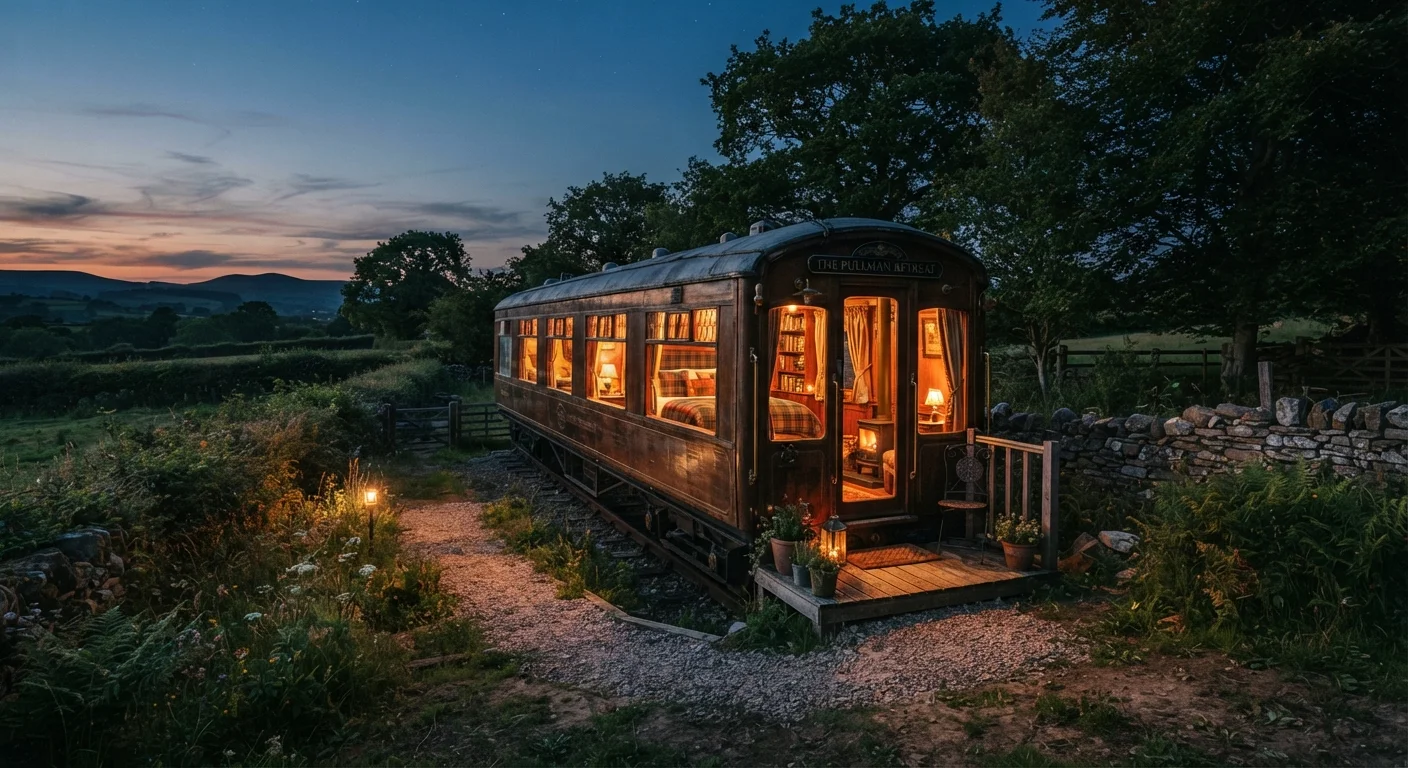
Photo credit: ExploreRoute.net | Travel Made Simple
In this article
Retired rolling stock turned into guest rooms sounds romantic — but there are practical quirks every traveller should know first.
Key Takeaways
- Converted train carriages offer an immersive, character-rich alternative to conventional hotel rooms.
- Spatial constraints — narrow corridors, compact bathrooms — are the most common guest adjustment.
- Location is frequently rural or semi-remote, which can be an asset or a logistical challenge depending on your plans.
- Noise, climate control, and accessibility vary widely between properties — always verify before booking.
- The experience rewards travelers who prioritize atmosphere over amenity uniformity.
Atmospheric interiors unlike any hotel room
Period detailing — original compartment doors, curved ceilings, brass hardware — creates a sense of place that modern builds cannot replicate. The carriage itself becomes the primary travel memory.
Strong privacy and self-contained setup
Most converted carriages house a single party with a private entrance, making them more secluded than boutique hotel rooms at a similar or lower price point.
Situated in genuinely scenic rural locations
Heritage rail corridors and rural estates offer countryside, coastal, or forest settings that mainstream hospitality rarely accesses.
Compact layout encourages slower, intentional travel
The contained space nudges guests toward spending time outside exploring surroundings rather than anchoring to a large room — a useful reframe for over-scheduled itineraries.
Often more affordable than comparable boutique stays
Despite the novelty factor, converted carriage accommodations frequently undercut the nightly rates of heritage hotels with equivalent character, though pricing varies widely by operator and region.
Narrow interior space requires adjustment
Standard passenger carriage interiors are roughly nine feet wide. Once a bathroom is fitted, the remaining layout can feel restrictive for two guests managing luggage and daily movement simultaneously.
Climate control is frequently limited
Original carriages were ventilated by movement, not fixed HVAC systems. Retrofit heating and cooling can struggle in seasonal extremes — a meaningful consideration for summer or winter bookings.
Accessibility is inconsistent and often poor
Steps up to carriage entrances, narrow door frames, and compact bathrooms can present genuine barriers. Accessibility retrofitting is not standardized, and operators should be contacted directly for specifics.
Remote location requires a vehicle for most guests
Very few carriage accommodations are reachable by public transit. Guests without a car may find themselves genuinely stranded, particularly for meals and day trips.
Ambient noise from the environment or neighboring properties
Rural settings can introduce unexpected noise — wind, wildlife, or farm activity — and thin carriage walls offer less sound insulation than masonry construction.
What a Converted Train Carriage Stay Actually Involves
At its core, a converted train carriage stay means sleeping in retired rolling stock — dining cars, sleeping coaches, or passenger carriages — that have been retrofitted as fixed guest accommodations. These aren't moving trains. The carriages are typically stationary on a short stretch of preserved track, in a rural yard, on a farm, or within a heritage railway site.
The conversion quality varies enormously. Some operators preserve period features — brass fittings, wood paneling, compartment doors — while updating plumbing and electrical systems. Others strip the interior and rebuild it as a contemporary space that simply happens to be shaped like a railway carriage. Understanding which type you're booking matters significantly to the experience you'll have. See our guide to booking unconventional stays for practical advice on vetting these properties before you commit.
The Real Advantages
Atmospheric interiors unlike any hotel room
Period detailing — original compartment doors, curved ceilings, brass hardware — creates a sense of place that modern builds cannot replicate. The carriage itself becomes the primary travel memory.
Strong privacy and self-contained setup
Most converted carriages house a single party with a private entrance, making them more secluded than boutique hotel rooms at a similar or lower price point.
Situated in genuinely scenic rural locations
Heritage rail corridors and rural estates offer countryside, coastal, or forest settings that mainstream hospitality rarely accesses.
Compact layout encourages slower, intentional travel
The contained space nudges guests toward spending time outside exploring surroundings rather than anchoring to a large room — a useful reframe for over-scheduled itineraries.
Often more affordable than comparable boutique stays
Despite the novelty factor, converted carriage accommodations frequently undercut the nightly rates of heritage hotels with equivalent character, though pricing varies widely by operator and region.
The most consistently cited advantage is immersion: the curved ceilings, the narrow corridor feel, the period hardware — all of it places you somewhere distinctly not a hotel room. For travelers who find standard accommodation forgettable, this specificity is the whole point. Converted carriages also tend to sit within genuinely interesting landscapes — heritage railway corridors often pass through countryside or coastal terrain that hotels rarely occupy.
Privacy is another underappreciated benefit. Most carriage accommodations house only one or two parties at a time, often in self-contained units with their own entrance. This can feel far more exclusive than a boutique hotel at a comparable price point. As part of the broader world of character-driven lodging, train carriage stays sit comfortably alongside historic hotels and converted heritage buildings — properties where the structure itself is the story.
The Practical Challenges Worth Knowing
Narrow interior space requires adjustment
Standard passenger carriage interiors are roughly nine feet wide. Once a bathroom is fitted, the remaining layout can feel restrictive for two guests managing luggage and daily movement simultaneously.
Climate control is frequently limited
Original carriages were ventilated by movement, not fixed HVAC systems. Retrofit heating and cooling can struggle in seasonal extremes — a meaningful consideration for summer or winter bookings.
Accessibility is inconsistent and often poor
Steps up to carriage entrances, narrow door frames, and compact bathrooms can present genuine barriers. Accessibility retrofitting is not standardized, and operators should be contacted directly for specifics.
Remote location requires a vehicle for most guests
Very few carriage accommodations are reachable by public transit. Guests without a car may find themselves genuinely stranded, particularly for meals and day trips.
Ambient noise from the environment or neighboring properties
Rural settings can introduce unexpected noise — wind, wildlife, or farm activity — and thin carriage walls offer less sound insulation than masonry construction.
The narrowness of a railway carriage is not a minor detail — it shapes every movement inside the space. A standard passenger coach is roughly nine feet wide internally, and once a bathroom is fitted, the remaining floor plan can feel genuinely tight for two people unpacking and moving around simultaneously. Guests who require step-free access or wider doorways should verify dimensions directly with operators, as accessibility retrofitting is inconsistent across properties.
Check Climate Conditions Before You Book
Carriage conversions vary significantly in their heating and cooling capabilities. A stay that feels perfectly comfortable in spring may be stuffy in July or drafty in January. Reading guest reviews from guests who stayed during your target season — not just the most recent reviews — gives a more accurate picture of thermal comfort. When in doubt, contact the operator directly and ask how the space performs in the season you're planning to visit.
Climate control deserves specific attention. Original carriages were built for a moving environment with mechanical ventilation from motion. Stationary conversions rely on added heating and cooling systems whose capacity can be limited, particularly in extreme seasonal temperatures. Checking guest reviews from the same season you plan to visit is one of the more reliable ways to gauge this.
Location: Asset or Obstacle?
Remoteness is both the appeal and the complication. Converted carriage sites are rarely near urban centers — they tend to occupy rail yards, rural estates, or working farms. For a digital-detox or countryside-immersion trip, this is precisely the point. For travelers who want day-trip access to towns, restaurants, or public transit, it can require careful planning around a personal vehicle.
~9 ft
Typical internal carriage width
Standard-gauge passenger carriages generally measure around 8.5–9.5 feet interior width, constraining bathroom footprints and overall floor plan flexibility in conversions.
3–5 units
Typical capacity per carriage site
Most converted railway accommodation sites operate fewer than six carriage units, contributing to the low-density, high-privacy character of the experience.
It's worth comparing this dynamic with other fixed-vessel stays: moored ships and converted barges as hotel accommodation often sit in harbor towns or city waterfronts, offering a different relationship with their surroundings. The carriage experience tends to be more deeply rural by nature. For a broader framework on managing the gap between expectation and reality in offbeat lodging, this honest look at where unique stays fall short is a useful counterweight to the romance of the concept.

Author
Where to Stay Editorial Team
Where to Stay Editorial Team is the collective byline for our editorial team and contributor network. Articles published under this byline or an editorial pen name are researched, written, and reviewed according to our editorial standards for clarity, consistency, and independence before publication.
View all articles →