
The Silk Road's Abandoned Caravanserais: Rest Stops at the Edge of Memory
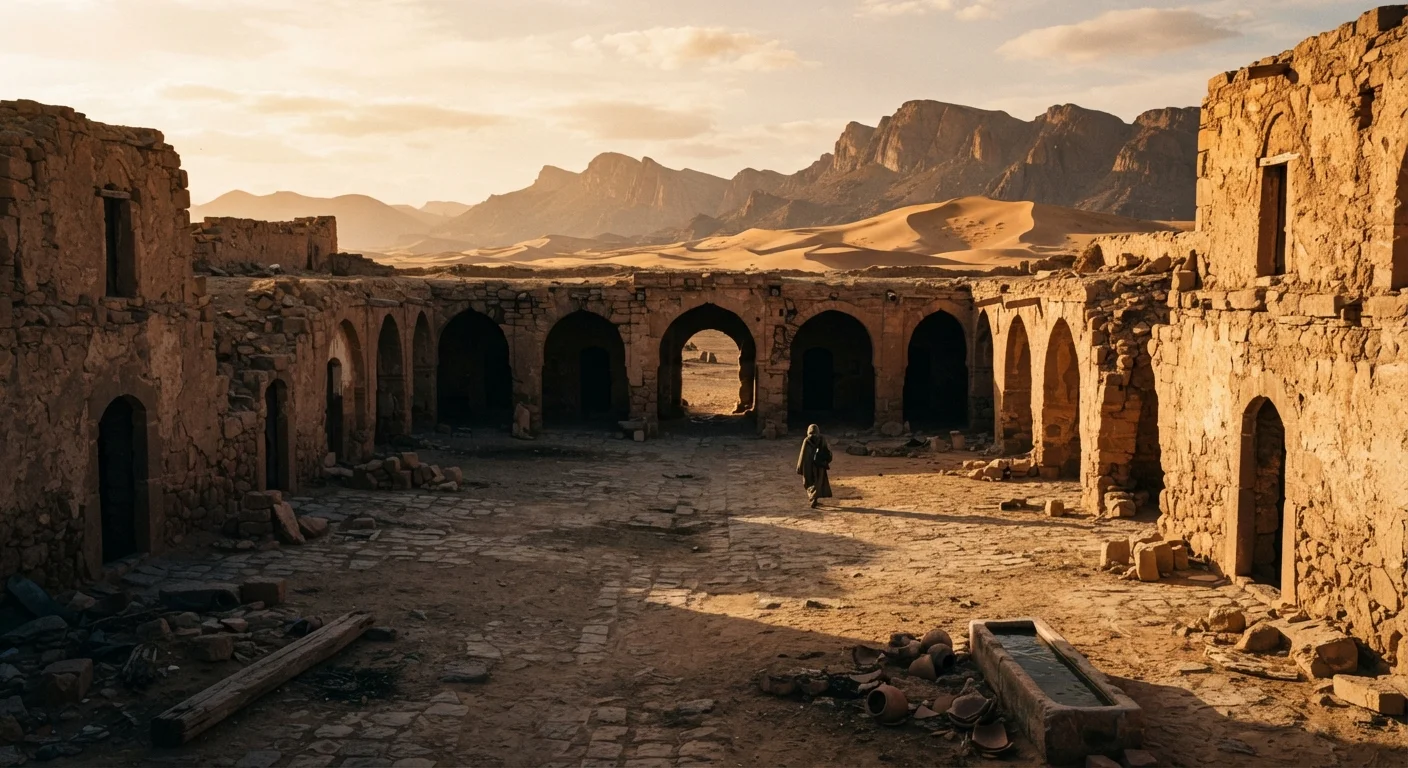
Photo credit: ExploreRoute.net | Travel Made Simple
In this article
Hundreds of caravanserais once lined ancient trade routes. The handful that survive offer an intimate glimpse into medieval commerce and mobility.
What a Caravanserai Actually Was
Before the age of highways and hotel chains, the caravanserai was one of the most consequential pieces of infrastructure on Earth. Spaced roughly a day's camel journey apart — typically 25 to 35 kilometers — these walled waystation complexes provided merchants, pilgrims, and diplomats with shelter, water, fodder for animals, and a degree of physical security during overland travel across Central Asia, the Middle East, Anatolia, and the Indian subcontinent.
| Peak construction period | 10th–17th centuries CE (Architectural and historical surveys of Islamic-period trade infrastructure) |
| Typical spacing between waystations | 25–35 km (one day's caravan travel) (Based on camel caravan daily range estimates in historical geography literature) |
| Surviving caravanserais in Iran | Approximately 800–1,000 (Iran Cultural Heritage Organization estimates; numbers vary by definition used) |
| Primary funding sources | State patronage (sultans, shahs) and private charitable endowment (waqf) |
| Notable concentration regions | Iran, Turkey (Anatolia), Uzbekistan, Afghanistan, Syria |
| UNESCO-listed examples | Several included within broader World Heritage Sites (e.g., Silk Roads: Routes Network of Chang'an-Tianshan Corridor) (UNESCO World Heritage List) |
At their architectural peak between the 10th and 17th centuries, caravanserais were not crude stopover sheds. Many featured vaulted iwans (arched porticos), central cisterns or pools, separate stabling wings, storage chambers for goods, and occasionally bathhouses and small mosques. Some were state-funded by sultans or Safavid shahs who understood that keeping trade flowing kept revenues flowing. Others were endowed by wealthy merchants as acts of public charity.
The word itself derives from the Persian kārwānsarā — kārwān meaning caravan, sarā meaning palace or enclosed court. That second word carries weight: these were not afterthoughts. They were deliberate, sometimes lavish investments in the idea that mobility was worth protecting. If you want to understand the Silk Road as an economic and cultural system rather than a romantic abstraction, the caravanserai is where to begin. For a broader grounding in reading such structures on site, interpreting architectural remains without a guide can sharpen what you notice when standing inside one.
Caravanserai
A walled waystation built along major trade and pilgrimage routes to shelter traveling merchants, their animals, and their goods. Most provided water, fodder, and basic security at no charge, funded by state or charitable endowment.
Iwan
A vaulted, three-walled hall open on one side, typically facing a central courtyard. The iwan is a defining element of Islamic architecture and appears prominently in caravanserai design across Persia and Anatolia.
Silk Road
A loose network of overland and maritime trade routes connecting China, Central Asia, the Middle East, and Europe, active from roughly the 2nd century BCE through the 15th century CE. The term itself was coined by a 19th-century German geographer.
Seljuk
A Turkic dynasty that ruled much of Central Asia and Anatolia from the 11th to 14th centuries. The Seljuks were prolific builders of caravanserais and are responsible for some of the finest surviving examples in Turkey and Iran.
Safavid
The Iranian dynasty that ruled Persia from 1501 to 1736 and oversaw extensive construction of caravanserais along major trade arteries. Shah Abbas I is credited with establishing a particularly dense network of state-funded waystations.
Robat
A Persian word for a small frontier fortification or waystation, often used interchangeably with caravanserai for smaller or more isolated examples. Sites bearing 'Robat' in their name are typically among the more remote and architecturally austere.
Surviving Sites Worth Seeking Out
Estimates suggest that between 800 and 1,000 caravanserais still stand in Iran alone — the country that arguably preserves the greatest concentration of Silk Road waystation architecture in the world. The Robat Sharaf complex in Khorasan province, constructed during the Seljuk period in the 12th century, contains two attached courtyards and elaborate stucco decoration that has, astonishingly, survived intact in places. Visitors who reach it encounter a building that has not been heavily reconstructed and whose silence feels earned rather than staged.
~1,000
Caravanserais surviving in Iran alone
Iran's Cultural Heritage Organization has documented close to one thousand surviving caravanserai structures, the largest national concentration in the world.
13th century
Date of Sultanhanı Caravanserai, Anatolia
Built under the Seljuk Sultanate of Rum, Sultanhanı is among the largest and best-preserved caravanserais in Turkey.
3,000+ years
Age of overland Silk Road trade
Overland trade along routes connecting China and the Mediterranean is documented across roughly three millennia, with caravanserais appearing as infrastructure matures in the medieval period.
In Anatolia, Turkey preserves the Sultanhanı Caravanserai near Aksaray — one of the largest surviving examples, built under the Seljuk Sultanate of Rum in the 13th century. Its monumental stone portal and colonnaded interior have been partially restored, which makes it more legible to first-time visitors than the more fragmentary Iranian sites. The tradeoff is that it receives tourist buses; arriving at dawn or late afternoon shifts the experience considerably.
Uzbekistan offers caravanserai remnants woven into the fabric of cities like Bukhara and Samarkand, where the old trading district of Bukhara's Tim Abdullah Khan still functions partly as a covered bazaar. The bones of the caravan economy are still visible in the architecture if you look past the souvenir stalls. Considering how accessibility and remoteness shape these experiences is worth thinking through — weighing remote access against easier infrastructure before committing to an itinerary.
These sites don't appear on most American travelers' radars for reasons that go beyond geography. Funding gaps and shifting tourism trends have quietly erased once-celebrated ruins from collective awareness, and caravanserais have suffered this fate acutely. They lack the pyramidal drama of more famous ruins; their power is horizontal, spatial, and contextual. Like the lost cities that history nearly erased, their stories require some preparation to hear clearly.
Practical Considerations for the Independent Traveller
Entry requirements, visa conditions, and travel advisories for Iran, Uzbekistan, and parts of Turkey change periodically. Always verify current entry rules, any applicable safety advisories, and vaccination requirements through official government sources — the U.S. State Department's travel.state.gov and the destination country's official embassy websites — well before departure. Do not rely on third-party travel blogs or this article for definitive entry or safety information.
Seasonality matters considerably at these sites. Many caravanserais sit in arid or semi-arid landscapes where summer temperatures can be extreme and where facilities — restrooms, potable water, shade — may be minimal or absent. Spring (March through May) and autumn (September through November) are generally more comfortable windows for visiting sites in Central Asia and Anatolia, though conditions vary by elevation and specific location.
Most surviving caravanserais are not staffed interpretation centres. A field-ready reference for independent travellers can help you arrive with the cultural and architectural context needed to make sense of what you're seeing. Consulting academic or institutional sources — university archaeology departments, UNESCO documentation, national heritage agencies — before your trip rewards you with a literacy that no on-site placard can provide.
Accommodation in the vicinity of remote caravanserai sites can range from small guesthouses in nearby villages to longer drives back to regional cities. For travelers drawn to lodging that itself carries historical atmosphere, unconventional stays in the region occasionally include converted historic structures. Road access to the more remote sites often requires a capable vehicle and a locally obtained map or guide — lesser-known scenic drives through these landscapes can transform a site visit into a sustained journey through the same corridors the caravans once traveled.

Author
Hidden Destinations Editorial Team
Hidden Destinations Editorial Team is the collective byline for our editorial team and contributor network. Articles published under this byline or an editorial pen name are researched, written, and reviewed according to our editorial standards for clarity, consistency, and independence before publication.
View all articles →