
Forgotten Historic Sites: A Field-Ready Reference for the Independent Traveller
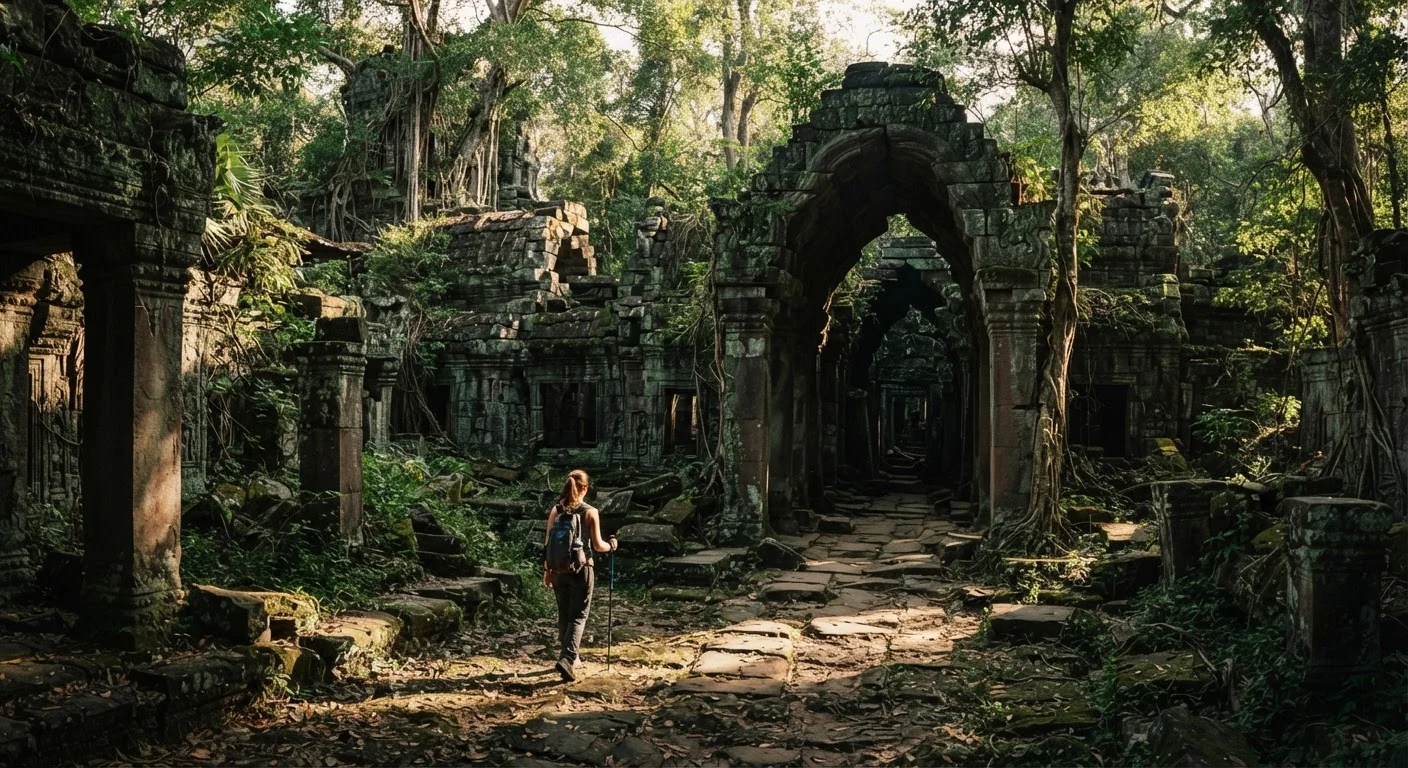
Photo credit: ExploreRoute.net | Travel Made Simple
In this article
- What We Mean by 'Forgotten' Historic Sites
- Core Terminology Every Independent Traveller Should Know
- Site Categories and What They Signal on the Ground
- Access Frameworks: Permits, Custodians, and Grey Zones
- Cultural Context and Ethical Conduct at Sensitive Sites
- Practical Orientation: Reading a Site Without a Guide
- Before You Arrive: Verification and Safety Baselines
Key terms, site categories, access frameworks, and cultural context — a compact reference for travellers exploring ancient ruins and lost cities on their own.
Key Takeaways
- Forgotten historic sites vary widely in legal access status, physical safety, and custodial oversight — research all three before visiting.
- UNESCO listing is one of several heritage frameworks; many significant sites carry national or indigenous designations that carry equal legal weight.
- The absence of signage, fencing, or entry fees does not mean a site is freely or legally open to visitors.
- Cultural sensitivity and minimal-impact conduct are not optional courtesies — they are ethical obligations at living heritage sites.
- Independent travellers benefit most from learning basic site-reading skills before they arrive, not after.
What We Mean by 'Forgotten' Historic Sites
The word forgotten does a lot of work in heritage travel, and it is worth unpacking before you pack a bag. A site rarely disappears from human memory entirely; it typically fades from mainstream tourism circuits because of funding gaps, political instability, limited infrastructure, or simply the gravitational pull of more famous neighbours. What causes once-celebrated ruins to fade from public attention involves intersecting pressures that are worth understanding before you travel.
For the purposes of this reference, a forgotten historic site is any archaeological, architectural, or cultural heritage location that lacks regular organised tourism — meaning no permanent visitor centre, no routine guided-tour infrastructure, and no meaningful presence in mainstream travel media. These sites may be legally managed, partially excavated, actively contested, or simply unmarked. That spectrum matters enormously to how you plan and behave as a visitor.
Travellers who seek out small towns and villages that most visitors overlook often stumble upon precisely these kinds of sites — a Roman-era wall embedded in a municipal car park, a pre-Columbian earthwork visible only from a ridge above town, a medieval monastery accessible only via an unmarked track. The reference framework below is designed to help you move through these encounters with knowledge rather than assumption.
Core Terminology Every Independent Traveller Should Know
- Archaeological site
- A location containing physical evidence of past human activity, typically beneath or at ground level. May be actively excavated, stabilised, or entirely unmanaged.
- Heritage site
- A broader category encompassing archaeological sites, historic structures, cultural landscapes, and intangible heritage. Designation can come from international bodies, national governments, or indigenous communities.
- In situ preservation
- The practice of conserving artefacts and structures in their original location rather than removing them. Most modern heritage frameworks prioritise this approach.
- Scheduled monument / listed structure
- Legal designations (terminology varies by country) indicating that a site is formally protected. Interference, excavation, or removal of material from a scheduled monument is typically a criminal offence.
- Living heritage site
- A site that remains in active ceremonial, spiritual, or community use by a contemporary population. Visitor conduct expectations here differ significantly from purely archaeological sites.
- Vernacular architecture
- Structures built using local traditions and materials, without professional architectural design. Often overlooked in favour of monumental remains, but frequently as historically significant.
- Stratigraphy
- The layering of soil and debris deposits over time. Understanding stratigraphy helps travellers appreciate why a site looks the way it does — what is exposed is rarely the oldest layer.
Before visiting any lesser-known site, contact the relevant national heritage authority directly — not through a travel aggregator — to confirm both the current permit process and whether the site is actively monitored. A five-minute email often reveals access details that no travel forum has documented.
Heritage authorities frequently update access rules in response to excavation schedules, conservation work, or seasonal closures, and these changes rarely propagate to third-party travel resources in time to be useful.
Carry a printed topographic map of the region surrounding any remote site, not just a digital pin of the site itself. Understanding the broader landscape — valleys, ridgelines, road networks — gives you spatial context that helps both navigation and site interpretation.
Remote historic sites often sit within landscapes that were themselves historically functional — trade corridors, defensive networks, agricultural territories — and a topographic view reveals those relationships in ways a zoomed-in site map cannot.
Site Categories and What They Signal on the Ground
Not all historic sites are the same kind of place, and the category determines almost everything about what you can reasonably expect to encounter.
- UNESCO World Heritage Sites — internationally recognised properties assessed against specific cultural and natural criteria. Many are well-managed; some in developing regions or conflict-affected areas are not. Listing does not guarantee infrastructure or safety.
- National-register sites — protected under a country's own heritage legislation. Entry rules, permit requirements, and enforcement vary widely between jurisdictions.
- Undesignated but archaeologically significant sites — known to researchers and sometimes to local communities, but carrying no formal legal protection. These are among the most ethically fraught to visit independently.
- Indigenous sacred or ancestral sites — may or may not overlap with the categories above. Access is often governed by community protocols rather than government permit systems. Treat these with the highest degree of deference.
- Subterranean sites — buried streets, cave dwellings, and ancient aqueducts present specific physical risks alongside their historical richness. Subterranean historic sites worth seeking out require specialist preparation beyond what surface-level ruin visits demand.
Undesignated Does Not Mean Unprotected
A site that carries no UNESCO or national-register designation may still be protected under local, regional, or indigenous law. In some jurisdictions, any disturbance of ground containing archaeological material — regardless of formal designation — is a criminal offence. Always research the legal framework of the country and region you are visiting before assuming that an unmarked site is freely accessible.
Access Frameworks: Permits, Custodians, and Grey Zones
The single most common mistake independent travellers make is conflating physical access with legal or ethical permission. A site that is unfenced, unmarked, and seemingly unattended is not necessarily open. Assumptions that ruin a visit to a forgotten historic site are often rooted in exactly this conflation.
Access at lesser-known sites typically falls into one of three frameworks:
- Formal permit systems — issued by a national ministry, regional authority, or archaeological commission. Some require advance written application weeks ahead; others are granted on the day at a local office. Research which applies to your destination.
- Custodian or community-based access — a local family, tribal council, or village committee controls entry. Payment (where culturally appropriate) goes directly to that community. This is often the most sustainable access model for both site and traveller.
- De facto open access — sites where no enforcement exists and no clear authority is present. Visiting these sites without attempting to identify and honour any legitimate custodian is ethically problematic, regardless of physical ease of access.
When planning accommodation near heritage destinations, it is worth considering that hotels closest to heritage attractions aren't always the most practical — particularly when the site itself has no facilities and the nearest town is the only base for permit collection or local guidance.
Cultural Context and Ethical Conduct at Sensitive Sites
Every forgotten site carries a living legacy, even when the civilisation that built it is long gone. Descendant communities, researchers, and local populations all hold relationships to these places that predate and outlast any traveller's visit. Ethical conduct begins with that recognition.
Living Heritage Requires Living Sensitivity
Sites that remain in active ceremonial or spiritual use by contemporary communities are not outdoor museums. Protocols around photography, clothing, approach paths, and permitted areas are set by those communities, not by travel conventions. When in doubt, ask a community member — and accept a 'no' without negotiation. Respectful conduct at living heritage sites is one of the clearest markers of an experienced independent traveller.
Practical conduct guidelines that apply across most heritage contexts:
- Do not remove any material — including fragments that appear incidental. In most jurisdictions this is illegal; in all contexts it is destructive.
- Stay on established paths where they exist. Ground disturbance at unexcavated sites can destroy stratigraphic context that researchers have not yet documented.
- Photograph with awareness. Some living heritage sites prohibit photography entirely, or restrict it to non-ceremonial areas. Ask before you point a lens.
- Manage your group size. Large groups cause erosion and overwhelm sites not designed for visitor traffic.
- Leave no waste. The absence of bins at a remote site is not an invitation to improvise.
Travellers who develop the habit of reading ancient ruins without a tour guide — interpreting stonework, street grids, and spatial organisation independently — often find they need less physical intervention to engage deeply with a site.
Practical Orientation: Reading a Site Without a Guide
Arriving at an unmarked ruin without interpretive materials is the norm rather than the exception at forgotten historic sites. Developing a methodical orientation process transforms that absence from frustration into independence.
Begin at the perimeter. Walk the boundary of what is visible before entering the centre. This gives you a sense of scale, identifies where structure concentrates, and reveals water sources, terrain features, and approach routes that often explain why the site exists where it does. Human settlement is rarely arbitrary — proximity to water, defensible high ground, and agricultural lowland are recurring locational logics across cultures and centuries.
Look for evidence of phasing — the way a site grew and changed over time. Walls that abut rather than bond with each other indicate different construction periods. Blocked doorways, repurposed column drums, and inconsistent stone-coursing all tell chronological stories. Interpreting architectural remains becomes more intuitive the more sites you visit, but a basic vocabulary helps from the start.
The backroads and scenic drives that lead to many forgotten sites often pass through landscapes that were themselves historically significant — river crossings, mountain passes, and ancient trade routes. Slowing down on the approach is part of the interpretive process.
Over 1,100
UNESCO World Heritage Sites globally
As of the most recent UNESCO count, more than 1,100 properties hold World Heritage status — yet countless thousands of archaeologically significant sites carry no international designation at all.
~40%
Heritage sites at risk from inadequate management
UNESCO and ICOMOS assessments have consistently indicated that a significant proportion of listed and unlisted heritage sites face threats from under-resourcing, climate change, or unregulated visitor pressure.
Before You Arrive: Verification and Safety Baselines
Independent travel to obscure historic sites demands a higher preparation threshold than standard tourism. The pre-visit checklist for obscure historic sites covers the essentials in full, but the core baseline includes: confirmed permit status, current access conditions from a source no older than 60 days, identified emergency contacts in the nearest populated area, and a communicated itinerary left with someone not travelling with you.
For anything related to entry requirements, health precautions, or travel advisories, always verify directly with official government sources and relevant embassies before travel. Conditions at remote heritage sites can change with little notice — seasonal flooding, structural instability, or political changes can close a site or make the approach genuinely hazardous. No article, guidebook, or forum post can substitute for current, official information.
Travellers comfortable navigating the outdoor dimensions of remote access may find useful overlap with adventure travel terminology — particularly concepts around exposure, bail points, and terrain assessment that apply equally to steep archaeological sites as to mountain trails.
This article is for general informational and educational purposes only. Travel conditions, access permissions, legal designations, and safety situations at historic sites can change without notice. Always verify entry requirements, permit rules, and travel advisories with official government and local authorities before visiting any destination.

Author
Hidden Destinations Editorial Team
Hidden Destinations Editorial Team is the collective byline for our editorial team and contributor network. Articles published under this byline or an editorial pen name are researched, written, and reviewed according to our editorial standards for clarity, consistency, and independence before publication.
View all articles →