
Cave Systems vs. Open Karst Landscapes: Two Very Different Underground Worlds
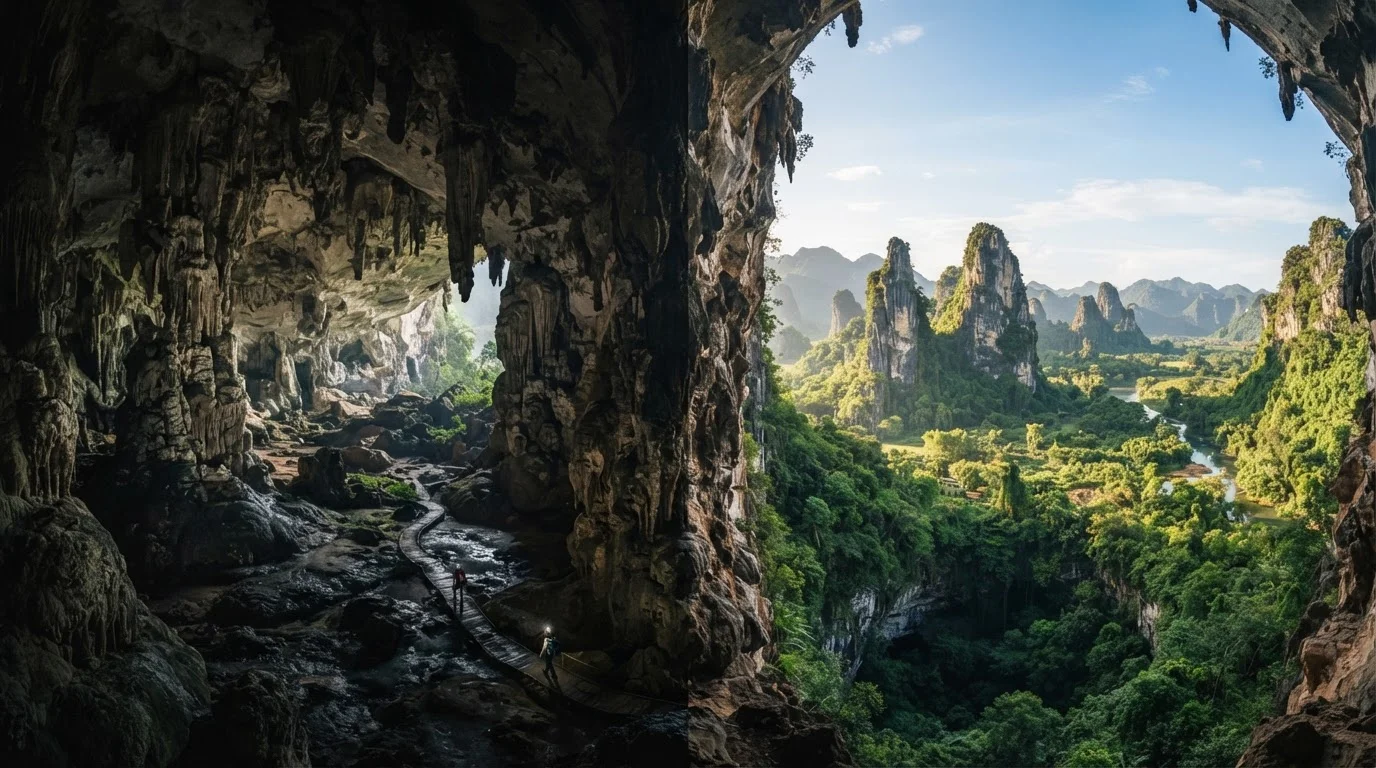
Photo credit: ExploreRoute.net | Travel Made Simple
In this article
Karst terrain creates wildly different natural spectacles above and below ground. Here's how the two differ and what each offers the curious traveller.
Key Takeaways
- Both cave systems and open karst landscapes are formed by the same dissolution of soluble rock, primarily limestone.
- Cave systems offer enclosed, guided, or technical exploration — access and difficulty vary widely by site.
- Open karst landscapes like tower karst or alvar plains are navigable above ground and often require no specialist equipment.
- Seasonal flooding, fragile ecosystems, and limited infrastructure make planning essential for both terrain types.
- Each landscape type suits a distinctly different travel temperament — knowing which you are shapes a better trip.
The Same Rock, Two Entirely Different Worlds
Karst is not a place — it is a process. When slightly acidic rainwater dissolves soluble bedrock such as limestone, dolomite, or gypsum over millions of years, it sculpts terrain into forms that defy ordinary landscape logic: hollows appear where solid ground once was, rivers vanish underground, and stone towers rise from flat plains like monuments to geological patience.
What separates cave systems from open karst landscapes is fundamentally a question of where that dissolving work happened most dramatically — below the surface or above it. The same chemistry, vastly different results. Both reward the traveler who takes time to understand what they are looking at, but they demand different preparation, different tolerances, and different expectations.
For context on how subterranean geology intersects with human history, see our guide to subterranean historic sites — a reminder that humans have been reading karst landscapes for millennia.
| Criterion | Cave Systems | Open Karst Landscapes |
|---|---|---|
| Primary environment | Underground, enclosed passages | Surface terrain, open air |
| Access requirements | Guided tours or technical training | Generally self-guided, good footwear |
| Visitor caps | Common; often strictly enforced | Rare; most sites open access |
| Photography conditions | Low light; tripod often essential | Natural daylight; golden hour rewarding |
| Physical challenge | Ranges from easy walks to strenuous crawls | Uneven surfaces; fissures require care |
| Seasonal considerations | Year-round stable temperature inside | Weather-dependent; flooding risk in wet season |
| Wildlife encounters | Bats, cave fish, endemic invertebrates | Surface species; rare karst-endemic plants |
| Conservation sensitivity | Extremely high; formations irreversibly damaged | High; slow-growing plant communities vulnerable |
Inside the Mountain: What Cave Systems Actually Offer
A cave is not simply a hole in a hillside. Fully developed cave systems — the kind formed by centuries of subterranean water movement — can extend for hundreds of kilometers, dropping through multiple levels and harboring their own microclimates, hydrology, and biology. The world's longest surveyed cave system, Mammoth Cave in Kentucky, stretches beyond 650 kilometers of mapped passage, and researchers continue to document new sections.
What strikes most first-time cave visitors is not the formations — though stalactites, stalagmites, helictites, and cave pearls are genuinely extraordinary — but the silence and the darkness. True cave darkness, with no light source, is disorienting in ways daylight travelers rarely encounter. That sensory removal creates an intimacy with geological time that few surface landscapes can match.
Access ranges from wheelchair-accessible show caves with electric lighting and paved paths to technical wild caving routes requiring ropes, helmets, and specialist guidance. Planning matters enormously. If you are drawn to cave-adjacent stays, our checklist before booking a cave hotel covers what to verify before you commit. And for the broader world of unconventional underground accommodation, our field guide to unconventional stays places cave dwellings in useful company.
650+ km
Surveyed length of Mammoth Cave, Kentucky
Mammoth Cave is the world's longest known cave system, according to the National Park Service, with new passages still being mapped.
~15%
Earth's land surface underlain by karst
Estimates from karst hydrogeology research suggest roughly 15% of the planet's ice-free land sits atop karst bedrock, supporting around a quarter of global freshwater supply.
1,000s
Cenotes mapped in Mexico's Yucatán Peninsula
The Yucatán's karst geology has produced thousands of sinkholes and flooded cave openings, many interconnected through vast underwater cave networks.
Open to the Sky: Reading Karst Landscapes Above Ground
Where erosion has stripped surface rock rather than tunneled beneath it, karst reveals itself as a landscape of strange, sculptural beauty. Tower karst — the soaring limestone pinnacles rising from flat plains, most famously seen around Guilin and Yangshuo in China's Guangxi region — forms when dissolution lowers the surrounding terrain while isolated masses of harder rock resist. The result is one of the most photographed landscapes on Earth, yet most visitors experience it only from a cruise boat rather than on foot between the towers themselves.
In Ireland, the Burren presents a different karst face entirely: a vast, fissured limestone pavement stretching across County Clare, where Arctic, Mediterranean, and Alpine plants somehow coexist in the rock cracks, exploiting the microclimate created by the stone itself. There are no ropes, no helmets, no guides required — just careful footwear and awareness that the fissures, called grikes, can be ankle-deep and irregular underfoot.
Sinkholes — circular depressions where cave roofs have collapsed — are another open karst feature that travelers encounter without necessarily recognizing them. Mexico's Yucatán Peninsula is dense with cenotes, flooded sinkholes that serve as swimming holes, dive sites, and, in the case of Chichén Itzá's Sacred Cenote, significant archaeological sites.
Cenotes, Blue Holes, and Flooded Karst
Not all karst features are dry. When cave roofs collapse and the resulting sinkholes fill with groundwater, they create cenotes, blue holes, or flooded cave systems — some of the most biodiverse and archaeologically significant aquatic environments on Earth. The underwater cave networks beneath the Yucatán Peninsula extend for hundreds of kilometers and require full cave-diving certification to explore safely. Surface swimming in accessible cenotes is common, but any overhead diving environment demands specialist training — general open-water dive qualifications do not apply.
For travelers who enjoy connecting karst landscapes by road, our hidden scenic drives hub surfaces routes that pass through less-visited karst regions across the US and beyond.
Choosing Your Karst Adventure: Practical Differences That Matter
The choice between cave and open karst is partly temperamental and partly logistical. Caves require you to accept someone else's schedule if you are using guided tours, limited natural light for photography, and in some systems, physical demands like crawling or wading. Many important caves impose strict visitor caps to protect fragile formations and endemic species — the Altamira cave paintings in Spain, for instance, are accessible only through a museum replica, the original being closed to routine visitation.
Open karst landscapes offer more autonomy. You move at your own pace, return at different times of day to catch changing light, and rarely face the same access bottlenecks. The tradeoff is exposure to weather and, in some regions, the challenge of navigation across terrain that looks deceptively flat but hides sudden drops, unstable surfaces, and seasonal flooding.
Both environments carry conservation responsibilities. Cave ecosystems are extraordinarily fragile — a single human handprint on a speleothem (a mineral deposit like a stalactite) can halt its growth by introducing oils and bacteria. Open karst pavement and alvar habitats host plant communities that have taken centuries to establish. Staying on marked paths, respecting closures, and following guide instructions are not bureaucratic inconveniences; they are the difference between these places persisting for future travelers or not.
For visitors who enjoy pairing landscape exploration with unconventional accommodation, matching landscape to lodging style offers a useful framework across terrain types well beyond karst. And if the archaeology dimension of cave visits interests you, the contrast explored in preserved ghost towns versus active dig sites mirrors some of the same access and expectation dynamics found underground.
Travel conditions, access rules, and site availability vary by location and season. Always verify current entry requirements, safety advisories, and site regulations with official local authorities before visiting any natural site.

Author
Hidden Destinations Editorial Team
Hidden Destinations Editorial Team is the collective byline for our editorial team and contributor network. Articles published under this byline or an editorial pen name are researched, written, and reviewed according to our editorial standards for clarity, consistency, and independence before publication.
View all articles →