
Neck Pillows, Eye Masks, and Noise-Cancelling Headphones: Do They Earn Their Place in Your Bag?
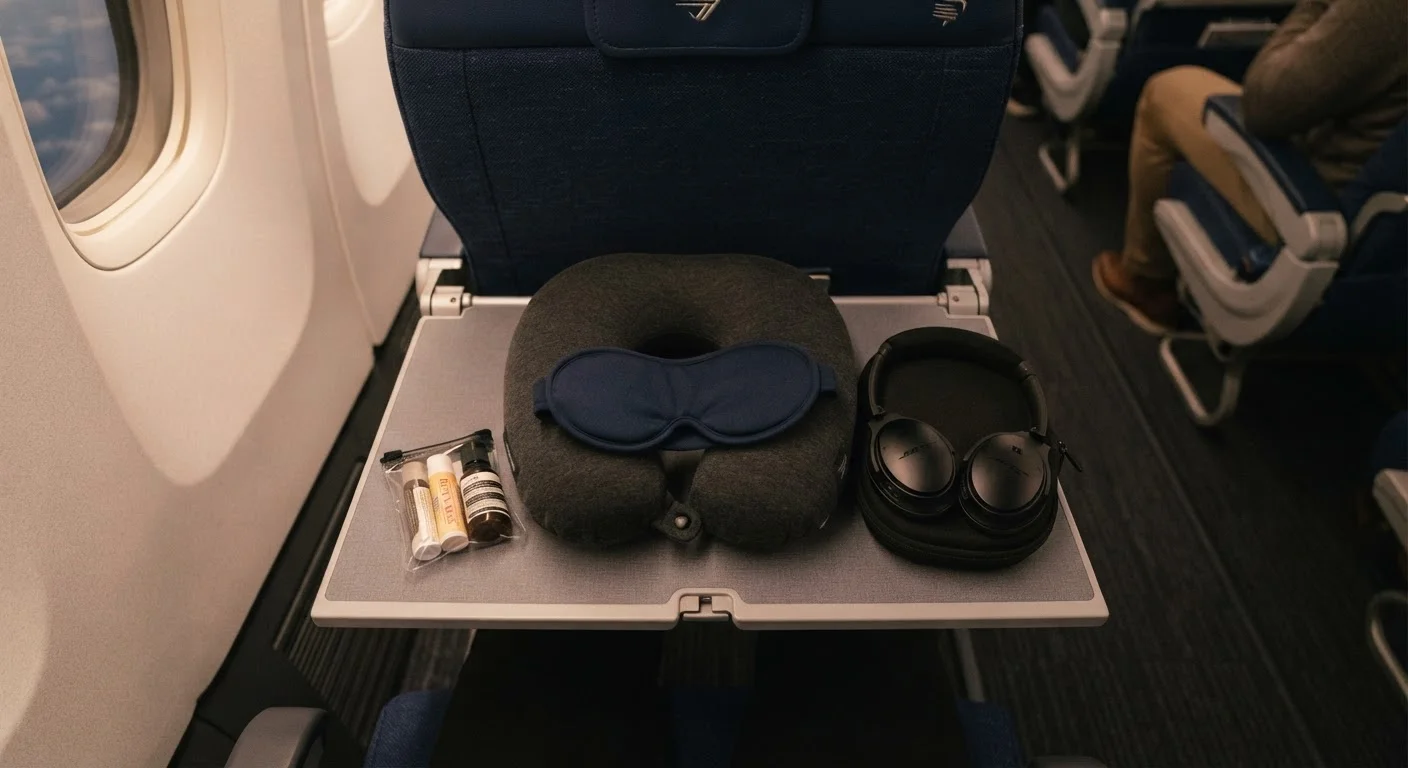
Photo credit: ExploreRoute.net | Travel Made Simple
In this article
An honest look at the most popular in-flight comfort accessories — what each one actually does well and where it falls short.
Key Takeaways
- Noise-cancelling headphones deliver the most consistently measurable comfort benefit of the three accessories.
- Eye masks are highly effective for light blocking but only useful if you can sleep on planes to begin with.
- Traditional U-shaped neck pillows have real ergonomic limitations; fit and fill level matter more than brand.
- Combined weight and bulk of all three items may not justify the trade-off on short or daytime flights.
- Each accessory addresses a different comfort variable — consider your personal sleep style before packing all three.
Headphones actively reduce fatiguing low-frequency cabin noise
Active noise-cancellation targets the engine drone that passive earplugs handle less precisely, lowering the sustained cognitive load of a long-haul flight.
Eye masks eliminate light without relying on crew or neighbors
Cabin lighting is rarely within your control; an eye mask gives you a consistent, personal blackout environment regardless of what other passengers do with window shades.
Neck pillows can prevent waking neck pain on overnight flights
For travelers whose head would otherwise fall unsupported during sleep, a well-fitted pillow reduces the muscle strain that causes stiffness on arrival.
Headphones improve focus and entertainment quality regardless of sleep
Even on daytime flights where sleep is not the goal, ANC headphones make movies, podcasts, and work audio noticeably clearer and less effortful to follow.
All three accessories are reusable across many trips
Unlike single-use comfort items, these accessories amortize their cost and environmental footprint over years of travel if maintained properly.
Eye masks are negligible in weight and pack size
A contoured eye mask adds almost no bulk to a carry-on and is one of the highest-utility-per-gram items a frequent flyer can bring.
Neck pillows are highly dependent on individual fit
The standard U-shape does not suit all body types or sleeping postures, and a poorly fitted pillow can actively worsen neck position rather than support it.
Quality ANC headphones add significant bulk and weight
Over-ear headphones occupy meaningful carry-on volume; travelers on short trips or tight packing constraints may not find the trade-off worthwhile.
Eye masks only help if you can fall asleep on planes
Light elimination is useful for sleep, but an eye mask does nothing to address turbulence anxiety, discomfort, or the physiological difficulty some people have sleeping upright.
Carrying all three adds combined weight and pack volume
On short-haul or daytime flights, the comfort return from three items may not justify displacing clothing or other essentials in a limited bag.
Headphone battery dependency creates a single point of failure
ANC performance drops or disappears when battery runs out; on very long flights without access to charging, this can become a real limitation.
The Case for Bringing These Accessories — and the Honest Caveats
In-flight comfort accessories have become standard carry-on fare, but frequent flyers know the difference between gear that genuinely improves a long-haul flight and items that end up stuffed at the bottom of a bag. Each of the three most popular accessories — neck pillows, eye masks, and noise-cancelling headphones — targets a different environmental problem in the cabin. Understanding what each one actually solves, and where it comes up short, is more useful than a blanket recommendation.
For a broader framework of what shapes how you feel at altitude, see the complete in-flight comfort overview, which covers physiology, environment, and equipment together.
Headphones actively reduce fatiguing low-frequency cabin noise
Active noise-cancellation targets the engine drone that passive earplugs handle less precisely, lowering the sustained cognitive load of a long-haul flight.
Eye masks eliminate light without relying on crew or neighbors
Cabin lighting is rarely within your control; an eye mask gives you a consistent, personal blackout environment regardless of what other passengers do with window shades.
Neck pillows can prevent waking neck pain on overnight flights
For travelers whose head would otherwise fall unsupported during sleep, a well-fitted pillow reduces the muscle strain that causes stiffness on arrival.
Headphones improve focus and entertainment quality regardless of sleep
Even on daytime flights where sleep is not the goal, ANC headphones make movies, podcasts, and work audio noticeably clearer and less effortful to follow.
All three accessories are reusable across many trips
Unlike single-use comfort items, these accessories amortize their cost and environmental footprint over years of travel if maintained properly.
Eye masks are negligible in weight and pack size
A contoured eye mask adds almost no bulk to a carry-on and is one of the highest-utility-per-gram items a frequent flyer can bring.
Noise-Cancelling Headphones: The Clearest Value Proposition
Aircraft cabin noise — primarily low-frequency engine roar — sits consistently in the 75–85 dB range during cruise, a level that causes measurable fatigue over a multi-hour flight. Active noise-cancellation (ANC) technology works by generating inverse sound waves to neutralize these low frequencies, and it does this particularly well. The result is a quieter perceived environment even before you play any audio.
The benefit is not purely subjective. Sustained exposure to cabin noise elevates cognitive load and disrupts sleep architecture. Reducing that input, even partially, lowers the sensory burden of a long flight. For a detailed look at aircraft noise sources and their effects, this guide to managing noise on long-haul flights is worth reading alongside this article.
The main drawback is bulk and cost. Quality ANC headphones are among the larger items you can carry, and the price gap between capable and mediocre noise-cancellation is real. Foam earplugs reduce overall volume but do not selectively target low frequencies the way ANC does — they are a lighter backup, not a direct substitute.
75–85 dB
Typical cruise-phase cabin noise level
Aviation engineering research consistently places cruise-phase cabin sound in this range, equivalent to a busy urban street sustained for hours.
~15–20 dB
Low-frequency noise reduction from quality ANC
Independent audio testing has found that well-designed active noise-cancelling headphones can reduce low-frequency ambient noise by roughly this margin in real-world environments.
Eye Masks: Simple, Light, and Conditional
An eye mask does one thing: block light. In a cabin environment where window shades are at the discretion of other passengers, overhead lighting is controlled by crew schedules, and screen glow from neighboring seats is constant, that single function is genuinely useful — but only for travelers who can fall asleep airborne in the first place.
Contoured masks that do not press directly on the eyelids tend to be more comfortable for longer wear and are less likely to disturb those sensitive to contact pressure around the eyes. Silk and foam options each have trade-offs in breathability versus compression. The accessory weighs almost nothing and packs flat, which means the cost-to-benefit ratio is favorable even if you only use it occasionally.
If in-flight sleep is the goal, an eye mask works best as part of a layered strategy. Sleeping on a plane: what actually works separates evidence-based techniques from popular myths and puts the eye mask in proper context alongside seat selection, timing, and behavior before boarding.
Eye Masks and Cabin Pressure Sensitivity
Some travelers with sinus congestion or eye pressure sensitivity find that certain contoured masks feel uncomfortable during ascent and descent when cabin pressure changes. If this applies to you, a lighter, less structured mask or simply a folded scarf used as a makeshift shade may be more tolerable. As with any comfort concern related to a medical condition, consult a qualified healthcare professional for personal guidance.
Neck Pillows: The Most Misunderstood of the Three
The traditional U-shaped neck pillow is the item most likely to disappoint. It was designed to support the head when sleeping upright, but the standard design pushes the head forward — the opposite of a neutral cervical position. Travelers who sleep with their head dropping to one side often find better results from a pillow worn with the opening at the back, or from a wrap-style design with more adjustable fill.
Fit relative to shoulder width and neck length matters considerably. A pillow that works well for one body type may do nothing useful for another. Inflatable versions reduce pack size but tend to offer less consistent support than memory foam. The honest assessment: neck pillows help a subset of travelers meaningfully and provide minimal benefit to the rest.
Seat recline also plays a role. Window seat vs. aisle seat on overnight flights explores how seat position affects your ability to sleep, which in turn determines whether a neck pillow has anything useful to do.
Neck pillows are highly dependent on individual fit
The standard U-shape does not suit all body types or sleeping postures, and a poorly fitted pillow can actively worsen neck position rather than support it.
Quality ANC headphones add significant bulk and weight
Over-ear headphones occupy meaningful carry-on volume; travelers on short trips or tight packing constraints may not find the trade-off worthwhile.
Eye masks only help if you can fall asleep on planes
Light elimination is useful for sleep, but an eye mask does nothing to address turbulence anxiety, discomfort, or the physiological difficulty some people have sleeping upright.
Carrying all three adds combined weight and pack volume
On short-haul or daytime flights, the comfort return from three items may not justify displacing clothing or other essentials in a limited bag.
Headphone battery dependency creates a single point of failure
ANC performance drops or disappears when battery runs out; on very long flights without access to charging, this can become a real limitation.
For a complete packing perspective — including what to wear, what to carry, and what to do before you board — the in-flight comfort checklist pulls these decisions into a single pre-flight reference.

Author
Smart Air Travel Editorial Team
Smart Air Travel Editorial Team is the collective byline for our editorial team and contributor network. Articles published under this byline or an editorial pen name are researched, written, and reviewed according to our editorial standards for clarity, consistency, and independence before publication.
View all articles →