
Window Seat vs. Aisle Seat on Overnight Flights
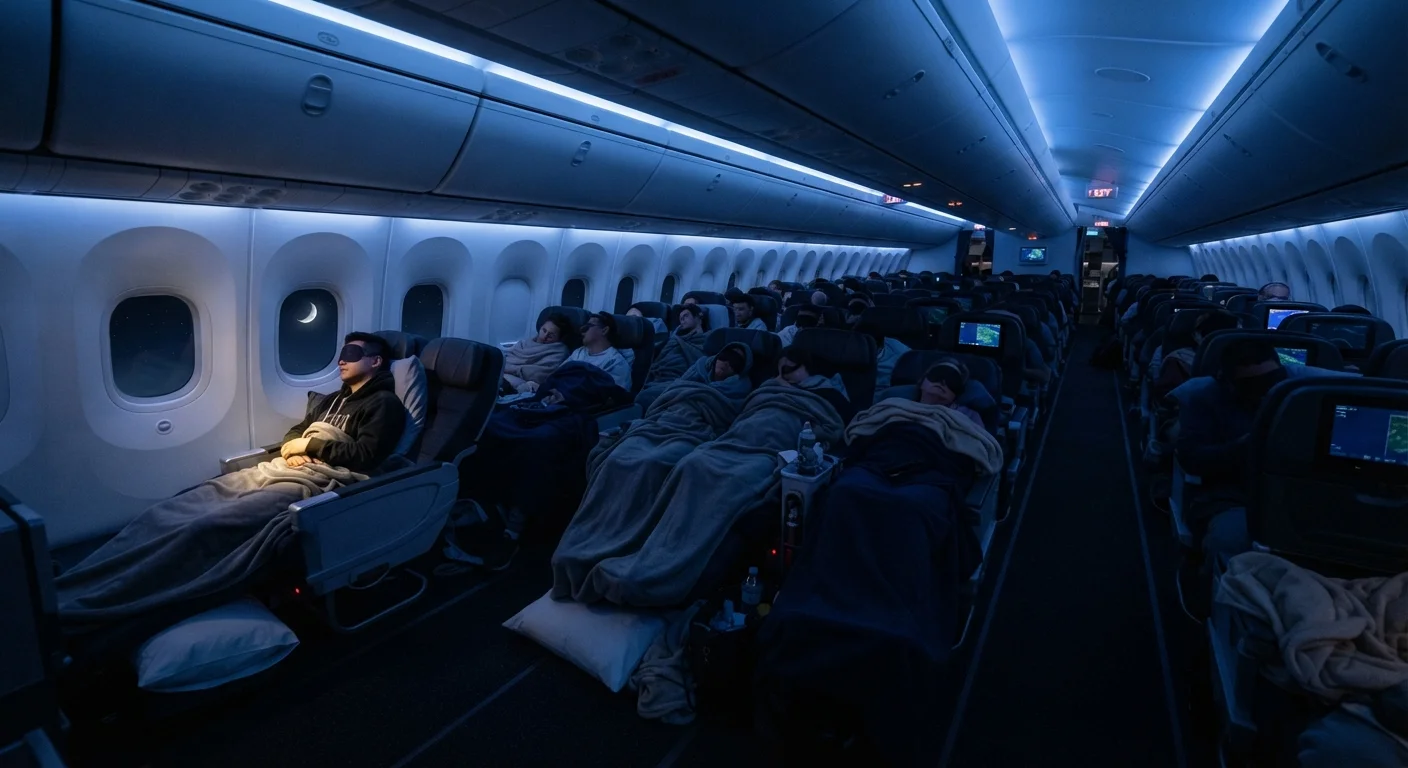
Photo credit: ExploreRoute.net | Travel Made Simple
In this article
Control over the shade or freedom to move without disturbing anyone? A focused comparison to help you decide based on how you actually sleep.
Key Takeaways
- Window seats give you full control over the window shade and a wall to lean against — two genuine sleep advantages.
- Aisle seats let you stand, stretch, and use the lavatory without disturbing seatmates, which matters more on overnight flights than day trips.
- Light sleepers are more vulnerable to aisle-seat disturbances: carts, passengers brushing past, and overhead light spills.
- Neither seat position eliminates the core challenge of sleeping upright — accessories and preparation matter alongside seat choice.
- Your natural sleep style (wall-leaner vs. restless mover) is the most reliable guide to which seat will actually work for you.
The Core Trade-Off: Containment vs. Freedom
On an overnight flight, the window vs. aisle decision is really a question about what disrupts your sleep more: being physically constrained, or being physically disturbed. Both seats have a genuine case — the mistake is treating the choice as trivial.
The window seat offers a wall, shade control, and a defined personal perimeter. You lean left, pull the shade, and nobody passes over you. The aisle seat offers exit rights — the ability to stand, walk, and use the lavatory at will without negotiating around sleeping neighbors. On a seven- or ten-hour flight, both of those things matter.
For a deeper look at how seat position fits into the broader picture of overnight flight preparation, see the complete in-flight comfort overview.
| Criterion | Window Seat | Aisle Seat |
|---|---|---|
| Sleep surface | Fuselage wall to lean against | No fixed surface; armrest only |
| Shade/light control | Full control over window shade | Dependent on window-seat neighbor |
| Lavatory access | Must wake 1–2 seatmates | Exit freely at any time |
| Movement & stretching | Constrained without disturbing others | Stand and walk at will |
| Aisle disturbances | Minimal; buffered by seatmates | Carts, crew, and passengers pass close |
| Overhead light exposure | Lower; away from main aisle zones | Higher; closer to crew lighting |
| Ideal sleep type | Still, lean-to-one-side sleepers | Restless, frequently waking travelers |
Window Seat: What the Data and Experience Actually Say
The strongest argument for the window seat is architectural: you have a fixed surface to rest your head against. Most travelers are side-sleepers or lean-sleepers, and the fuselage wall — padded with your own jacket or a neck pillow — replicates that. The aisle offers no equivalent surface.
Shade control is the second meaningful advantage. Cabin crew typically dim lights after meal service, but on east-to-west overnight routes, natural light can reappear well before your body is ready for it. Keeping the shade down is entirely within your control from a window seat; from the aisle, you're dependent on whoever is sitting by the window.
The limitation is immobility. If you need to use the lavatory mid-flight, you wake one or two people. On a full overnight flight, doing that twice becomes a social calculus that some travelers find genuinely stressful. That stress itself can undermine sleep quality.
Accessories help close the gap: a well-fitted eye mask and noise-cancelling headphones address two of the aisle's advantages from any seat. The honest assessment of in-flight comfort accessories breaks down where each item earns its carry-on space.
Aisle Seat: The Case for Mobility
Frequent flyers who prioritize circulation over containment consistently gravitate to the aisle — and for good physiological reasons. Sitting immobile for eight or more hours carries real circulatory implications, particularly for travelers with pre-existing conditions. The aisle removes the social barrier to standing up and moving.
8–10 hrs
Typical overnight long-haul flight duration
Most transatlantic and transpacific overnight flights fall in this range, making sustained immobility a genuine physiological concern rather than a minor inconvenience.
~90 min
Recommended movement interval on long flights
Aviation health guidance commonly suggests standing or walking briefly every 1–2 hours on long-haul flights to support circulation; aisle seats make this considerably easier to act on.
The aisle's vulnerabilities on overnight flights are well-documented among experienced travelers: galley carts pass close enough to brush elbows, flight attendants use flashlights that sweep the aisle, and passengers heading to the lavatory at 2 a.m. create an irregular but persistent series of small disturbances. Light sleepers feel all of these acutely.
If movement during the flight is a priority for you — whether for comfort or circulation — the practical in-flight movement routine offers a structured approach that works from either seat position, though it's considerably easier to execute from the aisle.
The deeper strategic question — how window, aisle, and middle interact with exit rows, bulkheads, and aircraft type — is covered in seat selection strategies for long-haul flights.
Making Your Decision: Know Your Sleep Profile
The most reliable selection framework isn't about the seat — it's about understanding your own sleep behavior on planes. Ask yourself two questions before booking: Do you typically sleep through a full night without waking, or do you wake and move repeatedly? And do you sleep better leaning against something fixed, or do you tend to shift positions?
If your honest answers are "sleep through" and "lean against something," the window seat is the structurally better match. If your answers are "wake and shift" and "can't stay still," the aisle protects the sleep of everyone around you — including yourself.
Either way, the seat selection is one variable among several. The evidence-based sleep strategies for flights article separates what genuinely improves in-flight sleep from common myths — worth reading alongside your seat decision rather than instead of it.
Seat Position and Circulation Risk
Travelers with a history of deep vein thrombosis (DVT), blood clotting disorders, recent surgery, or pregnancy face heightened considerations on long-haul flights. Seat position alone does not eliminate risk, and aisle access — while helpful for movement — is not a substitute for medical guidance. If you fall into any of these categories, consult a qualified healthcare professional before flying long-haul, and always verify current airline and medical guidance rather than relying solely on general information.

Author
Smart Air Travel Editorial Team
Smart Air Travel Editorial Team is the collective byline for our editorial team and contributor network. Articles published under this byline or an editorial pen name are researched, written, and reviewed according to our editorial standards for clarity, consistency, and independence before publication.
View all articles →