
Food Festivals vs. Everyday Eating: Two Very Different Windows Into a Culture
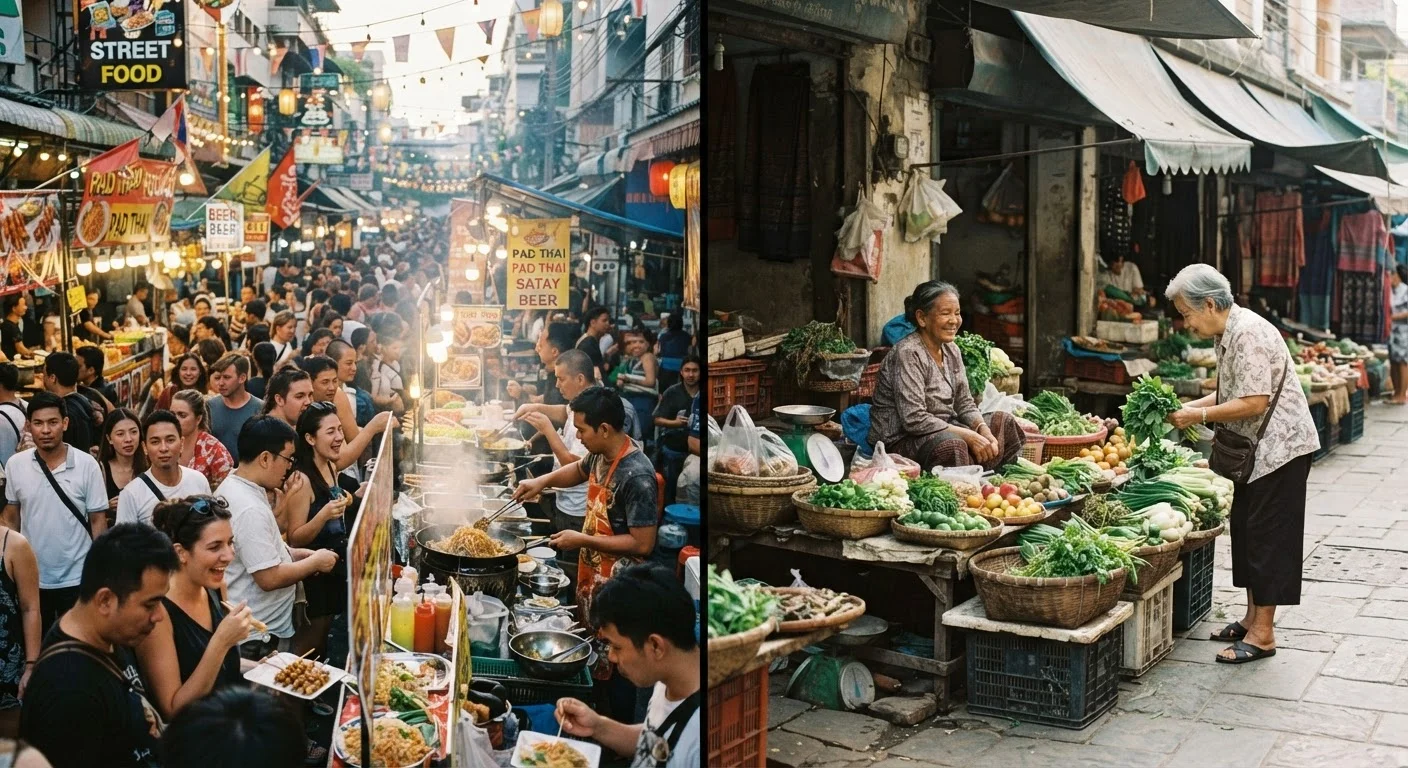
Photo credit: ExploreRoute.net | Travel Made Simple
In this article
Food festivals offer spectacle; daily markets offer truth. Understand the differences so you can choose the right experience for your travel style.
Key Takeaways
- Food festivals showcase cultural pride but are often curated, performative, and tourist-facing by design.
- Everyday eating — at markets, canteens, and neighborhood kitchens — reveals the unglamorous truth of a food culture.
- Both experiences have legitimate value; the key is knowing what each one can and cannot tell you.
- Festivals can introduce a food culture; daily routines are where you actually understand it.
- Displacement effects at festivals can price out locals, raising ethical questions for aware travelers.
- The most complete culinary picture combines both: festival spectacle paired with patient, daily observation.
What Food Festivals Actually Offer
A well-executed food festival is a genuine cultural statement. Events like the Salon du Chocolat in Paris, the Oaxacan Guelaguetza food program, or Malaysia's George Town Festival are built around real culinary heritage — not manufactured for tourists, but rooted in place. They bring together producers, chefs, and communities who might not otherwise share a single stage, and for an arriving traveler, that concentration of expertise is genuinely valuable.
But it's worth being honest about what a festival is: a curated performance of food identity. Dishes are selected for visual impact and broad palatability. Portions are miniaturized for tasting. Vendors are often chosen partly for presentation skills. The crowd shapes the atmosphere as much as the food does. None of this makes festivals inauthentic — it makes them a specific kind of truth, the truth a culture chooses to project about itself.
The practical upside is real: festivals let you survey a cuisine's range quickly, identify producers whose work you want to follow up on, and gain orientation that would otherwise take days of wandering to assemble. For travelers on tight itineraries, that efficiency matters.
| Criterion | Food Festivals | Everyday Eating |
|---|---|---|
| Curation level | High — selected for performance and appeal | Low — reflects actual supply and habit |
| Breadth of exposure | Wide — many dishes in one place | Narrow — one stall, one meal, one rhythm |
| Cultural authenticity | Curated projection of identity | Unfiltered daily reality |
| Accessibility for visitors | High — designed for newcomers | Variable — requires initiative and language |
| Economic impact on locals | Concentrated; displacement risk in some cities | Distributed; reaches deeper into local economy |
| Best for | Orientation and survey | Depth and genuine immersion |
What Everyday Eating Reveals
The morning vegetable market at 6 a.m., the canteen where office workers eat the same set lunch every weekday, the grandmother's stall that sells exactly one dish and has for thirty years — these are the sites where culinary culture becomes legible in a way festivals cannot replicate.
Everyday eating is unedited. What's available reflects what's actually in season, what the supply chain supports, what households can afford, and what tastes have endured across generations without the pressure to please strangers. When you watch a Bangkok family negotiate over which curry paste to buy, or observe how a Neapolitan baker handles dough at 5 a.m., you're witnessing knowledge that accumulated over centuries and was never designed for your observation.
This is also where the gaps in a culture's festival presentation become visible. Dishes too humble, too regional, too labor-intensive, or too tied to domestic life rarely make it onto a festival stage. Markets, homes, and street corners are where those stories live, and they reward patient, unhurried attention.
The challenge is that everyday eating requires more effort and tolerance for uncertainty. You may not share a language with the vendor. The menu may be handwritten and untranslated. The experience asks something of you that a festival, by design, does not.
The Ethical Dimension Travelers Often Overlook
Food festivals generate economic activity, but the distribution of that activity is uneven. In cities where culinary tourism has intensified — Bologna, Mexico City's Roma Norte, Chiang Mai's old city — festival-driven demand has contributed to rising rents that price out the very producers and family-run kitchens that gave those food cultures their reputation.
This isn't an argument against attending festivals. It's an argument for complementing them with spending patterns that reach further into the local economy. Culinary tourism can uplift or displace — often simultaneously — and aware travelers benefit from understanding that dynamic before they arrive.
Everyday eating, by contrast, tends to distribute spending more granularly: the market vendor, the neighborhood bakery, the family canteen. Those transactions are smaller individually but collectively more sustaining to a food culture's living infrastructure.
A Note on 'Authenticity'
The word authentic is doing a lot of work in culinary travel conversations — and it can mislead. Food cultures are not static; they evolve, absorb influences, and adapt to new conditions. A dish served at a festival isn't automatically inauthentic because it's presented for visitors, and a street stall isn't automatically more genuine simply because it's unglamorous. What the festival/everyday distinction really tracks is intentionality: who the food is made for, and under what conditions. Both matter. Neither tells the whole story alone.
Building a Smarter Culinary Travel Strategy
The most sophisticated food travelers don't choose between festivals and everyday eating — they use each to inform the other. A festival can serve as an initial survey: you taste broadly, note what surprises you, identify producers or dishes you want to pursue. The days that follow are where you chase those leads into the actual city — the neighborhood the chef mentioned, the market where a particular ingredient comes from, the unassuming lunch spot serving the same dish you paid a premium for at the festival stall.
If a festival isn't running during your visit, that's rarely a loss. The daily rhythm of a food culture is always present; it simply requires more initiative to access. Travelers miss genuine food culture most often not through bad luck but through defaulting to the most visible and convenient options — which, in almost every destination, skew toward tourist-facing experiences rather than lived ones.
For practical guidance on navigating daily food environments — from reading a market stall to assessing street food with confidence — see our related coverage on street food safety and awareness and guided tours versus self-directed eating.
~1 in 3
Travelers cite food as primary destination driver
The World Food Travel Association has consistently found food to be among the top motivators for destination selection among experienced international travelers.
6 a.m.
Typical opening hour of serious produce markets
Most wholesale and neighborhood food markets in Asia, Latin America, and Southern Europe operate at their most authentic and complete in the early morning hours, well before tourist foot traffic peaks.

Author
Specialty Travel Editorial Team
Specialty Travel Editorial Team is the collective byline for our editorial team and contributor network. Articles published under this byline or an editorial pen name are researched, written, and reviewed according to our editorial standards for clarity, consistency, and independence before publication.
View all articles →